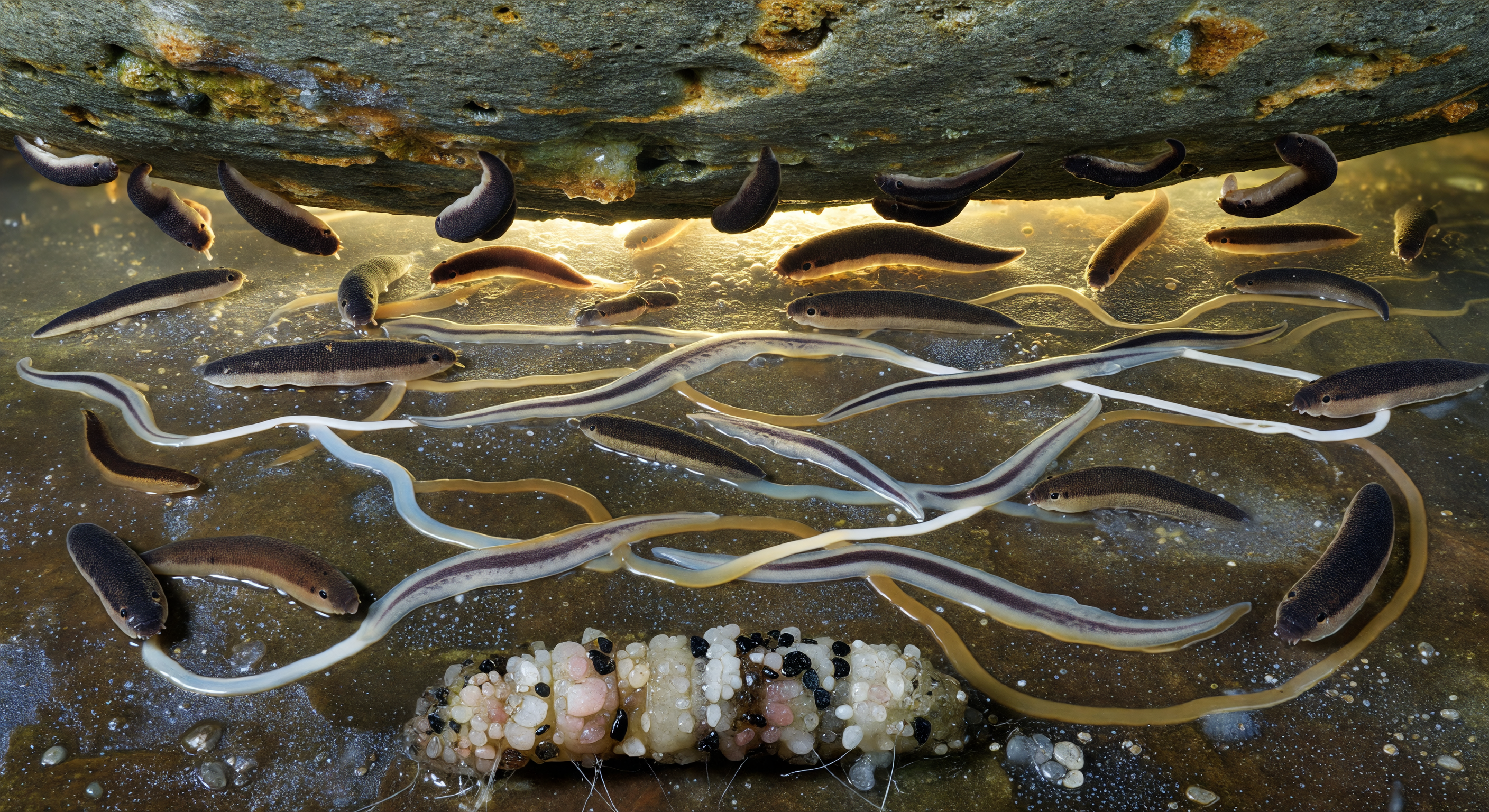
The underside of a lifted river cobble has become a sudden stage: twenty flatworm bodies ranging from a few millimeters to roughly two centimeters lie distributed across a biofilm plain of diatoms and bacterial mat, their dorsally dark forms now catching intrusive afternoon sunlight that pours in from the exposed stone margin as a violent gradient of white-gold fading into deep olive shadow. These are free-living turbellarian planarians — soft-bodied, bilaterally symmetrical animals navigating the world through ciliary gliding across mucus secretions, guided by primitive ocelli that register light intensity rather than images, and already the phototactic response is visible: animals at the illuminated margins are contracting and reversing within seconds, longitudinal muscles bunching the tissue into visible waves, while those deeper in shadow continue to extend forward in tapered ribbons, their translucent posterior margins faintly ghosting the branching gut diverticula beneath. The mucus trail network left by their nocturnal movements covers the biofilm floor in overlapping arcs of iridescent secretion — fresh trails raised slightly above the substrate surface and catching lateral light as bright silver ribbons, older trails already colonized by bacteria and matte with amber tone — a chemical and structural record of hours of movement suddenly made visible. At the lower frame, a caddisfly larval case rises as a rough cylinder of sand grains cemented in silk, each quartzite and feldspar grain glinting with its own mineral facet, a structure orders of magnitude more massive than the flatworms beside it, the entire scene suspended in that first, violent instant of a nocturnal world's exposure to daylight.
Other languages
- Français: Pierre Levée — Vie Dévoilée
- Español: Piedra Alzada — Vida Expuesta
- Português: Pedra Erguida — Vida Revelada
- Deutsch: Stein Gehoben — Leben Enthüllt
- العربية: حجر مرفوع — عالم مكشوف
- हिन्दी: पत्थर उठा — जीवन उजागर
- 日本語: 石を持ち上げ — 命が現れる
- 한국어: 돌 들어올리니 — 생명 드러나다
- Italiano: Pietra Sollevata — Vita Svelata
- Nederlands: Steen Gelicht — Leven Onthuld