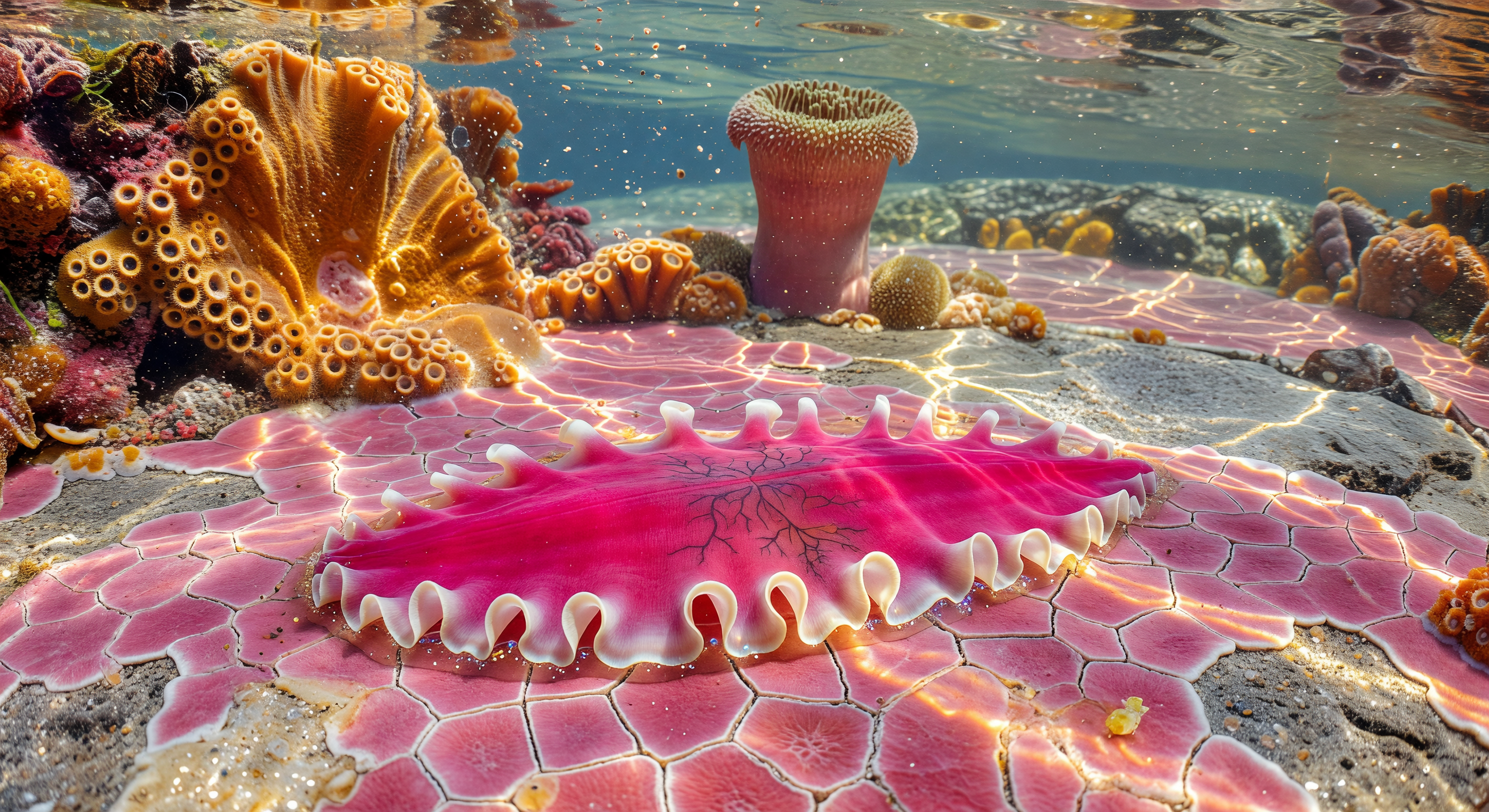
The viewer floats just above a calcium carbonate plateau of encrusting coralline algae, its surface cracked into polygonal cells of deep magenta and salmon pink that stretch in every direction like a vast mineral cityscape — and dominating this rocky terrain, the Pseudobiceros flatworm spreads itself like a luminous flag, its dorsal surface saturated electric fuchsia-violet shot through with the branching shadow-map of its gut diverticula showing faintly beneath translucent skin. This animal is among the most elaborate of the free-living polyclad turbellarians, an acoelomate whose dorsoventrally compressed body reaches near-transparency at its ruffled lateral margins, the white-cream frills thrown into perpetual complex folds by shallow surge — a consequence of tissue so thin and pliable that water movement alone sculpts it into standing waves of wet silk. The pool water above, only six centimeters deep in reality, reads here as an entire sky of liquid glass, its air-water interface refracting Pacific midday sun into caustic nets of hammered gold that slide continuously across the pink crust, veining every surface in shifting rivers of amber light and deep shadow. The mucus film secreted along the flatworm's ventral contact zone catches these same caustics as a mirror-bright meniscus, marking the animal's passage across living stone with a glittering molecular trail — the physical record of cilia-driven locomotion across a landscape that, at this scale, has the full presence and complexity of a continent.
Other languages
- Français: Magenta polyclade sur rose corallin
- Español: Magenta policlado sobre rosa coralino
- Português: Magenta policlado sobre rosa coralino
- Deutsch: Polyclade Magenta auf Korallenrosa
- العربية: ماجنتا دودي على وردي مرجاني
- हिन्दी: कोरलीन गुलाबी पर मैजेंटा पॉलीक्लैड
- 日本語: 珊瑚紅上の多岐腸マゼンタ
- 한국어: 산호빛 핑크 위의 마젠타 편형동물
- Italiano: Magenta policlade su rosa corallino
- Nederlands: Polyclaad magenta op koraalroze