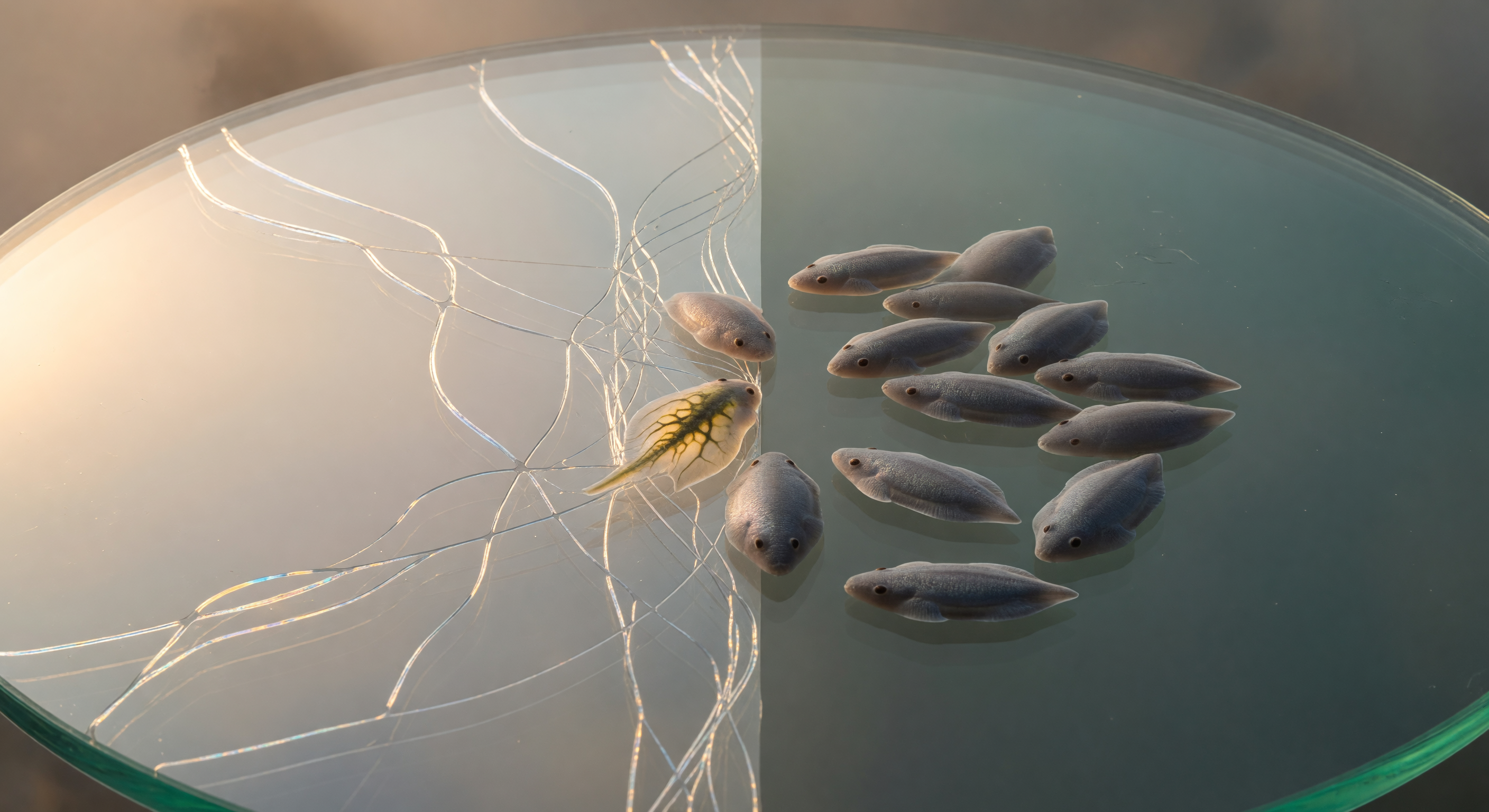
At eye level with the glass floor, a razor-sharp frontier divides the world into two hemispheres — to the left, warm amber-white light bleaches every surface to overexposure, and to the right, a cool teal-gray shadow absorbs that warmth into something denser and more private, the boundary between them not a gradient but a surgical wall of photons ending with architectural precision. Pressed into that first millimeter of darkness, twelve gray-brown planarians rest against the light-dark edge like travelers who have found a border and stopped, their dorsoventrally flattened bodies matte and low against the crystal-clear glass, surfaces shifting between ash-gray and a faint iridescent silver where rhabdite cells in the epidermis catch the oblique light at steep angles. One animal straddles the boundary in frozen mid-reversal — its auricle-bearing head already stilled in shadow, the paired crescent ocelli just visible as dark brown dots near the dorsal margin, while its posterior half remains in warm illumination, the branching gastrovascular cavity glowing as an olive-brown tracery beneath translucent skin, backlit like stained glass. The illuminated half behind them is a forensic record of departure: a lacework of dried mucus trails refracts the warm light into thin silver filaments, hairline iridescent threads crisscrossing the glass like a map of panic, overlapping paths recording every decision made by bodies that now rest, invisible, in the dark — the entire scene a behavioral experiment written in mucus, shadow, and the simple calculus of an animal that reads light as danger and darkness as safety.
Other languages
- Français: Frontière Lumière Ombre Nette
- Español: Límite Agudo Luz Sombra
- Português: Fronteira Nítida Luz Sombra
- Deutsch: Scharfe Licht Dunkel Grenze
- العربية: حد حاد بين الضوء والظلام
- हिन्दी: तीव्र प्रकाश अंधकार सीमा
- 日本語: 鮮明な光と影の境界
- 한국어: 선명한 빛과 어둠의 경계
- Italiano: Confine Netto Luce Ombra
- Nederlands: Scherpe Licht Donker Grens