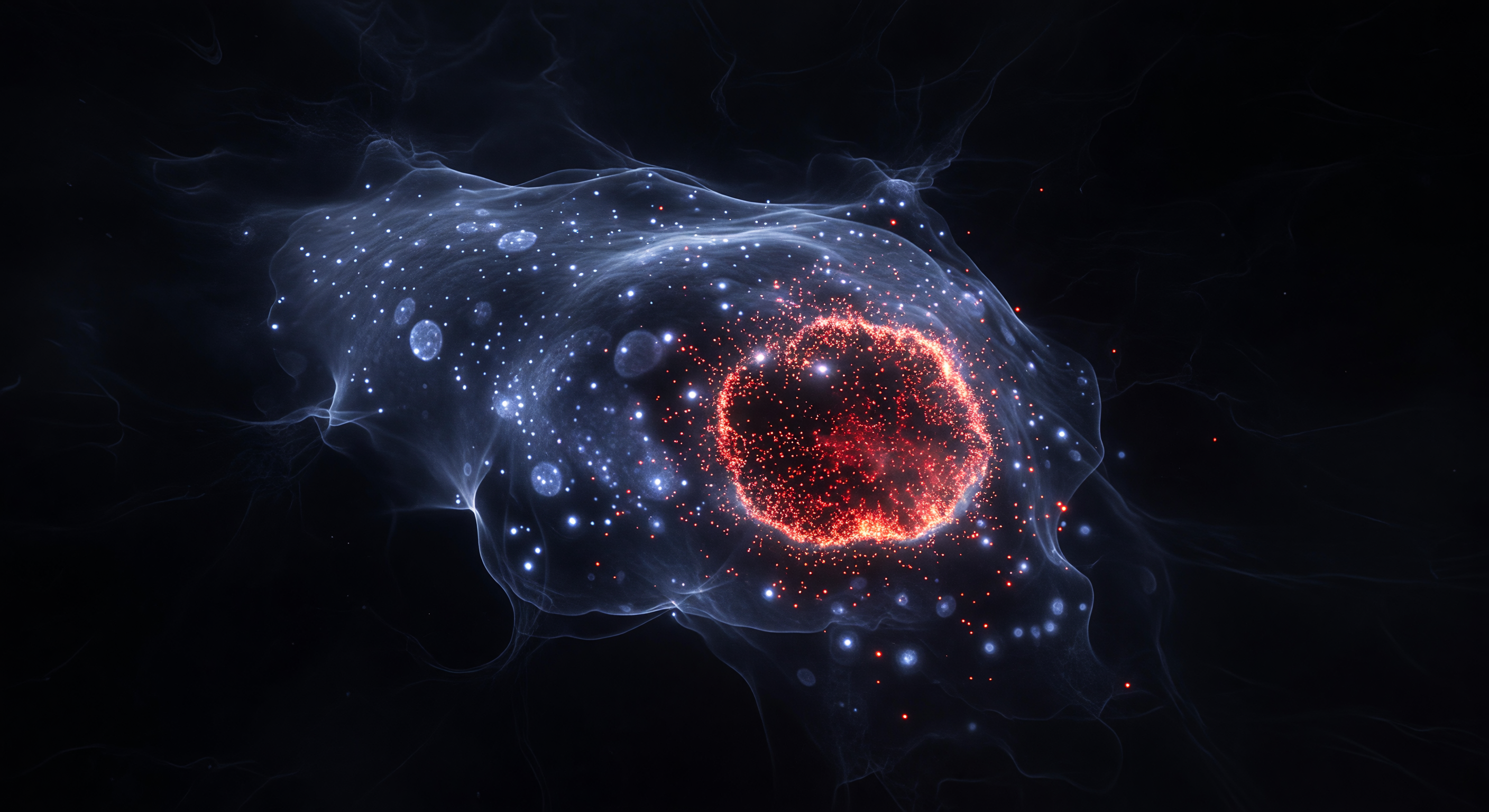
You are suspended in biological darkness, drifting at the scale of a single dividing cell, surrounded by a cosmos of cold nuclear light and volcanic crimson fire. The translucent body of a planarian — a freshwater flatworm imaged by fluorescence microscopy 48 hours after amputation — arches around you as a soft electric-blue shell: every nucleus stained with DAPI reads as a cold point of light, billions of cellular suns separated by dark parenchymal voids, the tissue between them a frozen gel of structural density. Moving toward the anterior wound margin, this quiet star field catastrophically thickens: neoblasts, the planarian's pluripotent stem cells, have migrated and proliferated in response to injury, their newly replicated DNA branded by EdU incorporation into brilliant crimson puncta that crowd, converge, and finally fuse into a continuous incandescent nebula — a solid wall of scarlet and deep red where individual dividing cells are no longer distinguishable, their signals merged into biological fire. This blaze represents one of animal biology's most dramatic regenerative events: neoblasts are the only dividing cells in the planarian body, and their rapid recruitment to wounds underlies the organism's legendary capacity to regenerate a complete head from a fragment of trunk within two weeks. The contrast between the sparse posterior ember-field and this anterior supernova encodes, in a single frozen image, the entire logic of regeneration — quiescence behind, urgency ahead, and the wound margin itself a luminous frontier between two states of biological time.
Other languages
- Français: Galaxie Néoblaste à la Plaie
- Español: Galaxia Neoblasto en la Herida
- Português: Galáxia Neoblasto na Ferida
- Deutsch: Neoblast-Galaxie an der Wunde
- العربية: مجرة النيوبلاست عند الجرح
- हिन्दी: घाव पर नियोब्लास्ट आकाशगंगा
- 日本語: 傷口のネオブラスト銀河
- 한국어: 상처의 네오블라스트 은하
- Italiano: Galassia Neoblasto alla Ferita
- Nederlands: Neoblast Sterrenstelsel bij de Wond