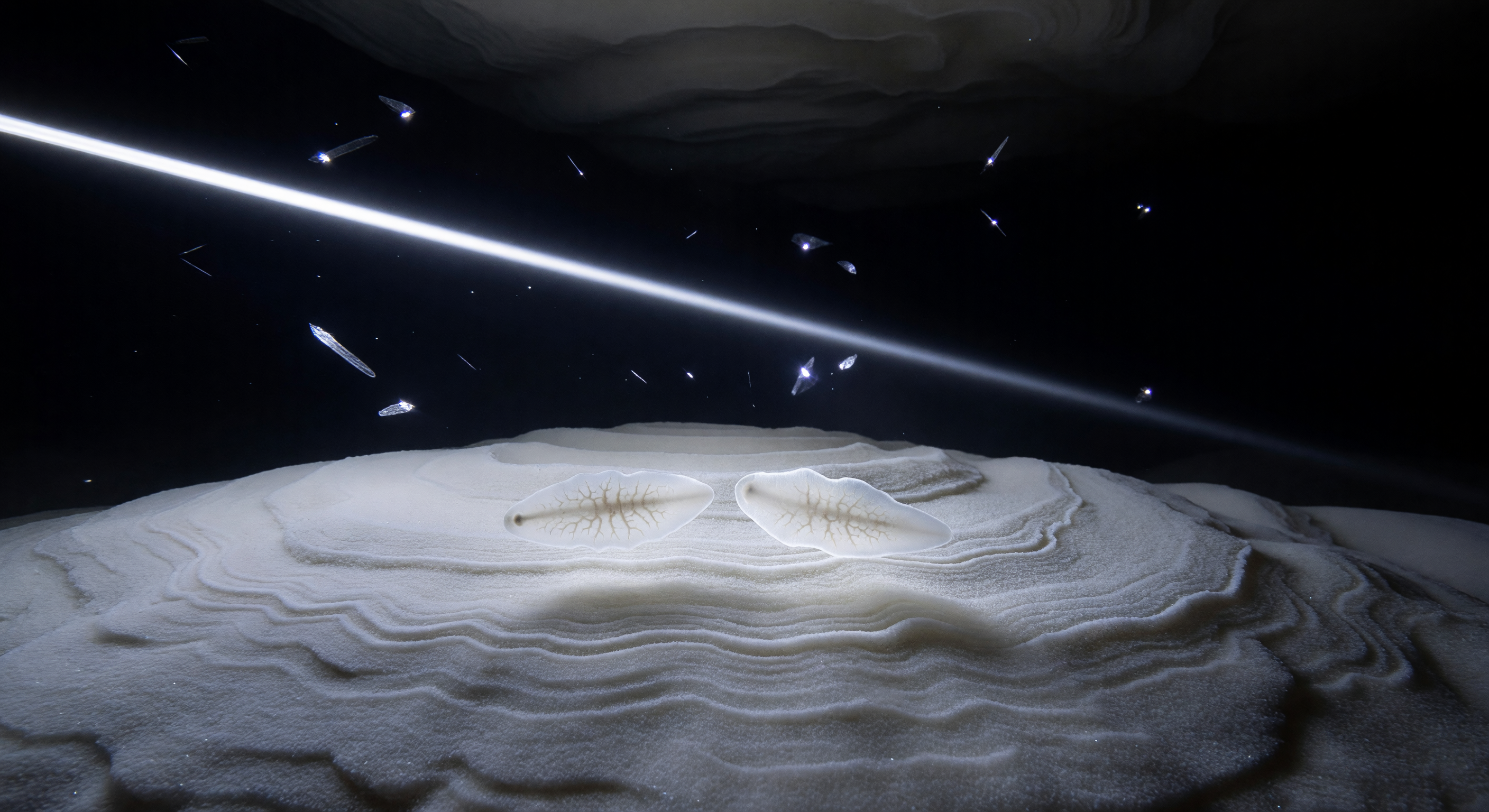
The spelunking beam finds them first — two white lozenges resting motionless on calcite sinter the color of old ivory, their bodies so pale and translucent that the branching gut diverticula glow through the tissue like river tributaries seen through frosted glass, warm beige-brown dendrites suspended inside a form that otherwise appears to be made of nothing but cold light and water. These are cave planarians of the genus *Dendrocoelum*, evolutionary refugees who have shed every pigment and both ocelli across countless generations in absolute darkness, navigating now by chemical gradients and vibration alone, their blunt anterior ends reading the subterranean stream through senses that have no use for the LED beam now illuminating them so clinically from above. Beneath their bodies, each animal floats above its own pale ghost-shadow cast by scattered upward light onto the sinter, while the calcite substrate itself — built in slow concentric ridges of deposited calcium carbonate, each layer a record of dissolved limestone precipitating from cold water over decades — fills the field of view like a frozen tundra of mineral, every ridge a soft lip of pale ivory frosted with microcrystalline texture. The water surface overhead is black glass, broken only by a single rigid stripe of reflected white light, and beyond the beam's edge the cave collapses into a darkness so complete that only isolated crystal facets betray their existence, igniting briefly as cold violet sparks before the void swallows them again.
Other languages
- Français: Ténèbres du Ruisseau Fantôme
- Español: Oscuridad del Arroyo Fantasma
- Português: Escuridão do Riacho Fantasma
- Deutsch: Karst Geisterbach Dunkel
- العربية: ظلام نهر الكارست الشبحي
- हिन्दी: कार्स्ट भूत धारा अंधकार
- 日本語: カルスト幽霊川の闇
- 한국어: 카르스트 유령 계곡 어둠
- Italiano: Buio del Torrente Fantasma
- Nederlands: Karst Spookstroom Duisternis