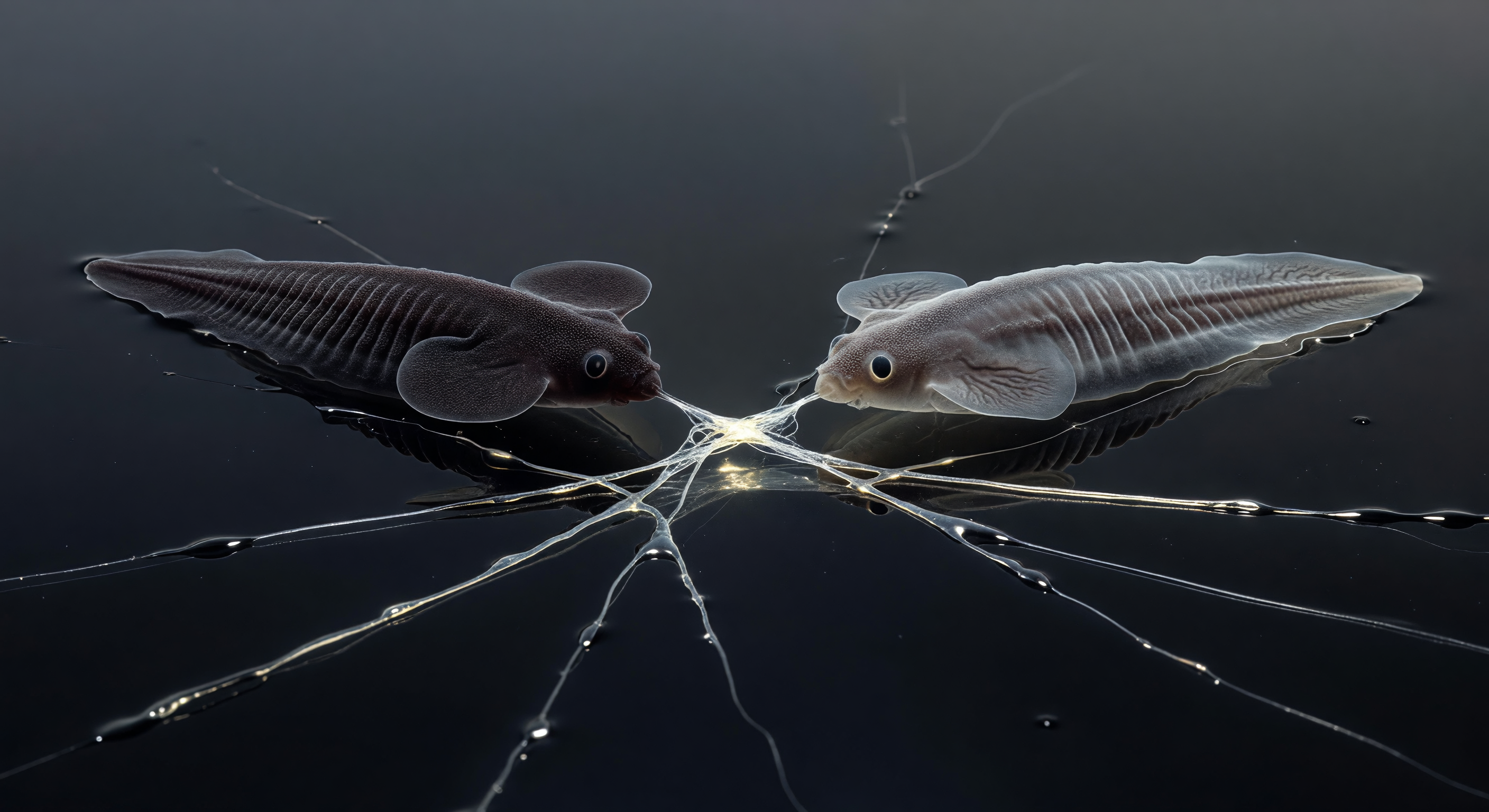
You are suspended millimeters above an obsidian plain — the wet-glass substrate stretches in every direction like a frozen black lake, its shallow water film refracting overhead light into trembling caustic streaks — and directly before you, two living landmasses of *Dugesia dorotocephala* are in the final seconds of tearing themselves apart. The anterior body has moved forward, its chromatophore-dense dorsal surface rippling with slow muscular contraction waves, its flared auricles and crescent-moon ocelli facing away from the drama, while the posterior body anchors itself to the glass through locked adhesive glands, its isometric contractions visibly flattening and ridging the tissue in rhythmic resistance. Between them, the gravitational center of this entire world: a tissue thread no thicker than spun glass, translucent white verging on pale gold, backlit by the water film beneath so it glows with apparent luminescence against the surrounding darkness, and within it — if you resolve your gaze — parenchymal cells still connected, longitudinal muscle fibers drawn to their elastic limit, extracellular matrix holding suspension at the threshold of rupture. This is asexual fission in *Platyhelminthes*, a reproductive strategy requiring no partner and no gamete, only the coordinated muscular pull of a body dividing itself into two regeneration-competent fragments, each carrying the molecular instructions to rebuild what is lost — and the silver mucus roads crossing the black substrate in every direction are the calligraphic record of how this single animal became, in the time it takes to watch, irrevocably two.
Flatworms