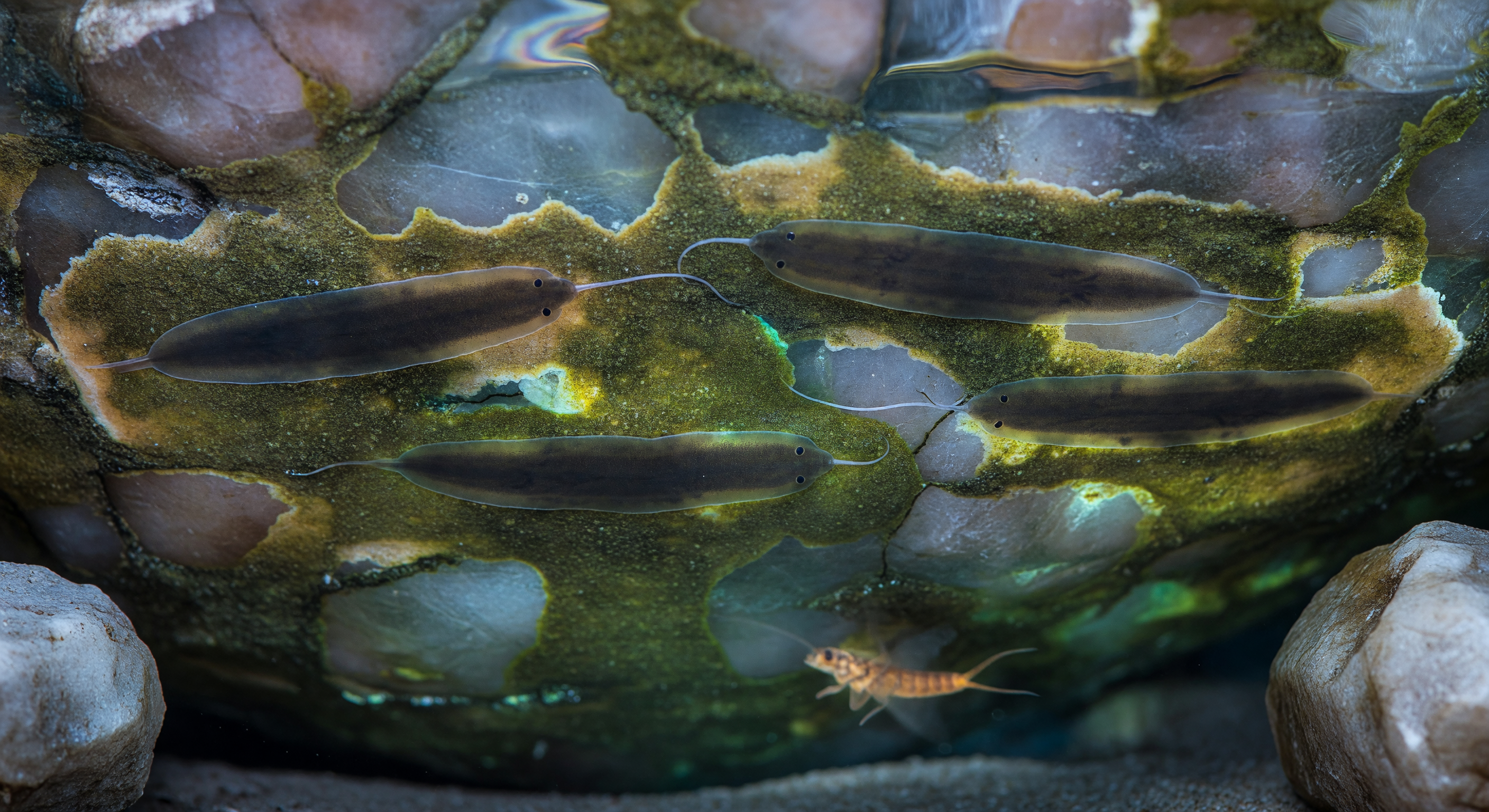
The view is pressed flat against the underside of a granite cobble, looking upward into a ceiling of living stone — feldspar and quartz territories interlocking at enormous apparent scale, their mineral edges catching refracted stream-light as faint prismatic glints, the entire surface filmed with a crust of periphyton in olive-drab, gold-green, and pale ochre where diatom colonies have colonized every facet. Three Dugesia planarians occupy this ceiling-world above, each a long dark ellipse of ash-gray and deep umber moving with the unhurried, muscular inevitability of something that has no skeleton to constrain it — bodies pressed intimately to the biofilm, flattened to near-perfect contact across their entire ventral surface by the continuous coordinated beating of cilia too small and too numerous to resolve, the locomotion appearing as pure, seamless glide. They are backlit by cold blue-green stream-light filtering down through the water column above the cobble and refracting into this sheltered underside chamber as a diffuse submarine luminescence, rimming each animal's flattened margins in smoky amber-green where tissue thins to translucency, the faint branching architecture of gut diverticulae just visible through the dorsal surface like weather systems seen from altitude. Behind each animal, the mucus ribbon it has laid down across the diatom mat catches the scattered upwelling light as a barely-there silver filament — refractive, slightly raised, a molecular adhesion highway still warm with the animal's passage — while deep in the mid-water beyond the cobble's sheltering lip, a mayfly nymph drifts as a soft volumetric amber ghost, warm against the aquamarine of the water column, its segmented body unresolved by distance into pure luminous suggestion.
Other languages
- Français: Glissement Aube Sous Granit
- Español: Desliz Auroral Bajo Granito
- Português: Deslize Auroral Sob Granito
- Deutsch: Morgendliches Gleiten Unter Granit
- العربية: انزلاق الفجر تحت الجرانيت
- हिन्दी: ग्रेनाइट तले भोर फिसलन
- 日本語: 花崗岩下の夜明け滑走
- 한국어: 화강암 아래 새벽 활강
- Italiano: Scivolata Alba Sotto Granito
- Nederlands: Dageraad Glijden Onder Graniet