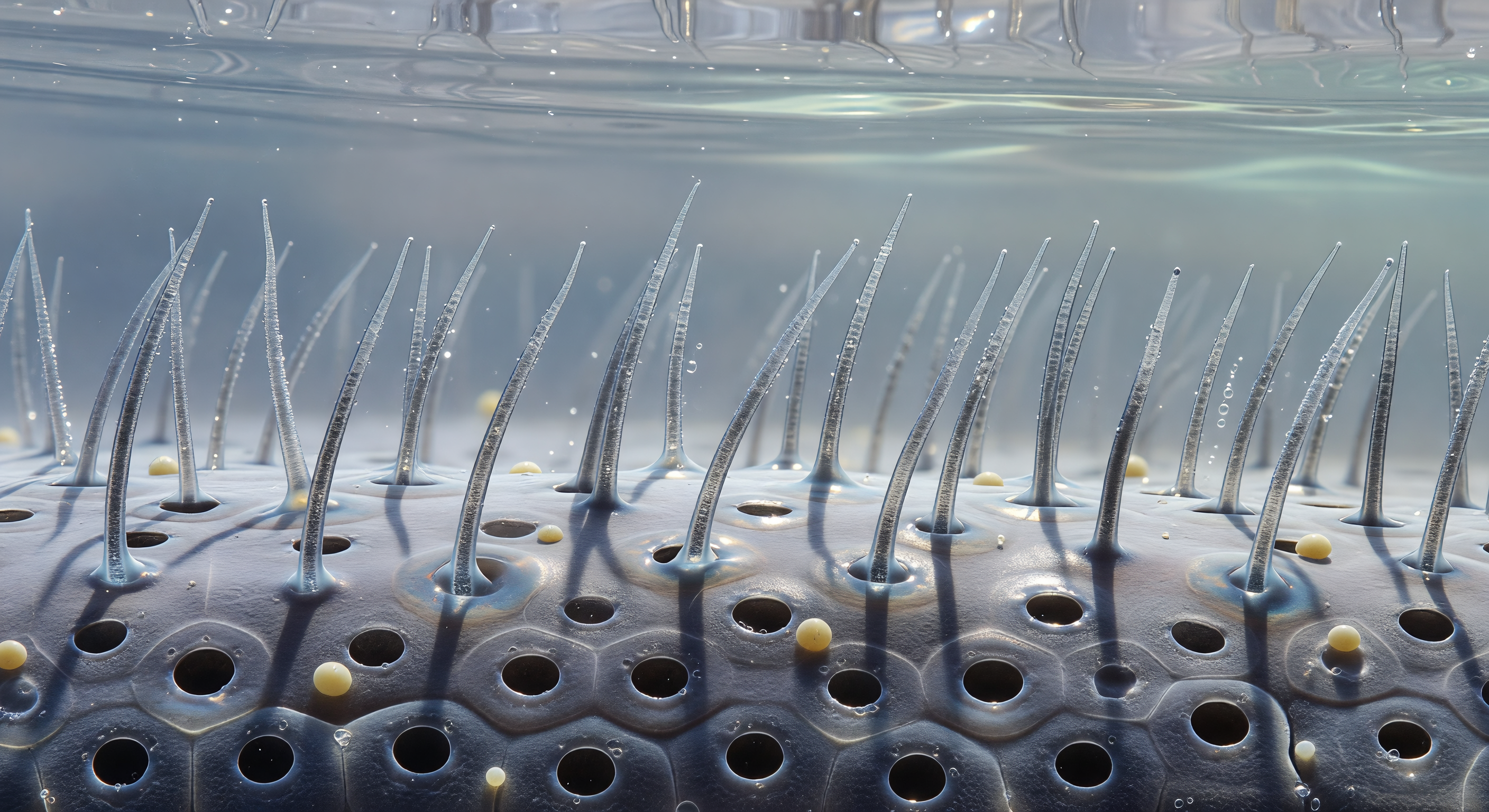
You stand within a colonnade without end — silver-gray shafts rising all around you to heights that dwarf your own, their tapered crowns glazed in a blue-silver mucus film that catches the low, raking light like hoarfrost on winter grass, while several nearest shafts are caught mid-beat, their upper thirds angled sharply in the same oblique direction and trailing faint smears of arrested motion at their tips. Beneath your feet, the epithelial floor rolls gently in polygonal plateaus separated by low cellular ridges, the surface studded at irregular intervals by dark, perfectly circular gland-cell pores that drop away like volcanic calderas into pitch-black interiors rimmed with a wet overflow of freshly secreted mucus. This is the ventral surface of a living planarian, and the ciliary array that drives the animal's gliding locomotion — each shaft a precisely structured axonemal engine beating at dozens of cycles per second — surrounds you as an effectively infinite forest whose individual members you can reach out and touch. The mucus film pooled in lenses between the cell ridges refracts the background aquatic light into pale prismatic halos of blue and amber, and the distant cilia dissolve into a silver-gray atmospheric haze at what feels like a continental horizon but amounts to a distance no greater than the width of two human hairs. Above, the underside of the water-mucus interface trembles as ciliary wave fronts propagate outward in coordinated metachronal rhythm, a living ceiling rippling with slow caustic light that filters down in shifting ribbons of pale aquamarine through a medium that is simultaneously the animal's lubricant, its adhesive, and its interface with the world.
Other languages
- Français: Sol de forêt ciliaire
- Español: Suelo del bosque ciliar
- Português: Chão da floresta ciliar
- Deutsch: Zilienwald Bodenperspektive
- العربية: أرضية غابة الأهداب
- हिन्दी: सिलिया वन भूमि दृश्य
- 日本語: 繊毛の森の地面視点
- 한국어: 섬모 숲 바닥 시점
- Italiano: Pavimento della foresta ciliare
- Nederlands: Cillair woudbodem perspectief