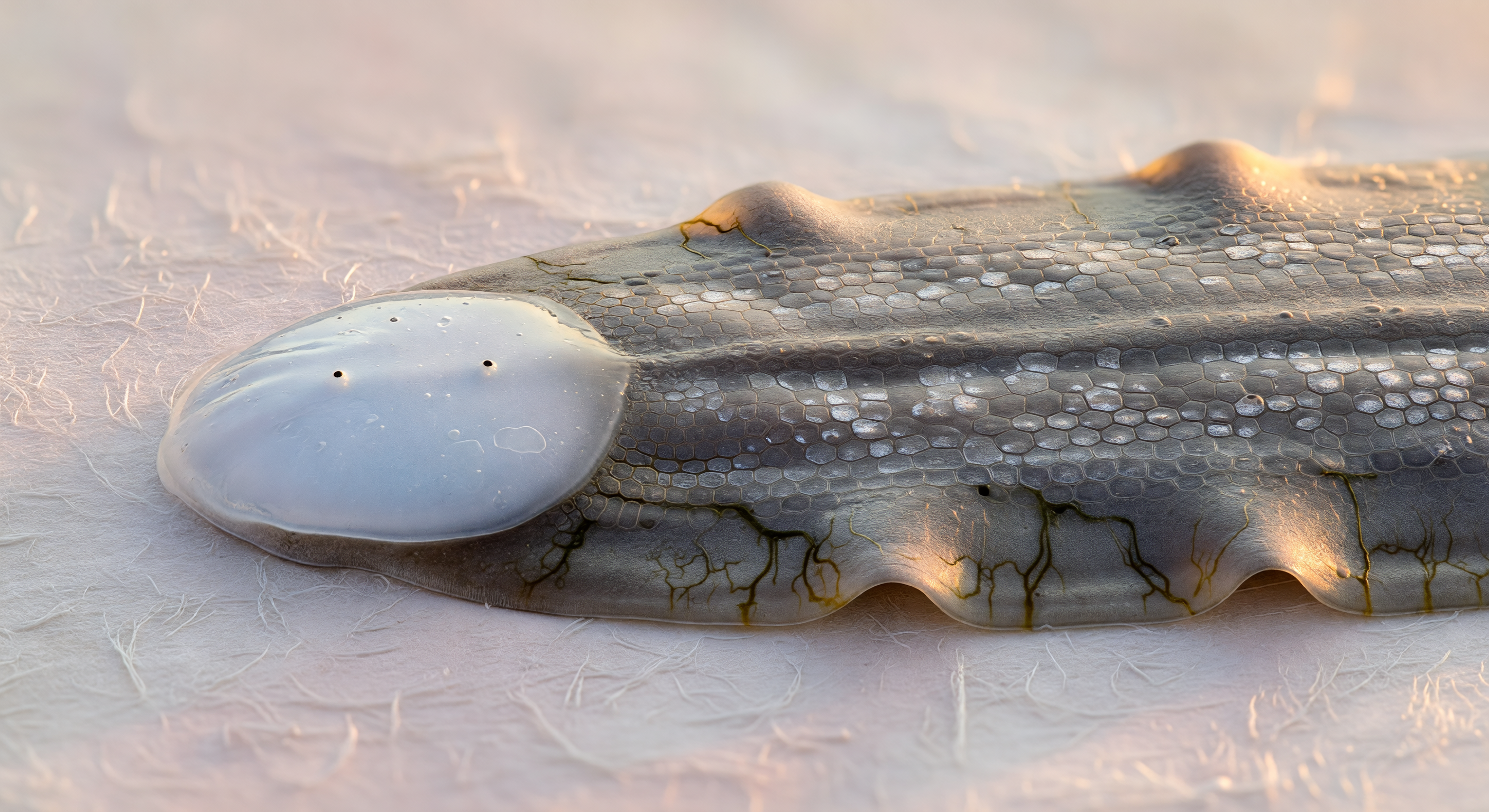
You hover centimeters above what the eye first reads as a coastal plateau at dusk — a broad, gently undulating mesa of dark gray-brown integument stretching rightward, its surface alive with a pearlescent sheen where rhabdite secretions and subsurface guanine deposits catch the oblique amber beam raking in from the upper right, the dorsal epidermis resolving into a subtly quilted mosaic of thousands of individual cells, each flagstone-facet glinting differently, while along the lateral margins the tissue thins to a translucent amber where gut diverticula trace dark dendritic shadows beneath, like rivers glimpsed through ice. At the left margin, the world transforms: the blastema rises as a shallow opalescent dome, glassy with retained moisture, scattering the warm light back as cold blue-white luminescence — a freshly formed plateau of pale milky translucence, smoother than any mature epidermis, sitting proud above the older pigmented tissue along a boundary ridge that marks the exact biological shoreline between differentiation and possibility. Within it, barely resolved but unmistakably present, two minute black pinpoints sit like distant volcanic craters on a white plain — nascent ocelli, dark pigment just beginning to consolidate around the photoreceptor clusters of a nervous system still being built neuron by neuron. Five days ago this anterior quarter of a living animal did not exist; what the light now sculpts so dramatically into geological relief is nothing less than the reinvention of a body from pluripotent cells, a process ancient enough to predate the Cambrian and quiet enough to be mistaken, at this scale, for slow stone.
Other languages
- Français: Aube du Blastème — Jour Cinq
- Español: Alba del Blastema — Día Cinco
- Português: Aurora do Blastema — Dia Cinco
- Deutsch: Blastem-Dämmerung — Tag Fünf
- العربية: فجر الأرومة — اليوم الخامس
- हिन्दी: ब्लास्टेमा भोर — पाँचवाँ दिन
- 日本語: 芽体の夜明け — 五日目
- 한국어: 재생아 여명 — 다섯째 날
- Italiano: Alba del Blastema — Giorno Cinque
- Nederlands: Blasteem-dageraad — Dag Vijf