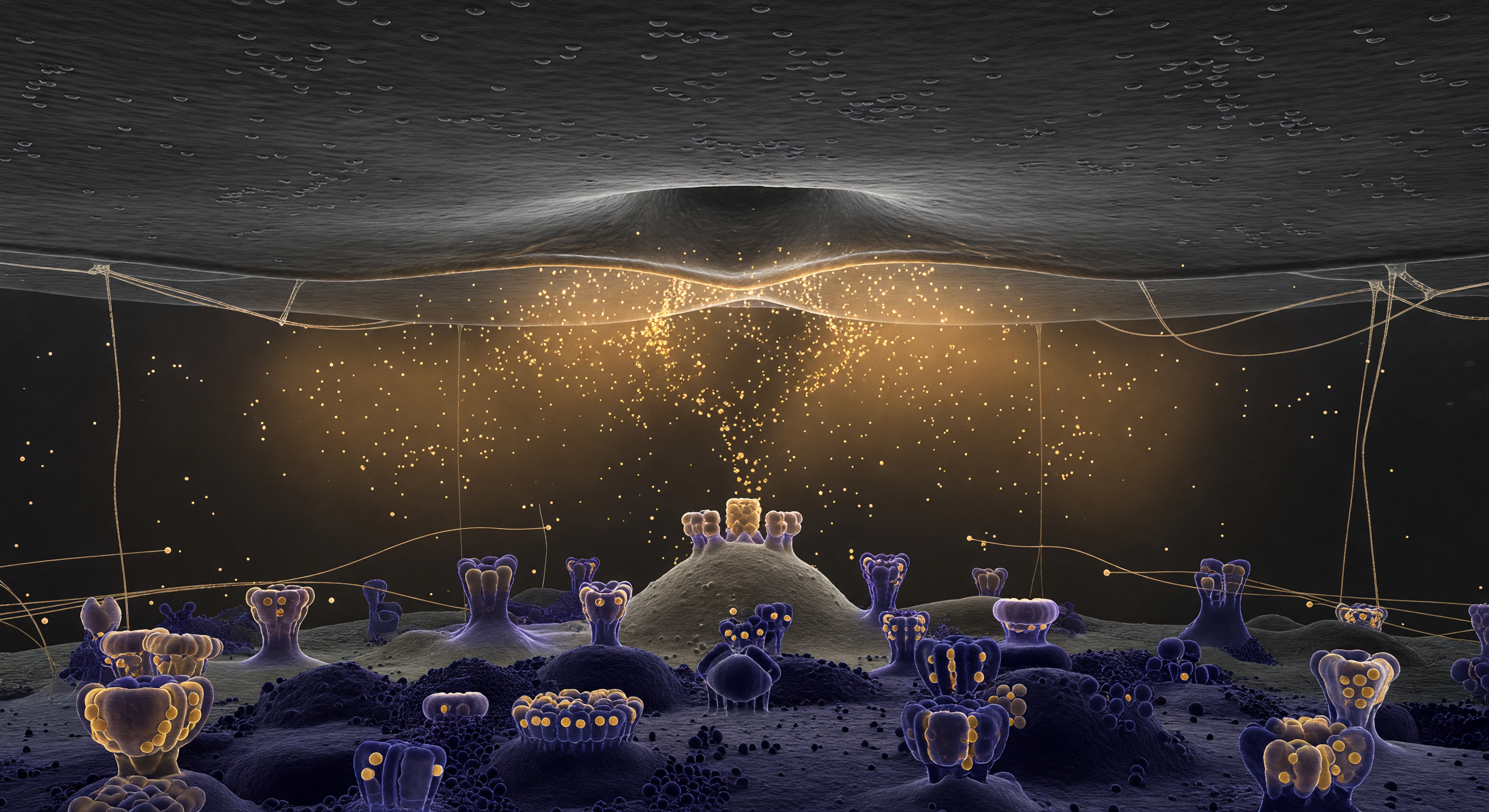
You are suspended inside a corridor that has no horizon — only ceiling and floor, both pressing in from above and below simultaneously, separated by a gap of just 25 nanometers, a distance so violently compressed that the entire synaptic cleft feels less like a space and more like a contact. Above you, the presynaptic membrane stretches as a vast charcoal plain, and at its center a single synaptic vesicle has committed irreversibly to fusion, its lipid bilayer collapsing into the membrane in a smooth omega-shaped dimple as the two leaflet pairs merge into one continuous sheet — a structural event lasting mere milliseconds that nevertheless reshapes the biochemical landscape of the entire corridor. From the fusion pore, thousands of neurotransmitter molecules — glutamate, or acetylcholine, depending on which synapse you inhabit — exhale outward as a warm amber cloud, not discrete objects but a diffuse volumetric tide governed entirely by Brownian diffusion, thinning at the edges as molecules spread laterally across the cleft, their motion unguided and probabilistic. Below, the postsynaptic density rises to meet them: a dark-purple, electron-dense scaffold of extraordinary architectural complexity, bristling with AMPA and NMDA receptor complexes whose extracellular domains protrude upward into the cleft like stone formations, their binding sites oriented precisely to intercept the incoming transmitter flood — a molecular geometry refined over hundreds of millions of years of synaptic evolution, here rendered suddenly, overwhelmingly immediate.
Other languages
- Français: Déluge Synaptique de Neurotransmetteurs
- Español: Inundación Sináptica de Neurotransmisores
- Português: Inundação Sináptica de Neurotransmissores
- Deutsch: Synaptischer Spalt Neurotransmitter-Flut
- العربية: فيضان ناقلات الشق التشابكي
- हिन्दी: सिनेप्टिक क्लेफ्ट न्यूरोट्रांसमीटर बाढ़
- 日本語: シナプス間隙の神経伝達物質の洪水
- 한국어: 시냅스 틈 신경전달물질 홍수
- Italiano: Diluvio di Neurotrasmettitori Sinaptici
- Nederlands: Synaptische Spleet Neurotransmitter Vloed