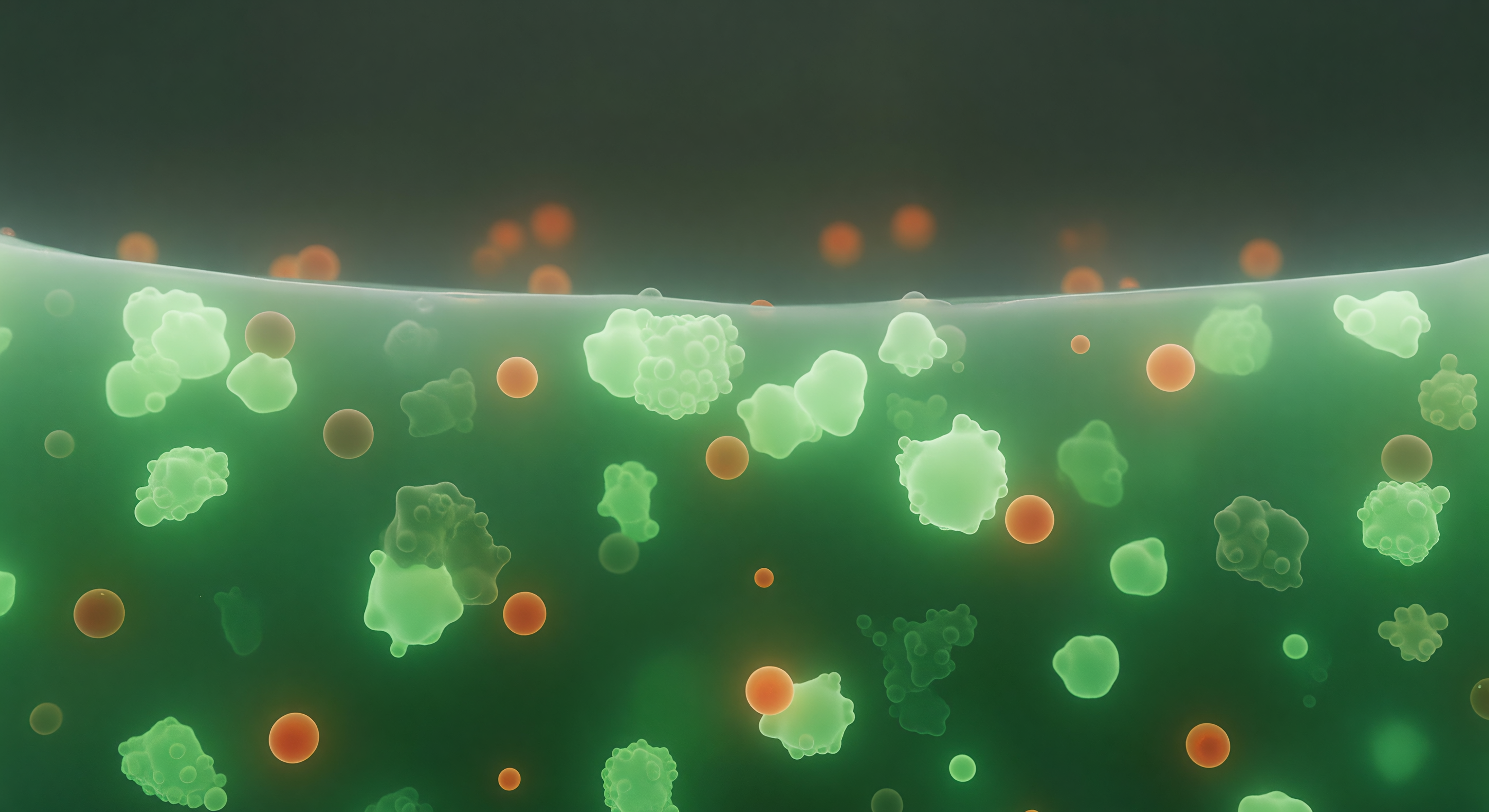
You are suspended inside a stress granule — a membraneless organelle that assembles by liquid-liquid phase separation when the cell halts translation under stress, concentrating RNA-binding proteins and stalled messenger RNAs into a viscoelastic condensed phase distinct from the surrounding cytoplasm. The world around you is an emerald luminescence with no single source: G3BP1 protein, a nucleating scaffold of stress granule assembly, saturates the medium at concentrations far exceeding those of the dilute cytoplasm just beyond, and its GFP fluorescence fills the interior with a cool, diffuse glow that thickens with distance into an impenetrable jade opacity. Closer and farther, mRNA-protein clusters materialize as brighter nodes — not hard objects but local intensifications where RNA and low-complexity domain proteins have co-condensed further, pooling into denser microdomains within the already-dense matrix — while warm amber-orange TIA1-rich co-condensates drift in slow suspension, their surfaces shimmering where two distinct liquid phases meet at an ultralow interfacial tension. Far ahead, the condensate boundary declares itself as an abrupt precipice, a sharply curved interface where the entire luminous green world drops into near-nothingness in a distance of only tens of nanometers — the physical signature of phase separation, a thermodynamic horizon separating two coexisting states of the same cellular matter.
Other languages
- Français: Intérieur du Condensat Granulaire
- Español: Interior del Condensado Granular
- Português: Interior do Condensado Granular
- Deutsch: Stressgranulat Kondensat Inneres
- العربية: داخل كثيف حبيبات الإجهاد
- हिन्दी: तनाव कणिका संघनित आंतरिक
- 日本語: ストレス顆粒凝縮体内部
- 한국어: 스트레스 과립 응축체 내부
- Italiano: Interno del Condensato Granulare
- Nederlands: Stressgranule Condensaat Interieur