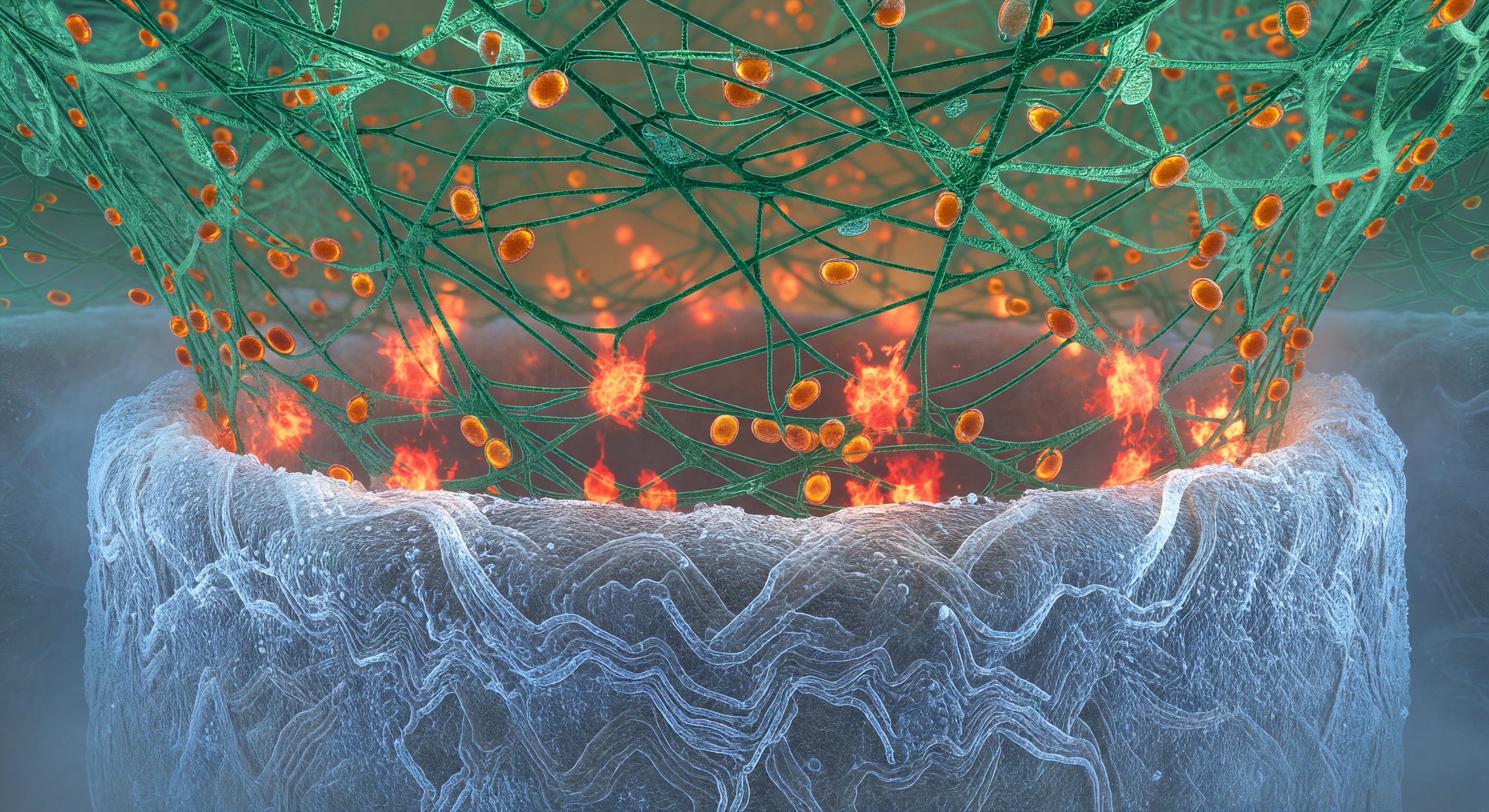
You stand pressed into the killing zone between two of the most formidable biological architectures the living world produces — beneath you, the fungal hypha curves away like the hull of a vast pale vessel, its chitin wall radiating cold blue-white luminescence where calcofluor dye has rendered every interlocked polysaccharide strand incandescent, a surface dense and granular as ancient salt that disappears into haze at both flanks under its own geological weight. From above, the neutrophil's actin cradle descends in a viridian forest of branched F-actin cables, each filament crosslinked under tension and gleaming with a resinous wet light, the entire scaffold gripping the hypha with the organized ferocity of a living vise. At the interface you inhabit, reactive oxygen species erupt in irregular red-orange detonations — concentrated bursts of oxidative chemistry igniting like slow flashbulbs, their amber cores bleeding outward into copper coronas that momentarily backlight the actin mesh from below, the product of NADPH oxidase complexes assembling at the phagosomal membrane to flood this narrow space with superoxide and its downstream derivatives. Threading through the scaffolding above, azurophilic granules drift in warm amber procession along actin cables, each one a sealed reservoir of myeloperoxidase and elastase converging on the brightest ROS fronts — the entire scene a coordinated molecular siege in which chemistry, mechanics, and targeted biochemical delivery converge at a contact zone measured in micrometers but experienced here as an vast, smoldering battlefield.
Other languages
- Français: Zone de destruction par les neutrophiles
- Español: Zona mortal de neutrófilos ROS
- Português: Zona de morte por neutrófilos
- Deutsch: Neutrophiler ROS Todeszone
- العربية: منطقة قتل الخلايا المحببة
- हिन्दी: न्यूट्रोफिल ROS मृत्यु क्षेत्र
- 日本語: 好中球ROS殺傷ゾーン
- 한국어: 호중구 ROS 사멸 지대
- Italiano: Zona mortale del neutrofilo
- Nederlands: Neutrofiel ROS Dodingszone