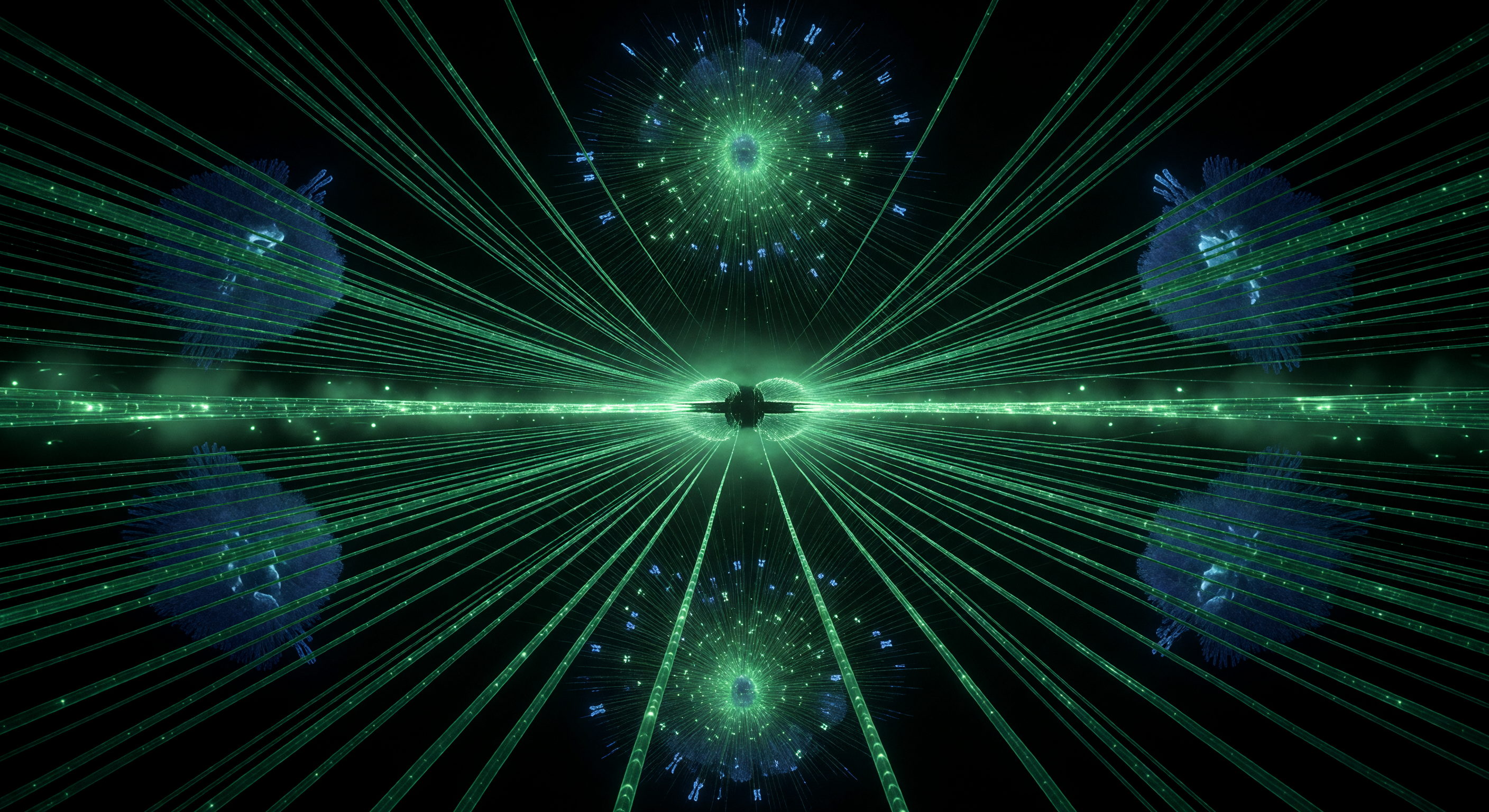
You are suspended at the exact center of a dividing cell during anaphase, and surrounding you in every direction is a cathedral of electric-green light — the mitotic spindle rendered in fluorescent tubulin, its microtubule cables radiating from two blazing centrosomal poles far above and below like the rigging of some vast biological machine under full tension. The kinetochore fibers are the most dramatic structures: thick, taut, intensely luminous bundles of polymerized tubulin, each one locked onto a chromosome mass and pulling it poleward with measurable force, the blue-violet chromatin receding into the polar glow like storm clouds retreating into twin suns. Directly at your level, the midbody cuts across the visual field as a bar of concentrated white-green fire — the antiparallel overlap zone where interpolar microtubules from opposite poles interdigitate and are cross-linked by motor proteins including the kinesin Eg5, so densely packed with tubulin that it outshines the rest of the spindle — while all around you, interpolar fibers cross in overlapping diagonals, forming a three-dimensional lattice of living polymer through which you float weightless. Beyond the spindle's glow, the cytoplasm is absolute black, yet not empty: macromolecular crowding at 300–400 mg/mL scatters the microtubule fluorescence into soft aureoles of milky green mist at every fiber's edge, giving biological mass to the darkness and reminding you that this entire luminous architecture — chromosome segregation, spindle tension, the midbody's fire — is a protein machine operating in real time, measured in minutes, inside a space you could cross in a single human stride.
Other languages
- Français: Croisement des Fibres du Fuseau
- Español: Cruce de Fibras del Huso Mitótico
- Português: Cruzamento de Fibras do Fuso
- Deutsch: Spindelerfasern Kreuzung
- العربية: تقاطع خيوط المغزل الانقسامي
- हिन्दी: माइटोटिक तर्कु तंतु संगम
- 日本語: 紡錘糸の交差点
- 한국어: 방추사 섬유 교차
- Italiano: Incrocio di Fibre del Fuso Mitotico
- Nederlands: Spoelvezels Kruising