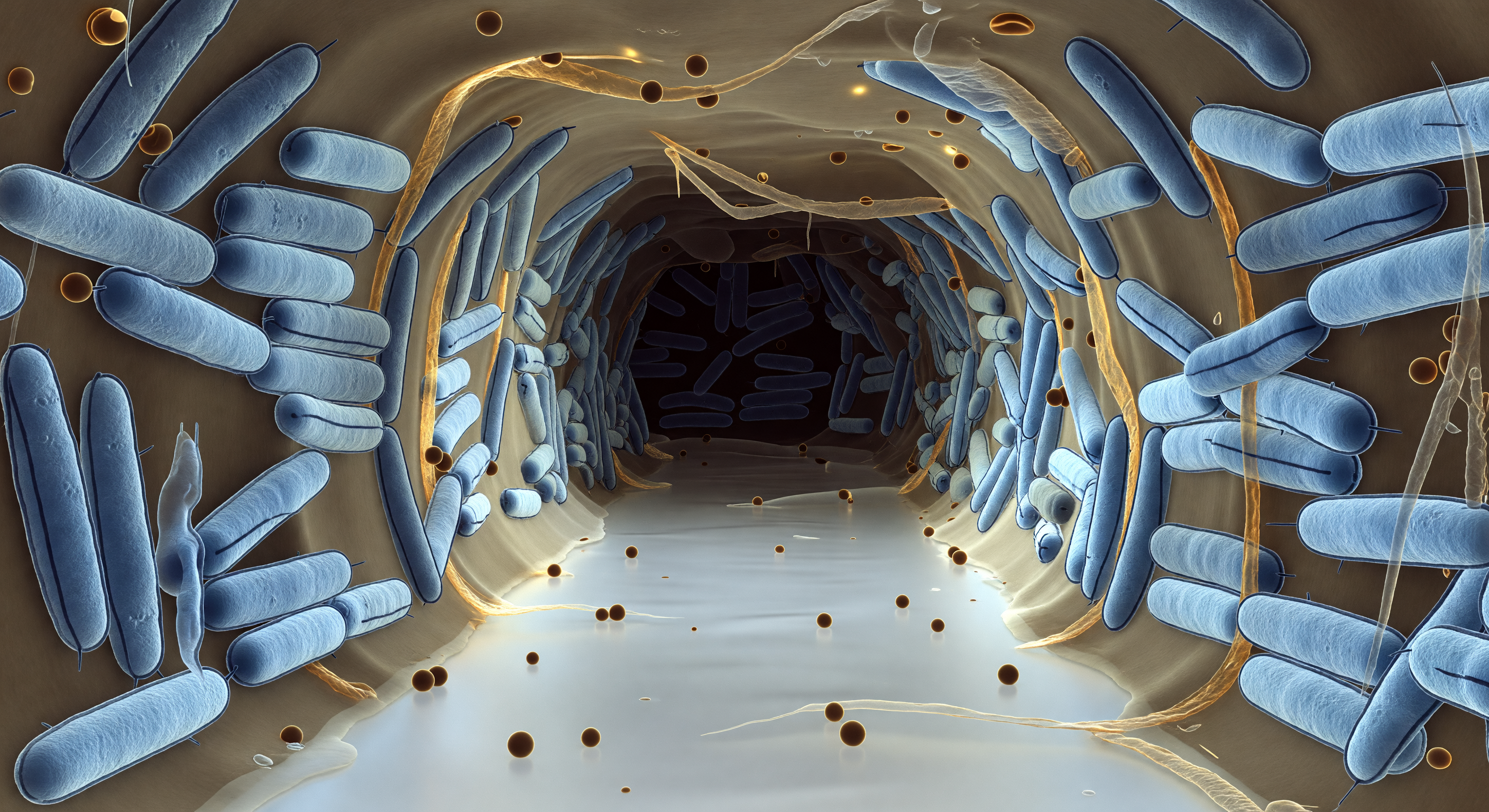
You are suspended at the mouth of a corridor carved through living architecture — a pale, luminous void cutting between walls of densely packed bacterial bodies, each one an ice-blue cylinder roughly the scale of a building to you, their double outer membranes tracing two razor-thin dark lines along every surface, a structural motif repeated hundreds of times into the deepening blue-grey haze where the channel bends toward shadow. The translucent amber-tan exopolysaccharide matrix fills every gap between organisms, binding them into a coherent collective structure — part scaffold, part communication medium — its surface faintly iridescent where hydration layers create thin-film interference, massing into ropy bundles between neighboring cells before thinning to a gossamer film at the channel edge. Scattered across the fluid column and resting against the matrix overhang are outer membrane vesicles, perfectly spherical and amber-glowing, each a sealed lipid bubble carrying signaling molecules and enzymes between organisms that cannot otherwise touch — a form of molecular postal service operating continuously within this chemically active corridor. The light fades with biological purpose: the pale silver-white of your position grades through charcoal toward the channel's vanishing point, tracing the real oxygen and nutrient gradients that govern which cells in this community survive, sporulate, or starve, the entire biofilm less a colony than a differentiated tissue assembled without a blueprint, sustained by nothing but chemistry and proximity.
Eukaryotic cells (tissues)