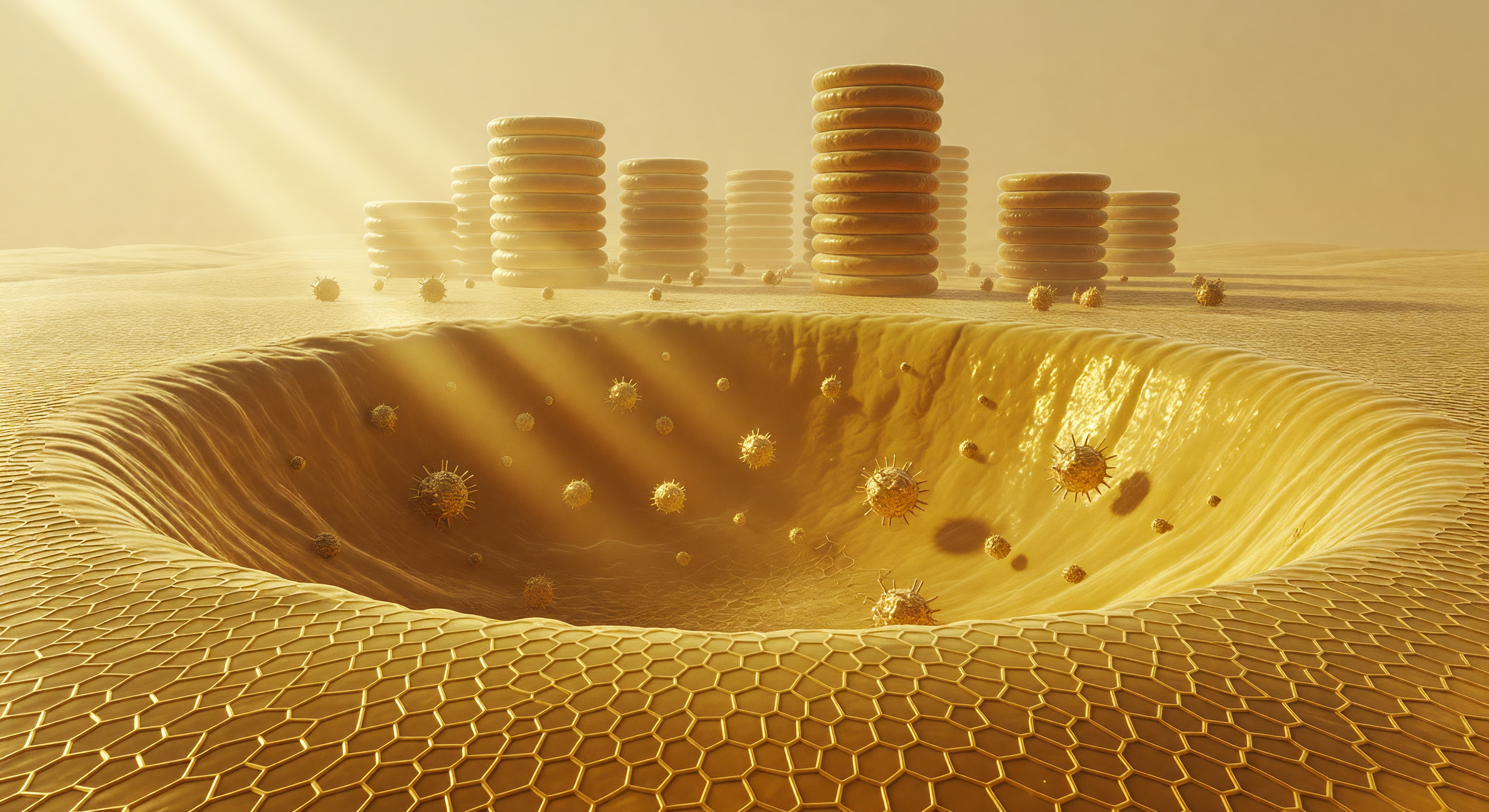
You hover at the nadir of an enormous amber basin, the central concavity of a human red blood cell sweeping away in every direction like the floor of a warm, ochre-tinted impact crater — its surface a continuous, gently undulating plain of translucent gold, somewhere between stretched caramel and sun-warmed honey. Just beneath that shimmering membrane, pressed into the underside like etchings in amber glass, the hexagonal lattice of the spectrin cytoskeleton renders itself visible in slightly cooler relief — a geodesic web of biological scaffolding that gives the whole plain the quality of hammered gold foil, the network maintaining the cell's remarkable capacity to deform through narrow capillaries and spring back without rupturing. Raking oblique illumination drives in from the upper left with the hard-edged precision of a scanning electron beam, catching every crest of the membrane's undulation and throwing the concave hollows into pools of deep amber shadow, lending the biological surface the hyper-material tactility of cast bronze. At mid-distance, neighboring red blood cells have stacked themselves into rouleaux — smooth-sided columns of biconcave discs pressed face to face, a reversible aggregation driven by plasma proteins bridging adjacent membranes — their corrugated silhouettes rising like sandstone towers from a straw-colored plasma still carrying its suspended cargo of spiny, projection-roughened platelets, each one a surveillance body circulating in readiness, dwarfed by the great cellular walls around it yet enormous against the spectrin lattice at your feet.
Other languages
- Français: Paysage du Cratère Érythrocytaire
- Español: Paisaje del Cráter Eritrocitario
- Português: Paisagem da Cratera Eritrocitária
- Deutsch: Erythrozyten Krater Landschaft
- العربية: منظر فوهة كرية الدم الحمراء
- हिन्दी: लाल रक्त कोशिका क्रेटर परिदृश्य
- 日本語: 赤血球凹面クレーター景観
- 한국어: 적혈구 오목 크레이터 풍경
- Italiano: Paesaggio del Cratere Eritrocitario
- Nederlands: Erytrocyt Holle Krater Landschap