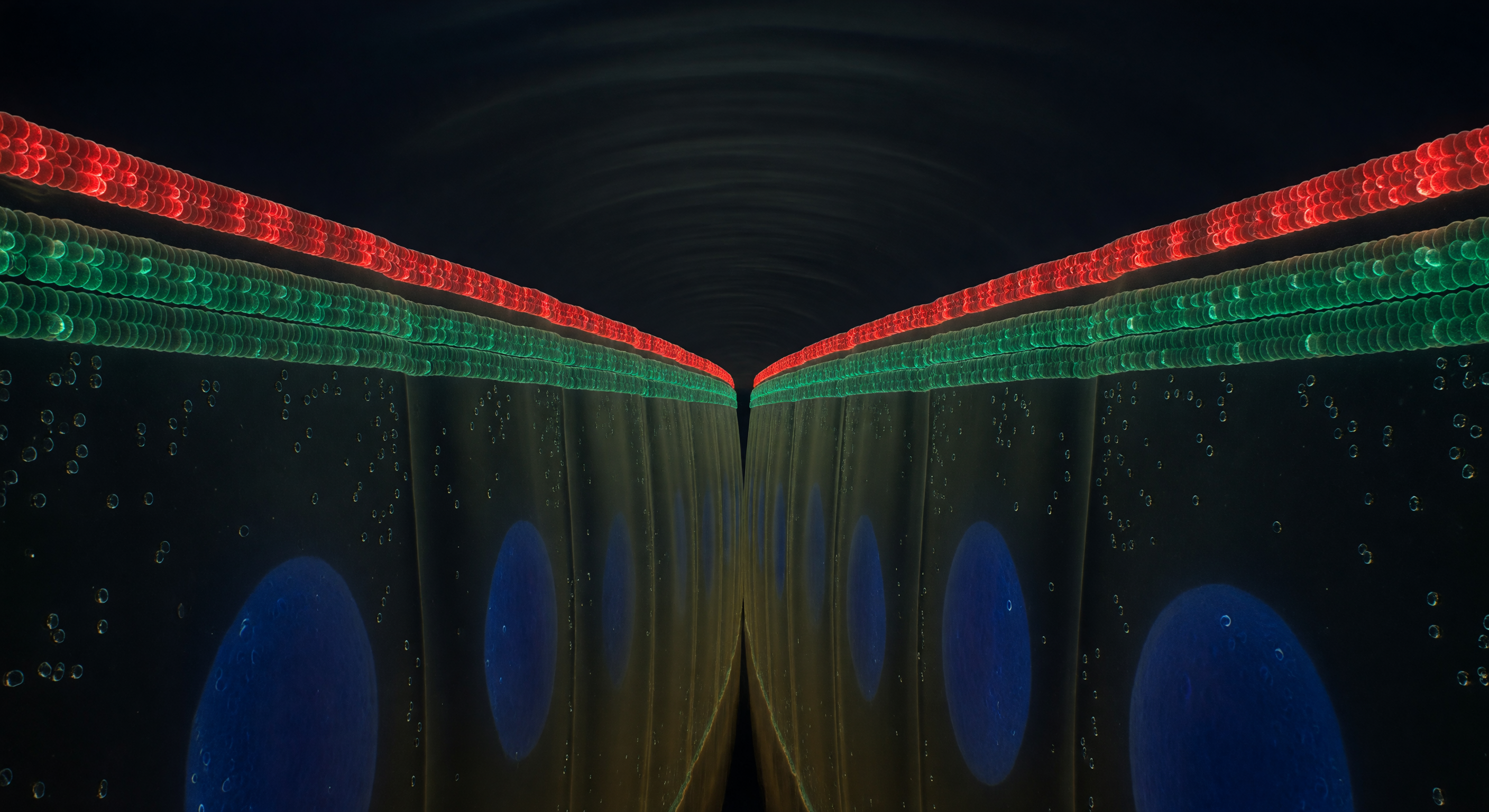
You hover in the narrow aqueous corridor between two immense epithelial walls, pressed nearly flush against one another, their paired membranes running like dark parallel cliffs into the depths below you — a space so confined that the extracellular fluid filling it registers less as a gap than as a faint golden humidity, thickened with glycocalyx sugars and dissolved ions. Girding the full perimeter of this interface at your eye level, a continuous crimson belt of tight junction proteins — claudins, occludins, ZO-1 — forms an unbroken molecular seal, a glowing cinnabar weld fused directly into the bilayers of both cells simultaneously, its slight granularity betraying the crystalline clustering of individual protein complexes repeating along the seal like stitches in living metal. Just below it, a second band resolves in cooler emerald light: the E-cadherin adherens junction, its ectodomains reaching across the 20-nanometer intercellular gap and interlocking like interlaced fingers, mechanically coupling the cytoskeletons of both cells into a single tensile system that coordinates epithelial integrity across the entire tubule circumference. Above you, the tight junction belt marks an absolute boundary — beyond it, the tubule lumen opens without transition into a cavernous black void, its aqueous contents held back entirely by the molecular seal at which you hover — and below you, through semi-opaque cytoplasm radiating diffuse indigo from enormous DAPI-blue nuclei, the cell bodies recede like the deep panels of a stained-glass window seen from within the lead came, the junction proteins themselves the luminous armature holding the living architecture together.
Other languages
- Français: Anneau de Jonction Épithéliale
- Español: Anillo de Unión Epitelial
- Português: Anel de Junção Epitelial
- Deutsch: Epithelialer Verbindungsring
- العربية: حلقة الوصل الظهاري
- हिन्दी: उपकला संधि वलय
- 日本語: 上皮密着結合の環
- 한국어: 상피 밀착 연접 고리
- Italiano: Anello di Giunzione Epiteliale
- Nederlands: Epitheliale Verbindingsring