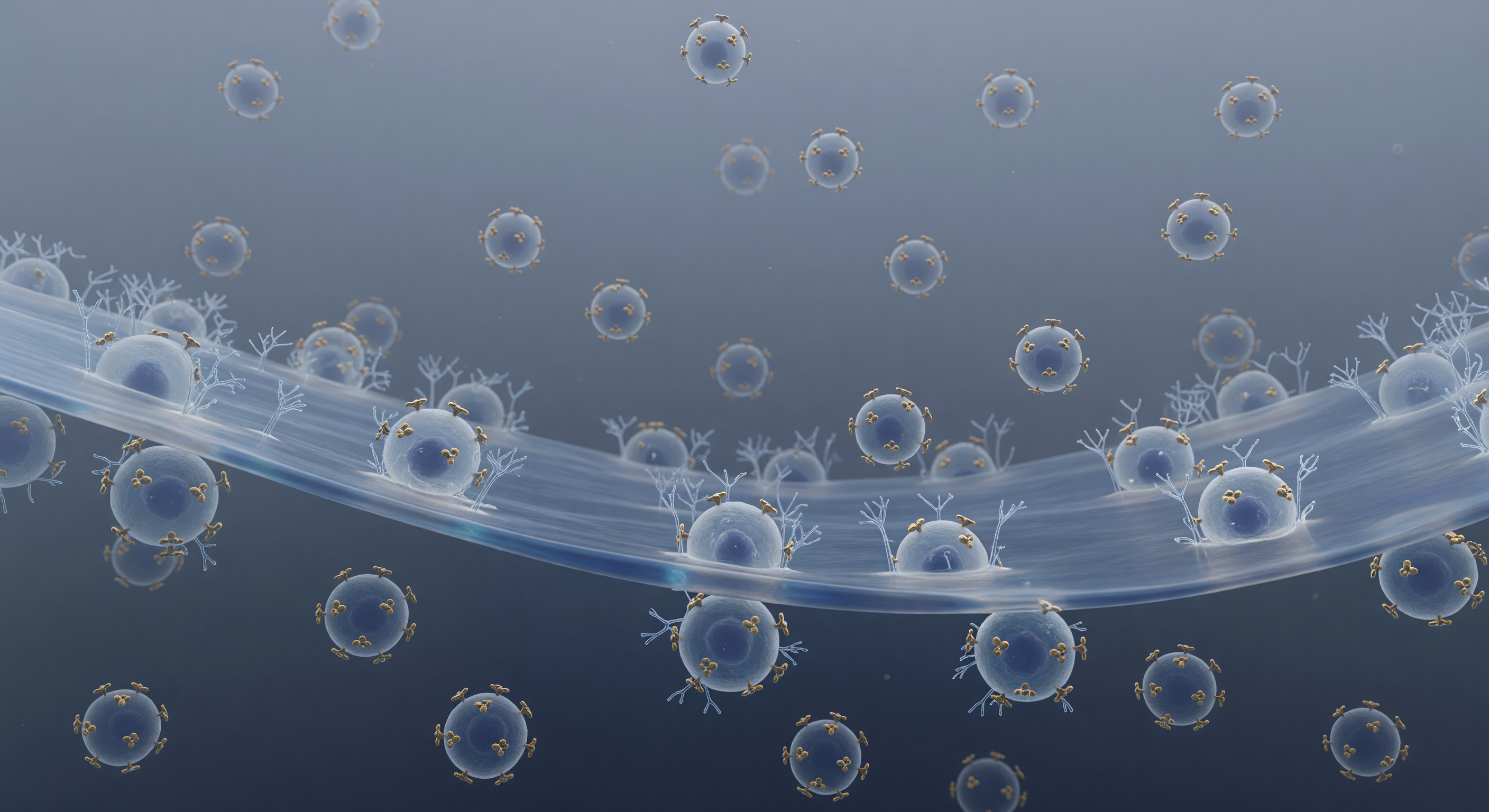
You are suspended in the extracellular fluid just beyond the boundary of a human T-lymphocyte, and the world around you is defined not by light but by mass, chemistry, and the slow inevitability of molecular drift. The plasma membrane curves away in every direction like the cliff face of a deep-ocean trench — its surface an undulating slate-blue interrupted by the enormous crowns of CD4 receptors and the translucent, carbohydrate-tipped fronds of the glycocalyx, which blur the hard edge of the cell into a zone of increasing molecular density, like silt rising from a seafloor. Dozens of HIV-1 virions drift through the faintly translucent extracellular fluid in Brownian suspension around you, each one a softly glowing sphere roughly 120 nanometers across, its interior a smoky blue-gray housing the faint cone-shaped shadow of a condensed capsid core, its outer envelope studded with trimeric gp120-gp41 spike complexes rendered in burnished gold — the only warmth in an otherwise cold, directionless cryo-EM luminescence that emanates from nowhere and everywhere at once. The closest virions have begun drifting into the glycocalyx forest, their gold spikes extending toward CD4 anchoring sites with a proximity that reads as inevitability: the first molecular handshake of viral entry, playing out in a medium where Brownian noise, receptor affinity, and diffusion gradients are the only forces that matter. Beyond them, more virions dissolve progressively into the pale haze of dissolved glycoproteins, their gold trimers reduced to faint warm sparks fading into the pearlescent murk of a fluid world with no photons, no shadows, and no indifference — only chemistry.
Other languages
- Français: Dérive dans la tempête virale
- Español: A la deriva entre viriones
- Português: À deriva na tempestade viral
- Deutsch: Treiben im Virionensturm
- العربية: عائم بين عاصفة الفيريونات
- हिन्दी: विरियन तूफान में बहते हुए
- 日本語: ウイルス粒子の嵐を漂う
- 한국어: 바이러스 폭풍 속을 漂流
- Italiano: Alla deriva tra i virioni
- Nederlands: Drijvend in virionenstorm