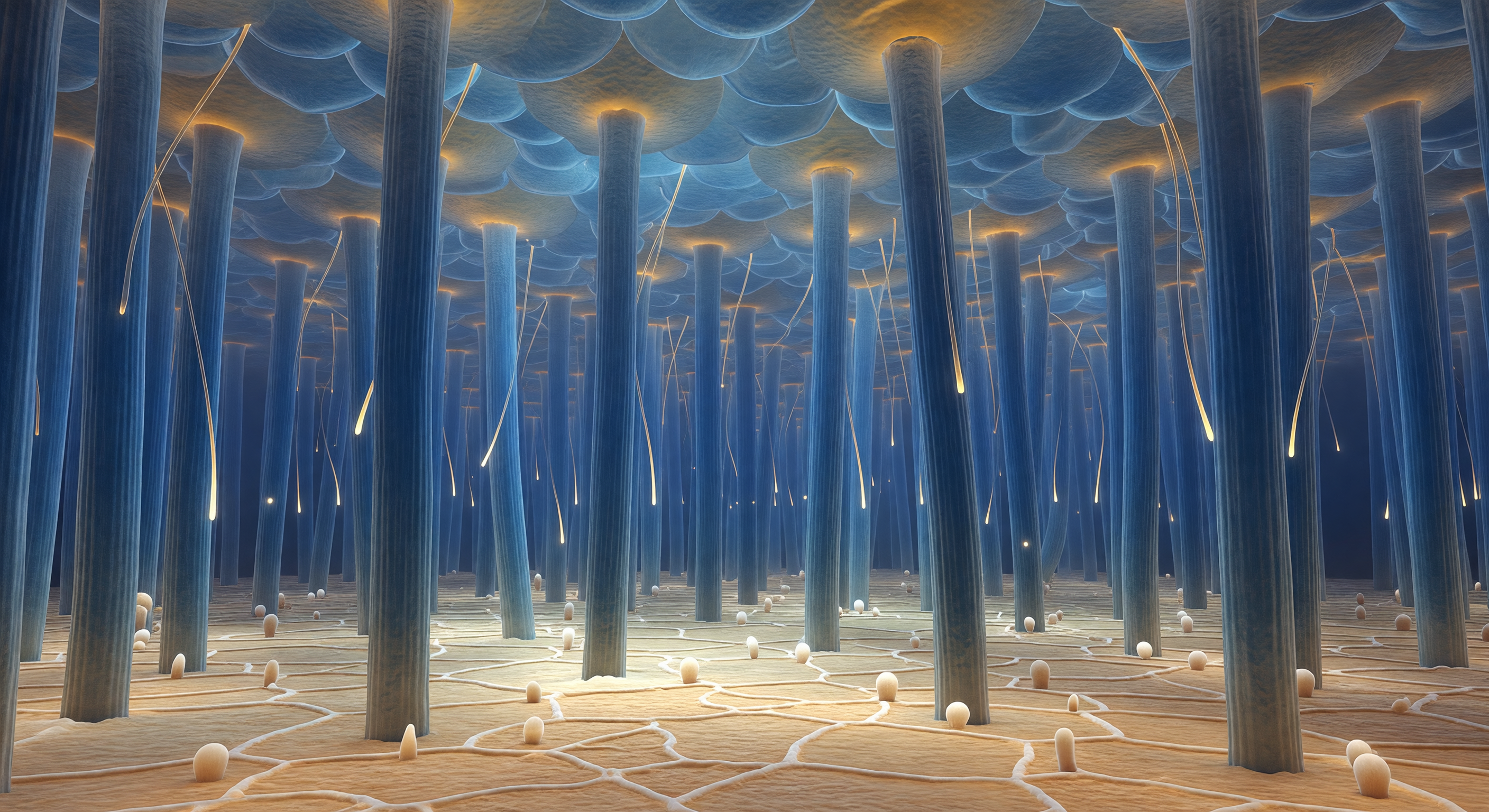
You are standing at the base of a living forest that has no trees — only hundreds of smooth, deep blue-cyan cylinders rising from a warm ochre plain in every direction, each shaft roughly 200 nanometers across and six micrometers tall, packed so densely that no horizon exists, only an infinite repetition of vertical forms dissolving into aqueous blue-gray haze above. These are airway epithelial cilia, each one internally braced by a nine-plus-two arrangement of microtubule doublets whose geometry presses faintly through the outer membrane like ribs beneath wet silk, driven by dynein motor proteins consuming ATP in coordinated strokes to sweep the overlying mucus layer toward the throat at roughly ten millimeters per minute. Between the nearest shafts, amber-gold mucus threads hang in slow catenary arcs — luminous, slightly translucent strands of glycoprotein gel whose viscoelastic properties allow them to stretch without breaking, catching diffuse biological light the way honey catches candlelight, anchored where they touch a ciliary surface by the same surface tension that shapes a dewdrop. Far overhead, the metachronal wave is caught in a single frozen instant: an entire colonnade of cilia leaning ten to fifteen degrees in unison while the adjacent rank stands upright again, the phase offset between each row producing a scalloped, rippling ceiling — a breathing rhythm carved into space, generated by a structure that has no awareness it is breathing at all.
Other languages
- Français: Forêt de Cils Vue du Sol
- Español: Perspectiva del Bosque de Cilios
- Português: Perspectiva do Chão Ciliar
- Deutsch: Zilienwald Bodenperspektive
- العربية: منظور أرضية غابة الأهداب
- हिन्दी: सिलिया वन तल दृश्य
- 日本語: 繊毛の森の床視点
- 한국어: 섬모 숲 바닥 시점
- Italiano: Prospettiva del Bosco di Ciglia
- Nederlands: Ciliën Bosperspectief