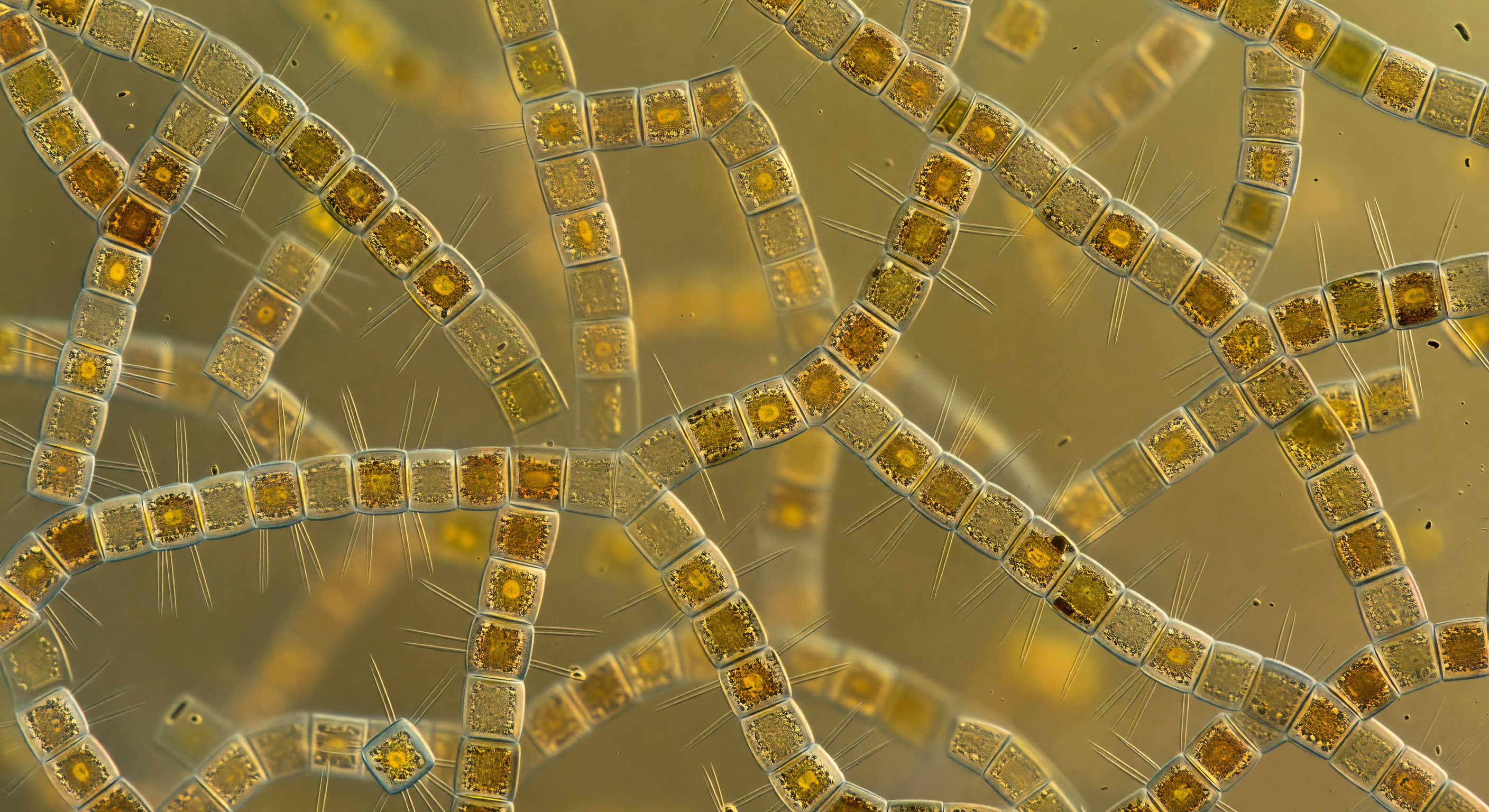
You are suspended inside a living fog of glass and gold, every direction occupied by cylindrical silica towers — *Skeletonema costatum* cells linked end-to-end by radiating arrays of fultoportula struts, each rod a needle of cold clarity catching diffuse light against the warm amber haze that fills every sightline. The illumination has no source: surface sunlight, filtered down through millions of fucoxanthin-laden chloroplasts, has been scattered, partially absorbed, and re-emitted so many times that the water column itself glows from within, a saturated amber-green radiance arriving equally from all directions and eliminating shadow almost entirely. Visibility collapses within half a millimeter, distant chains dissolving into the luminous haze before they can resolve, because the medium between them is not open water but a colloidal soup of extracellular polysaccharides, dissolved pigment, and bacterial cells — dark rod- and comma-shaped forms coating nearly every frustule surface in a dense organic mat that absorbs light where clean silica would scatter it. This is a spring bloom at its peak: a community of single-celled photosynthesizers dividing every twelve to thirty-six hours, knitting the upper ocean into an open ribcage lattice of biogenic silica that stretches, without interruption, in every direction — claustrophobic, gorgeous, alive in every cubic micrometer.
Other languages
- Français: Bloom Dense Brume Ambrée
- Español: Floración Densa Niebla Ámbar
- Português: Floração Densa Névoa Âmbar
- Deutsch: Dichter Bernstein Blütennebel
- العربية: ضباب كهرماني كثيف مزهر
- हिन्दी: घना एम्बर शैवाल कोहरा
- 日本語: 濃密な琥珀色の藻類霧
- 한국어: 짙은 호박빛 조류 안개
- Italiano: Fioritura Densa Nebbia Ambrata
- Nederlands: Dichte Amber Algenwaas