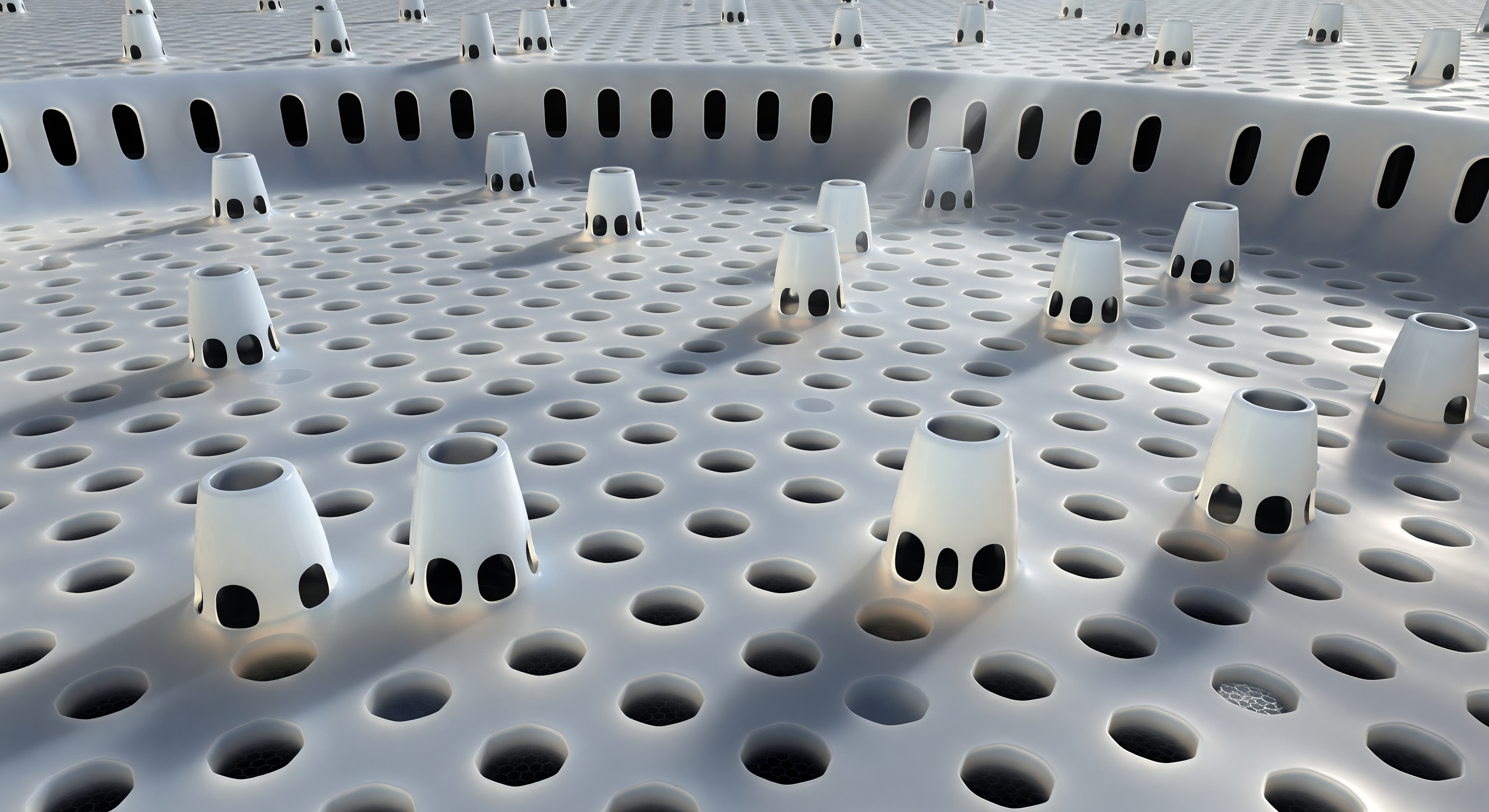
You drift above a tilted world of glass, its surface curving away in every direction like the hull of an enormous buried planet, tessellated from edge to invisible edge with thousands of perfect hexagonal pits — each one a six-sided shaft dropping two hundred nanometers into absolute silica shadow, their velum meshwork floors visible only as ghostly lattices revealed by the low-raking electron-beam illumination that turns every ridge into blazing white and every interior into matte black. This is the valve face of *Coscinodiscus wailesii*, a centric diatom, and what reads as monumental architecture is the organism's frustule: a shell of amorphous biogenic opal deposited with nanometer precision inside a silica deposition vesicle during the cell's division cycle, its areola geometry encoding taxonomic identity in the very periodicity of the hexagonal array. From the plain, fultoportulae towers rise at irregular intervals — hollow silica columns open at their bores, each flanked by three satellite pores through which the cell once secreted chitin fibrils outward into the water column, their directional shadows sweeping across the hexagonal field like sundials marking a frozen moment. At the valve margin, rimoportulae appear as dark elongated slits cut cleanly through the silica precipice, mechanosensory structures whose inner chambers once connected cytoplasm to sea, while below the mantle's curve the smooth cingulum bands begin — featureless hoops of silica receding into depth, the plain girdle holding epitheca to hypotheca in a joint refined across two hundred million years of evolutionary pressure.
Other languages
- Français: Architecture Nanopores au MEB
- Español: Arquitectura Nanoporos SEM Inmersiva
- Português: Arquitetura Nanoporos MEB Imersiva
- Deutsch: REM Nanoporen Architektur Immersiv
- العربية: هندسة النانومسام بالمجهر الإلكتروني
- हिन्दी: SEM नैनोपोर वास्तुकला दृश्य
- 日本語: SEM ナノポア構造の没入景観
- 한국어: SEM 나노기공 건축 몰입 경관
- Italiano: Architettura Nanopori SEM Immersiva
- Nederlands: REM Nanoporeuze Architectuur Meeslepend