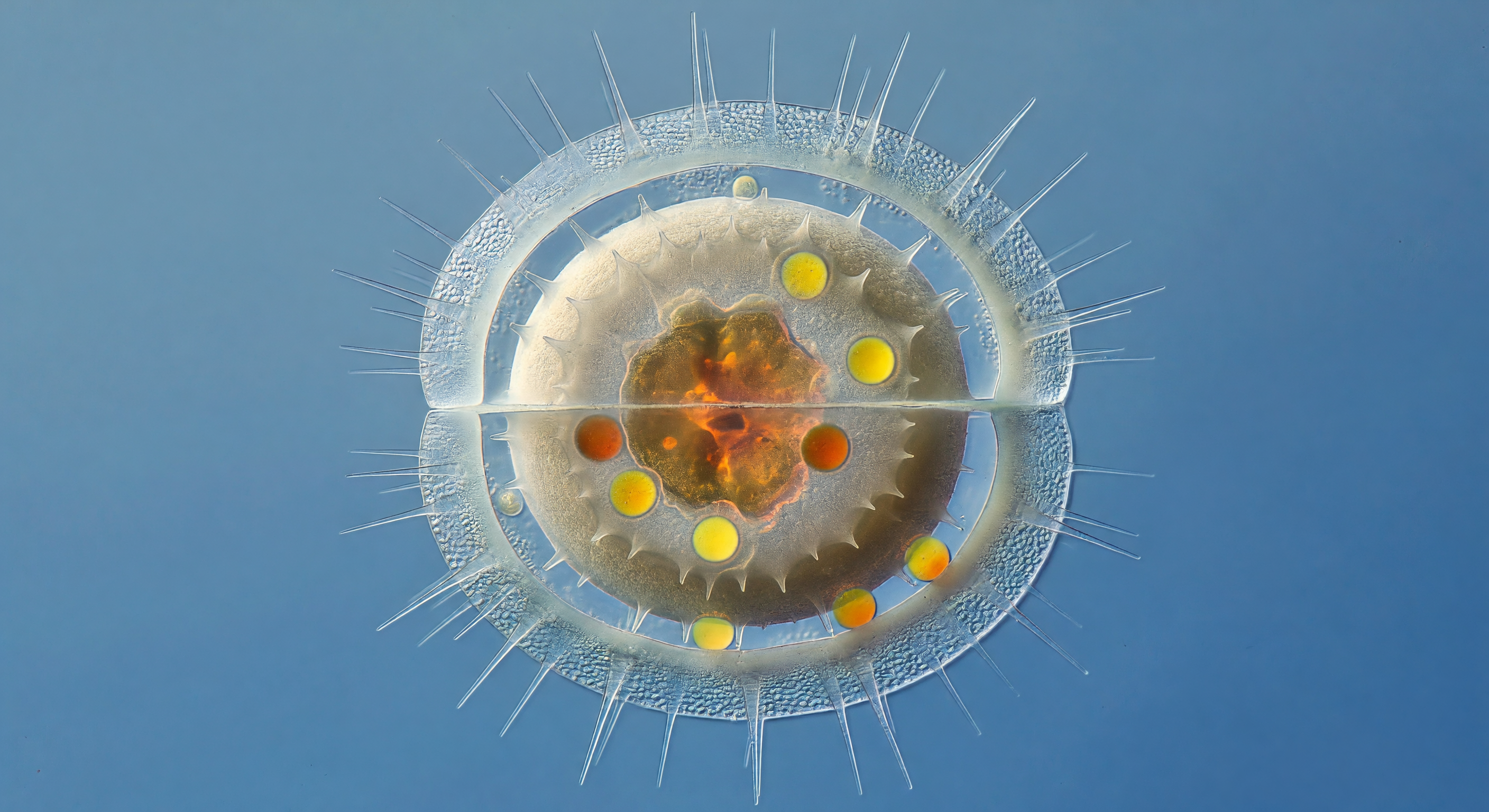
You are suspended ten micrometers from the outer wall of a dying *Chaetoceros* frustule, close enough that its long hollow setae radiate past you like the spokes of a shattered chandelier, each one a tapering needle of nearly vanished silica scattering ambient blue-green light into faint spectral halos. The parent cell's walls have thinned to gossamer — hydrated amorphous opal barely a hundred nanometers thick, its areolae bleached of interference color, the whole cylindrical lantern form held together more by geometric habit than by any remaining structural integrity, its copulae rings splayed slightly outward by the pressure of what swells within. Inside, the resting spore fills the dying shell the way a river stone fills a soap bubble: two full micrometers of granular amorphous silica stacked in concentric laminae, its surface roughened with blunt hexagonally clustered spines, its color the matte warm ivory of unglazed ceramic — opaque where the parent frustule is ghostly, dense where the outer walls are dissolving back into the silicic acid they borrowed from the sea. And yet sealed within that heavy ceramic vault, visible only because the thinning parent transmits light like a paper lantern, the interior of the spore glows: a collapsed lobe of deep amber chloroplast tissue — fucoxanthin concentrated to near-opacity — surrounded by brilliant cadmium-to-ember lipid droplets, each one a bead of stored solar energy pressing gently against the thick inner wall, the entire living treasure radiating warmth against the cold blue oceanic water fading to deep cobalt at the edge of the field.
Other languages
- Français: Perle Dormante Sous Verre
- Español: Perla Espora en Vitrina
- Português: Pérola Adormecida em Vidro
- Deutsch: Ruhende Spore im Glashaus
- العربية: لؤلؤة الجراثيم داخل الزجاج
- हिन्दी: कांच घर में सुप्त बीजाणु मोती
- 日本語: ガラスの家の休眠胞子
- 한국어: 유리 집 속 휴면 포자 진주
- Italiano: Perla Spora Nel Guscio Vitro
- Nederlands: Rustende Spore in Glazen Huis