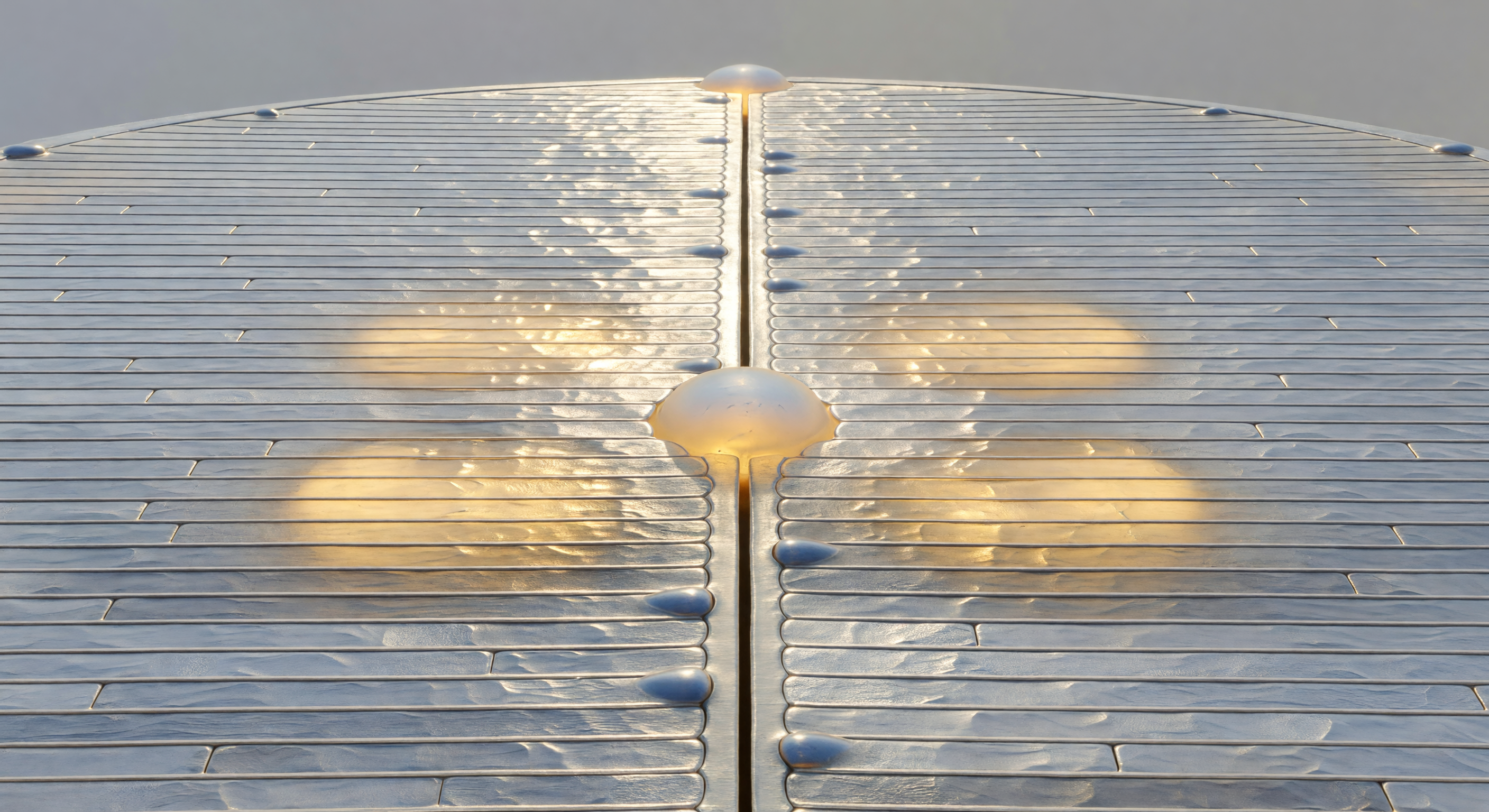
You hover above a continent-wide plateau of sculptured glass, its surface hammered into parallel ridges by polarized light that reads every nanometer of relief as though raking across cold metal at dusk — this is the valve face of *Pinnularia nobilis*, a pennate diatom roughly 150 micrometers from pole to pole, its frustule cast from amorphous biogenic silica deposited inside living membrane vesicles with molecular precision. The transverse costae march across the full width of the plateau in strict regimentation, each a low ridge of opaline material separated by rectangular bays where the silica thins and the differential interference contrast wavefront shifts from bone-white to dove-grey, while the central sternum runs the entire axial length as a pale luminous highway — the structural backbone from which the raphe slit is incised like a deliberate canyon, its absolute darkness hinting at the nanometer-wide groove through which this living cell extrudes adhesive mucilage to glide across substrates at speeds measured in micrometers per second. Beneath the cool metallic surface, visible through the silica as warmth bleeds through amber glass, two H-shaped chloroplast lobes glow with fucoxanthin-orange biology, and between them the nucleus sits as a frosted ellipsoid of sourceless interior light — two worlds stacked one over the other, the cold mineral architecture of a frustule that will outlast its maker by millions of years enclosing the warm, metabolizing, dividing life that built it.
Other languages
- Français: Pinnularia Sculptée en Relief DIC
- Español: Pinnularia Esculpida en Relieve DIC
- Português: Pinnularia Esculpida em Relevo DIC
- Deutsch: Pinnularia im DIC-Relief Geformt
- العربية: بينولاريا منحوتة بتباين التداخل
- हिन्दी: DIC राहत में उकेरी पिनुलेरिया
- 日本語: DIC干渉で刻まれたピンナラリア
- 한국어: DIC 부조로 조각된 피눌라리아
- Italiano: Pinnularia Scolpita in Rilievo DIC
- Nederlands: Pinnularia Gebeeldhouwd in DIC-Reliëf