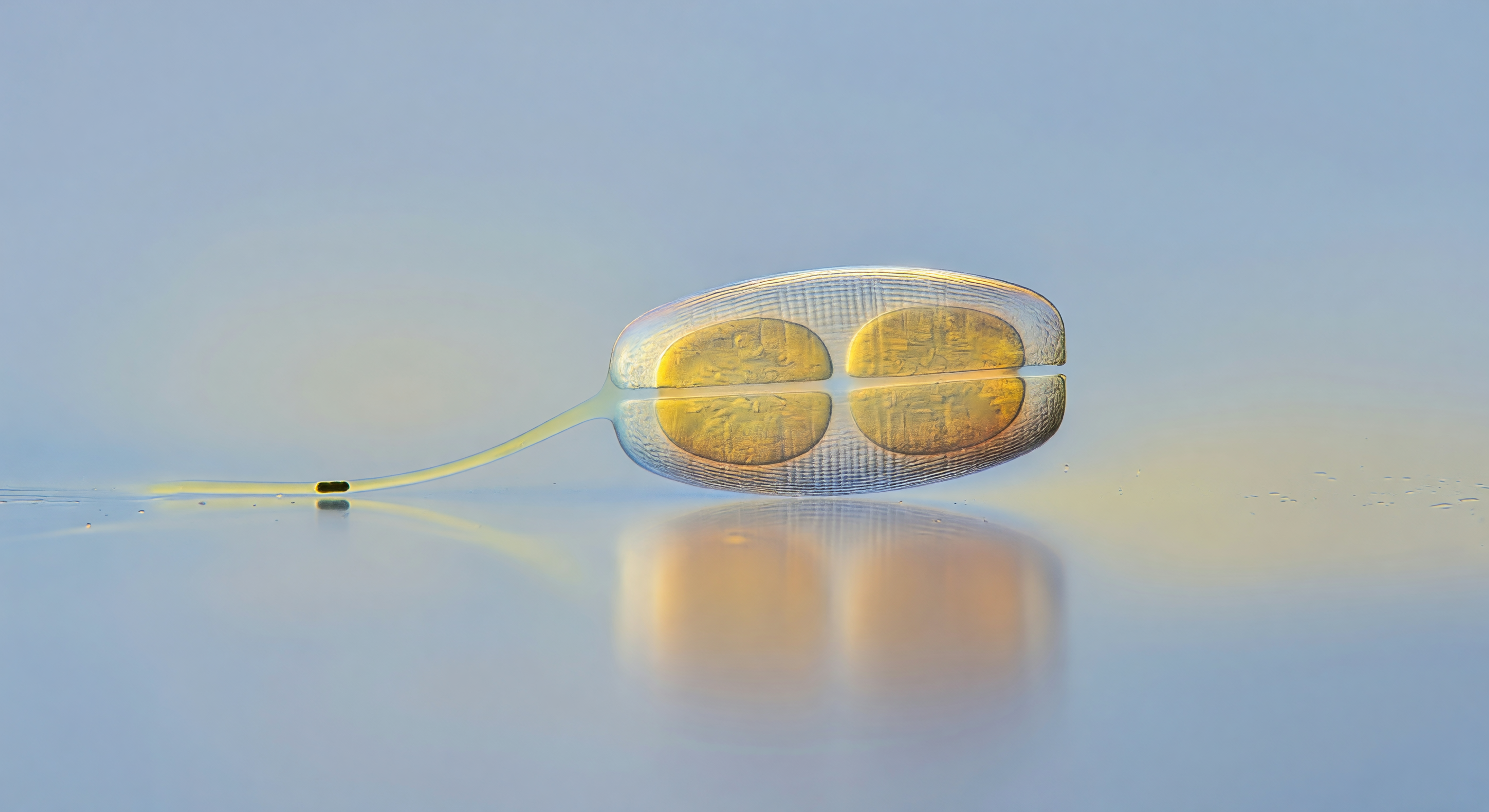
You are suspended just above a polished glass plain that extends to every horizon, its surface barely distinguishable from the seawater film lying across it — a molecular-thin glycoprotein slick giving the substrate a faint iridescent sheen, as if the ocean floor itself had been compressed to a single luminous sheet. Ahead of you, slow and inevitable as a barge crossing a harbor, a *Navicula* cell thirty micrometers long slides rightward through this world: a biconvex hull of amorphous hydrated silica whose valve face is finely corrugated with transverse striae, their diffraction shimmer cycling through steel-blue and warm bronze as oblique phase-contrast light catches the dorsal ridge in a crescent of silver-white. Within the translucent frustule, two large chloroplasts glow with saturated golden-ochre light — fucoxanthin pigment bleeding softly through the silica walls and pooling on the glass beneath the cell in twin lobes of amber warmth — while the raphe slit, a near-invisible seam running the cell's median axis, continuously extrudes the adhesive mucilage that both anchors and propels the organism through the friction of its own secretion at speeds of one to twenty-five micrometers per second. Trailing roughly eight micrometers behind the living hull, a single bacterial rod clings to the pale-yellow refractive wake of that mucilage ribbon — dark, comma-shaped, utterly still — held fast by the same extracellular chemistry that bonds diatom to glass, a reminder that even this solitary gliding cell drags an ecological relationship behind it.
Other languages
- Français: Navicula Glisse sur Verre
- Español: Navícula Desliza en Vidrio
- Português: Navícula Desliza no Vidro
- Deutsch: Navicula Gleitet über Glas
- العربية: نافيكولا تنزلق على الزجاج
- हिन्दी: नाविकुला कांच पर फिसलती
- 日本語: 珪藻ガラスを滑る
- 한국어: 규조류 유리 위를 활주
- Italiano: Navicula Scivola sul Vetro
- Nederlands: Navicula Glijdt over Glas