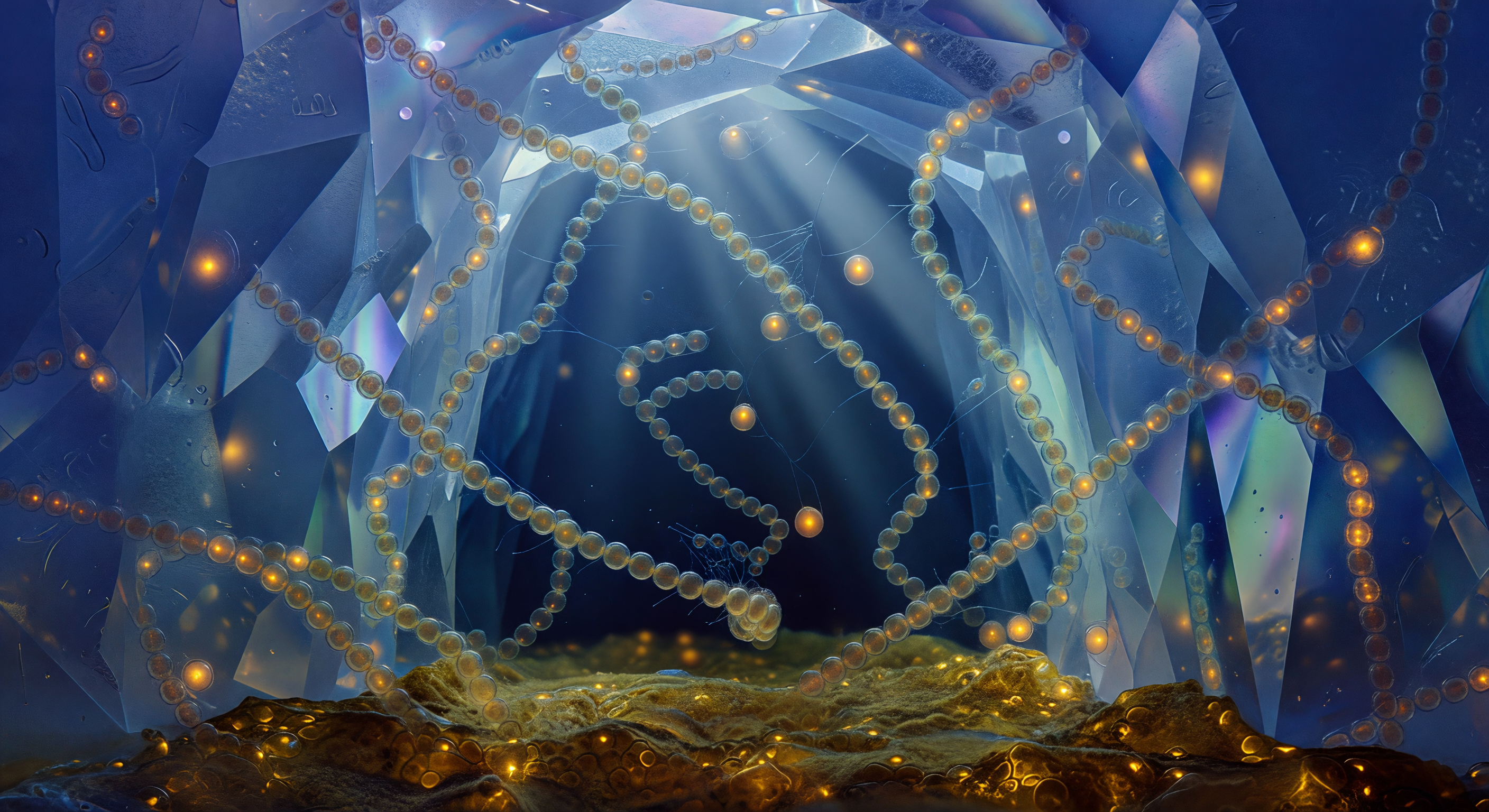
You are suspended inside a narrow fracture in Antarctic sea ice, its walls rising around you like the inner faces of a geode cut from polar glass — each crystallographic plane a slightly different angle, splintering the dim light filtering down from the surface into overlapping wedges of cobalt, pale violet, and cold silver. The channel exists because brine, excluded as seawater freezes, concentrates into these sinuous veins where the salt lowers the freezing point enough to keep liquid water at –2°C, creating a hypersaline microhabitat whose slightly viscous fluid carries a faint amber optical warmth against the surrounding blue ice. Drifting through this enclosed world are ribbon-chains of *Fragilariopsis cylindrus*, each cell an 8-micron silica cylinder so glassy it nearly vanishes, made visible only by the saffron-bronze chloroplasts burning inside like compressed embers — fucoxanthin pigments shifted toward warmer wavelengths to harvest the dim, blue-attenuated polar light reaching this depth. Around each chain, an invisible sheath of antifreeze exopolysaccharide gel hazes the frustule outlines and anchors gossamer mucilage threads to the ice-crystal walls, the biological strategy that keeps these organisms locked within the channel rather than flushed into open water. Below, the channel floor is stained dark amber-bronze by generations of accumulated diatom biomass — a compressed living mat that marks this frozen architecture as something more than geology: a vertical canyon of cold light and biological warmth, microhabitat and organism co-constructed at the boundary of ice and liquid.
Other languages
- Français: Diatomées Polaires Chenal Glacé
- Español: Diatomeas Polares Canal Salmuera
- Português: Diatomáceas Polares Canal Gelo
- Deutsch: Polare Diatomeen Eissolelkanal
- العربية: دياتومات قطبية قناة جليدية
- हिन्दी: ध्रुवीय हिमनद नमक चैनल शैवाल
- 日本語: 極地氷塩水路珪藻類
- 한국어: 극지 빙염수 채널 규조류
- Italiano: Diatomee Polari Canale Ghiaccio
- Nederlands: Polaire Diatomeeën Pekelkanaal