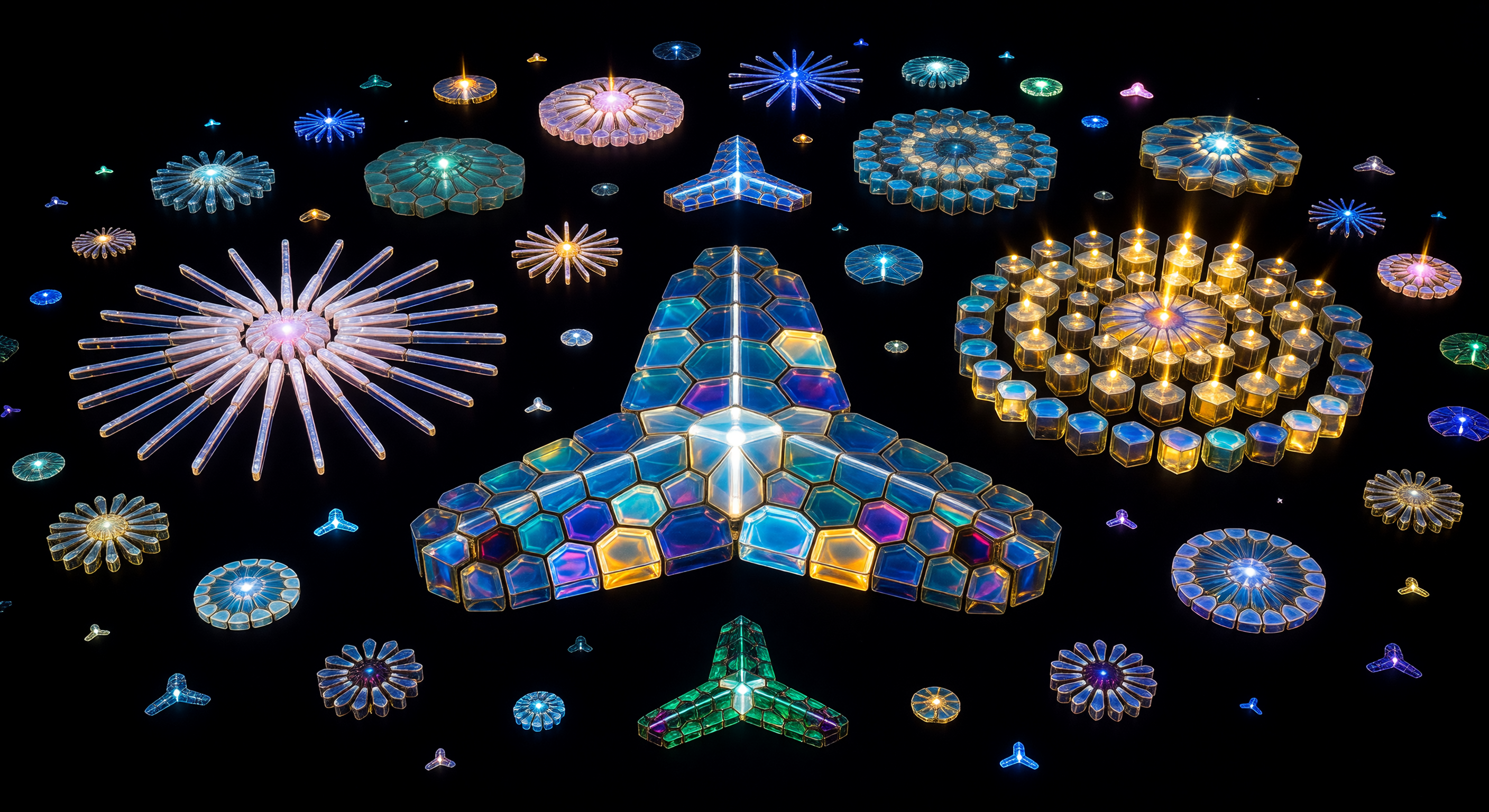
You are suspended at the heart of a Victorian diatomist's masterwork, surrounded by a constellation of silica architecture hovering in absolute black — each frustule a self-luminous reliquary of amorphous opal-A glass, acid-cleaned to pure mineral skeleton and glowing with cold interference light. These are the frustules of single-celled algae, organisms whose bodies are entirely enclosed in precisely nanofabricated silica shells built in two interlocking valves, each hexagonal areola a diffraction grating only nanometers thick that splits incident light into electric cobalt, smelted amber, and shivering violet across its surface. The *Triceratium* blazing before you spans perhaps forty times your simulated body length, yet it is a single cell's worth of architecture — its terraced silica ramparts and pierced lantern pores the product of a biological silica deposition vesicle working with molecular precision over a matter of hours. Around you, the *Coscinodiscus* wheel, the pearl-spoke *Arachnoidiscus*, and the sigmoid calligraphy of *Pleurosigma* each glow with their own spectral identity, their striae densities and pore geometries the very characters taxonomists use to read species identity like text. In the void between them, fragments of *Navicula* and *Pinnularia* return borrowed diffracted light as faint blue sparks — the scattered remnants of organisms whose shells, once sedimented, will outlast the cells themselves by millions of years.
Other languages
- Français: Joyaux Victoriens Champ Noir
- Español: Gemas Victorianas Fondo Oscuro
- Português: Joias Vitorianas Campo Negro
- Deutsch: Dunkelfeldkristalle Viktorianisch
- العربية: جواهر فيكتورية حقل مظلم
- हिन्दी: विक्टोरियन रत्न अंधेरा क्षेत्र
- 日本語: 暗視野ヴィクトリア宝石配列
- 한국어: 암시야 빅토리아 보석 배열
- Italiano: Gemme Vittoriane Campo Scuro
- Nederlands: Donkerveld Victoriaanse Juwelen