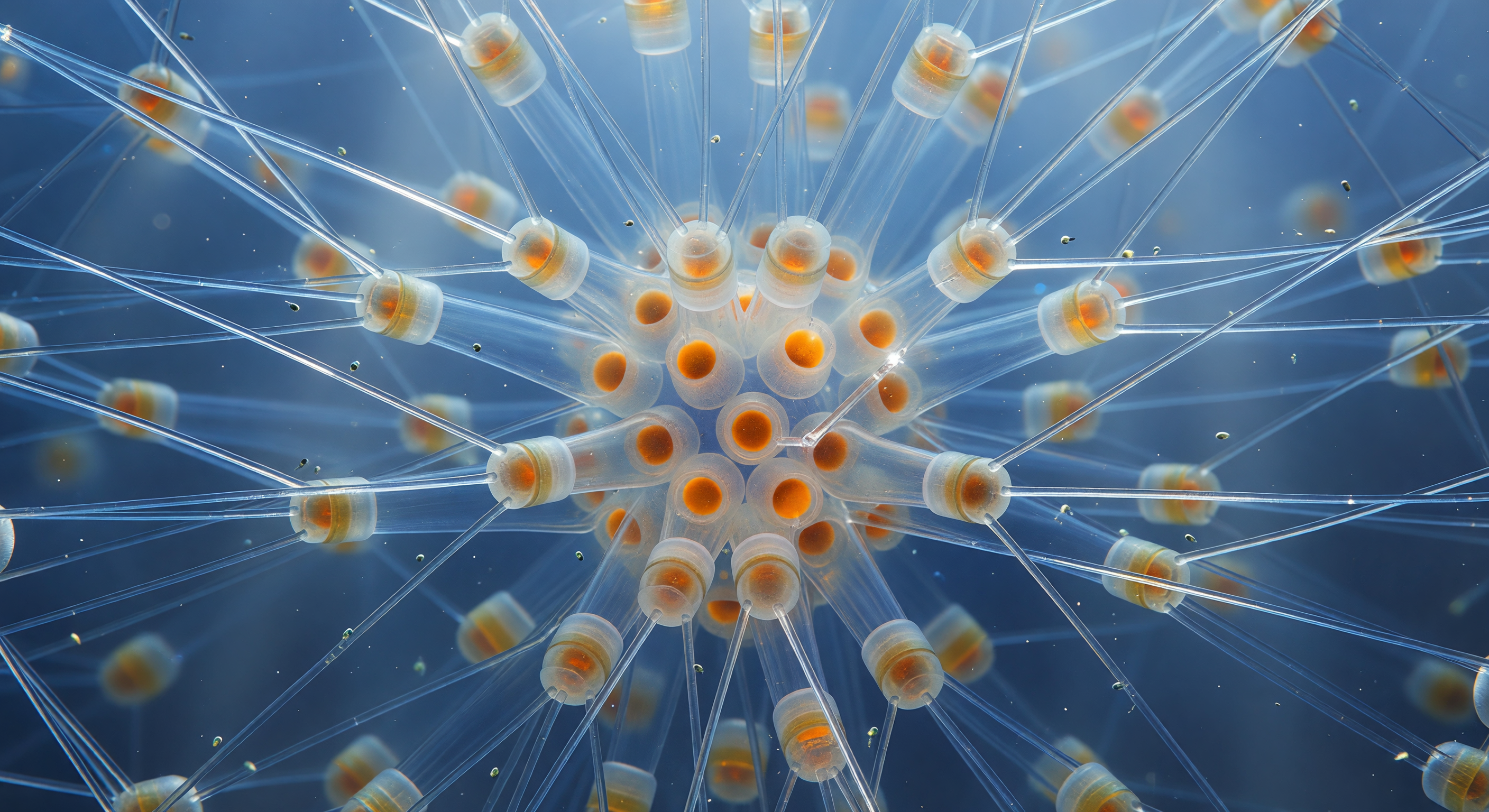
You are suspended inside the geometric heart of a *Chaetoceros* colony drifting in open ocean, surrounded in every direction by hollow silica setae—each needle nearly transparent, no thicker than spun quartz, extending from stacked cylindrical cell bodies in interlocking X-lattices that recede into cold indigo haze. These bristles are biogenic glass: amorphous hydrated silica (SiO₂·nH₂O) deposited by living cells within membrane-bound vesicles, their walls so thin that ambient oceanic blue passes clean through them, broken only by bright hairline caustics where curved surfaces concentrate filtered sunlight into white-gold filaments suspended between the struts like trapped stars. At the colony's dense core, resting spores glow with a deeper, more saturated amber—heavily silicified spheres whose thickened valves scatter light diffusely, warm embers of organic density anchoring the crystalline scaffolding—while the cylindrical cell bodies ringing them reveal their fucoxanthin-rich chloroplasts as burnt-sienna warmth pressed against frosted girdle rings stacked like sections of translucent glass tubing. Nanoscale flagellates drift between the setae on invisible currents, each a pale grey-green mote catching light for a single instant as it turns, the water itself carrying a faint milky haze of dissolved organics and silica debris that softens the far background into gradients of cerulean and slate—the whole structure reading as a living chandelier of biogenic glass, an architectural interior whose microscopic truth is entirely lost from the outside world.
Other languages
- Français: Profondeurs de la forêt de soies
- Español: Profundidades del bosque de cerdas
- Português: Profundezas da floresta de cerdas
- Deutsch: Tiefen des Borsten Waldes
- العربية: أعماق غابة الشعيرات
- हिन्दी: शैटोसेरस कंटक वन गहराई
- 日本語: 珪藻剛毛の森の深み
- 한국어: 규조 강모 숲의 깊이
- Italiano: Profondità della foresta di setole
- Nederlands: Diepten van het borstelwoud