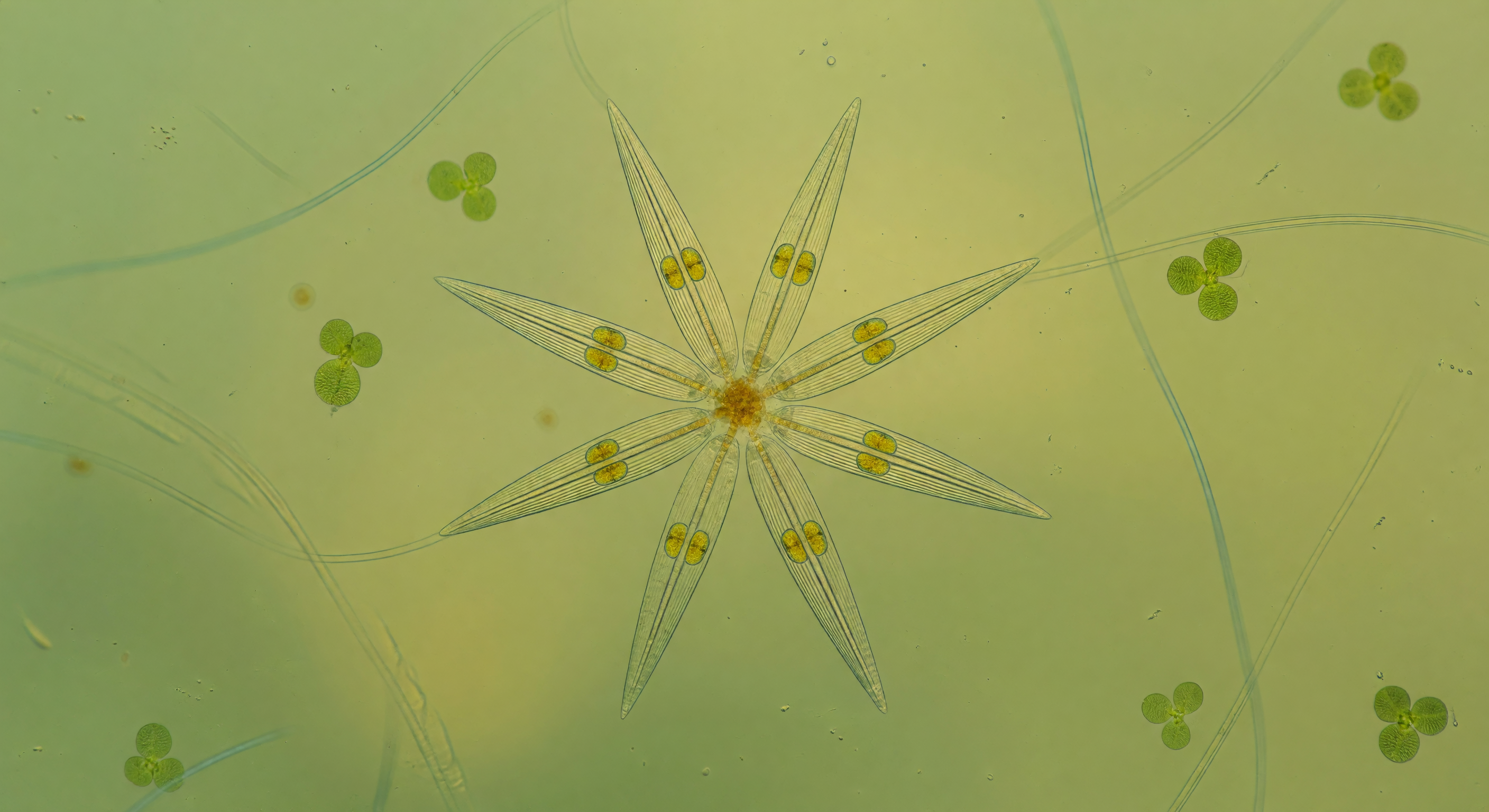
You are suspended in the amber-green twilight of a freshwater epilimnion, hovering at the tip of one arm of a perfect eight-armed silica rosette that dominates your entire field of view — an *Asterionella formosa* colony, its arms each a slender rod of biogenic amorphous silica tapering like a cathedral buttress, translucent as fire-polished borosilicate glass and edged with thin-film interference halos of pale gold and cool silver where downwelling daylight catches the striated areolae along each valve face. At the colony's centre, a dense amber knot of mucilage polysaccharide binds all eight frustules into their characteristic star geometry, the same biopolymer adhesion that allows colonial diatoms to construct architecturally precise superstructures from individually nanoporous silica shells — each cell wall a two-part epitheca-over-hypotheca assembly deposited in silica deposition vesicles over hours of quiet cellular labour. Two paired chloroplasts run the length of every arm like amber ingots, their fucoxanthin pigmentation glowing warmly through the glass and casting faint brown-gold luminescence into the surrounding water, driving the photosynthesis that makes freshwater epilimnion blooms of this species visible as golden-brown surface flocs to the naked eye. Beyond the colony, soft-focus Staurastrum desmids and cyanobacterial filaments populate the luminous haze of the water column, their presence a reminder that this medium — viscous, tannin-tinged, chemically alive — is a competitive ecosystem in which the Asterionella's silica architecture both concentrates light for photosynthesis and slows sinking through Stokes drag, buying time in the illuminated zone at the cost of a mineral investment that will outlast the cell itself by millions of years.
Other languages
- Français: Colonie Étoilée Asterionella
- Español: Colonia Estelar Asterionella
- Português: Colônia Estelar Asterionella
- Deutsch: Asterionella Sternkolonie Süßwasser
- العربية: مستعمرة نجمية في المياه العذبة
- हिन्दी: अस्टेरियोनेला तारा कॉलोनी
- 日本語: アステリオネラ星形コロニー
- 한국어: 아스테리오넬라 별 군락
- Italiano: Colonia Stellare Asterionella
- Nederlands: Asterionella Sterkolonie Zoetwater