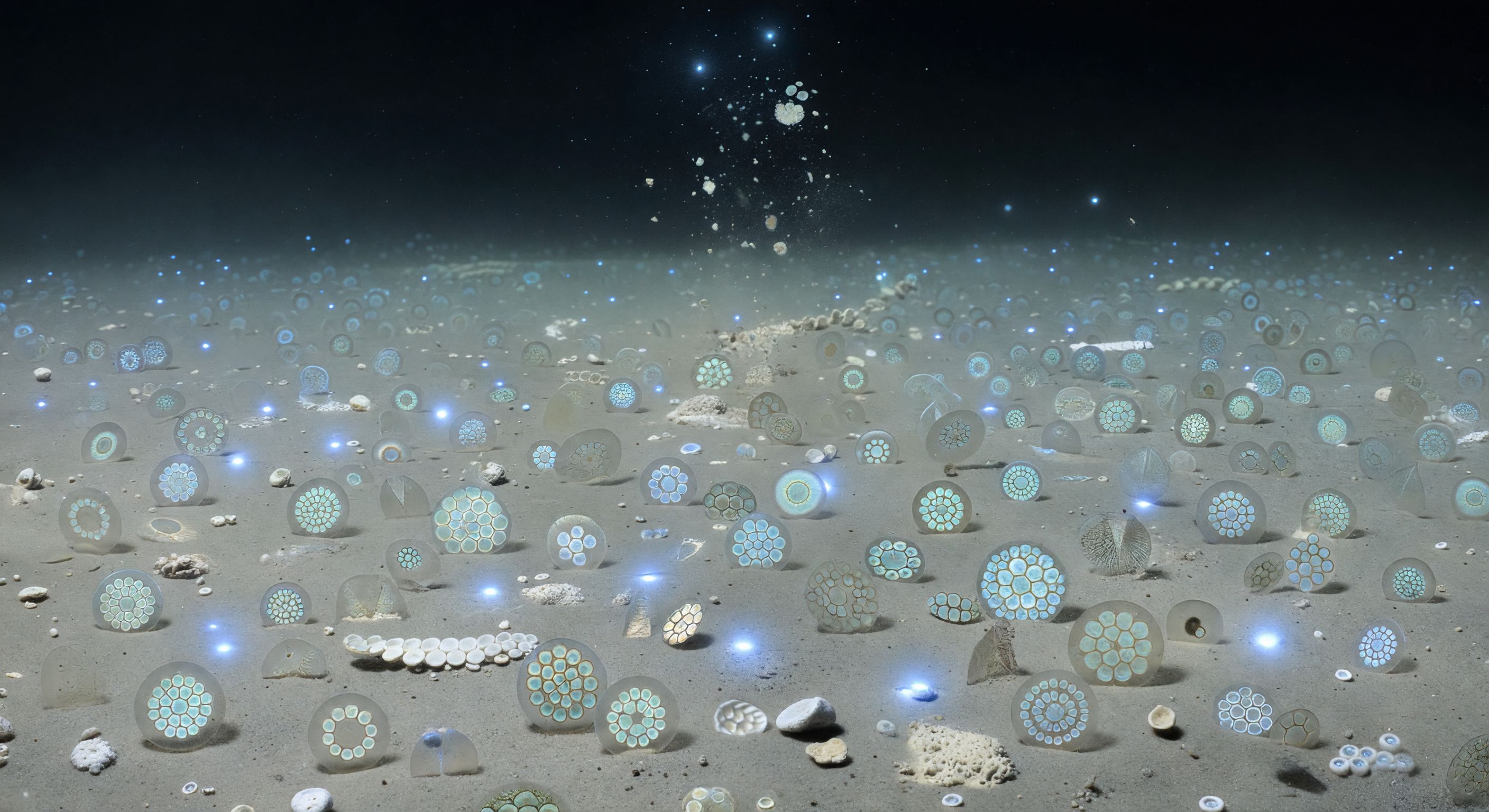
You drift centimeters above the Southern Ocean floor at three thousand meters depth, where the world resolves into a pale grey-beige plain built not from rock or sand but from the accumulated silica and carbonate remains of a hundred million years of surface blooms — a sediment called diatomaceous ooze, composed almost entirely of biogenic opal and foraminifera tests settling through the water column in a slow, perpetual snow. Tilted at random angles from this surface, intact *Coscinodiscus* frustules protrude like translucent manhole covers half-buried in ash, their concentric rings of hexagonally packed areolae still geometrically perfect, the amorphous hydrated silica of each valve catching interference colors — pale aquamarine, faded gold, cold ivory — in a world where no sunlight has ever reached; between them, *Eucampia* girdle-band fragments and feather-edged pennate valves of *Fragilariopsis* show the work of corrosive abyssal water operating just above the lysocline, their margins dissolved into lacy gradients where structured glass becomes suggestion, while white foraminifera tests sit like small architectural ruins among the siliceous material, some intact, some already collapsing into chalky stain. From several points embedded in the ooze, slow pulses of cold blue bioluminescence bloom and die in the bacterial colonies metabolizing within the sediment matrix, their light diffusing upward through overlying frustule valves and briefly illuminating the areolae like fiber-optic arrays before darkness reasserts itself. Far toward the haze-limit of visible depth, a pale plume rises in a soundless column where a polychaete moves beneath the surface, its passage lifting decades of delicate accumulation into a slow-motion cloud of frustule fragments and carbonate dust that drifts upward through the dark water, each tumbling shard of diatom valve catching a blue bacterial flicker for a fraction of a second before the column of darkness swallows it completely.
Diatoms