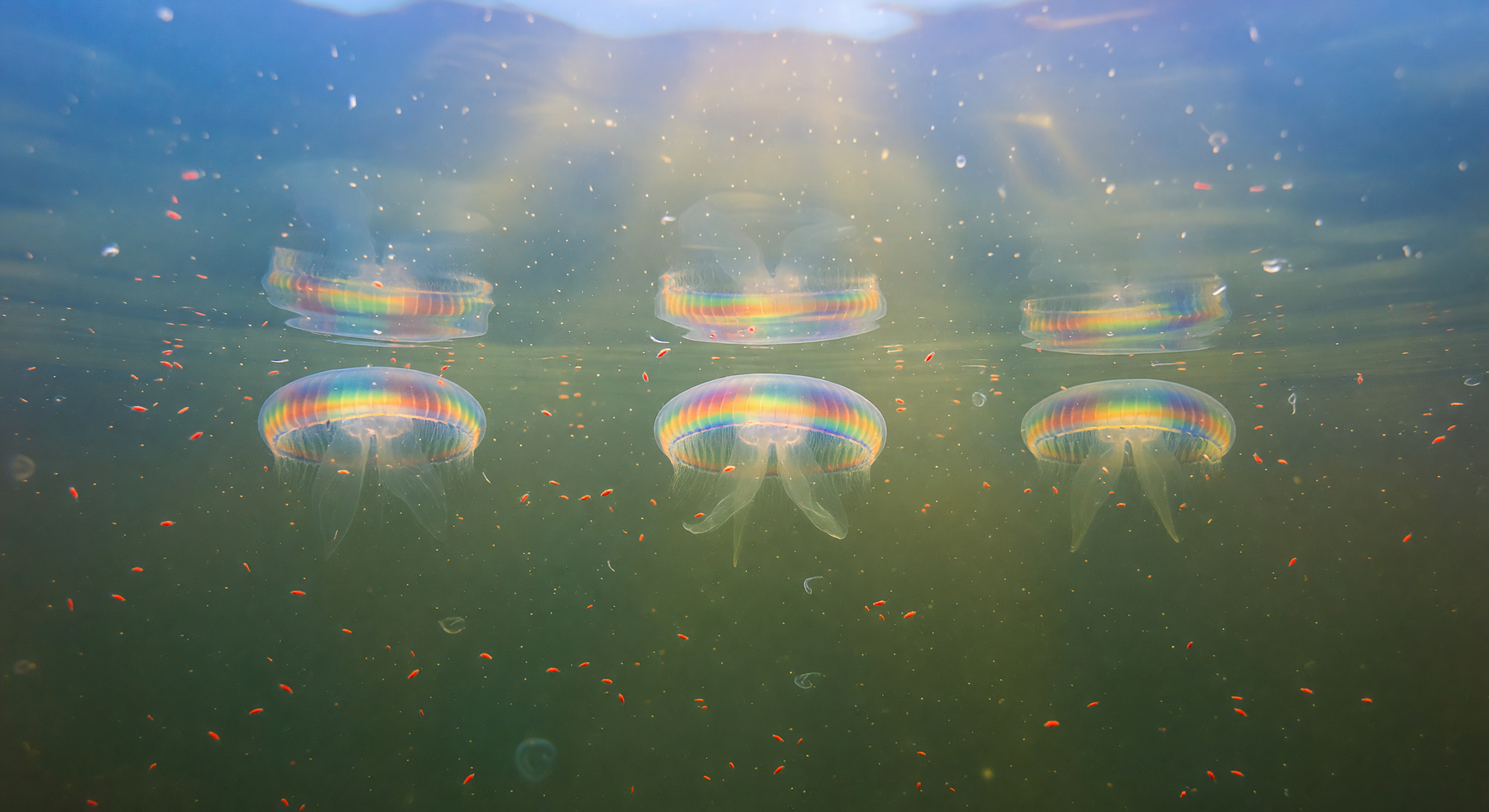
You are suspended at forty meters in open water, weightless in a column of blue that cools and greens perceptibly at eye level, where the thermocline asserts itself as a continuous trembling lens — a horizontal shimmer stretching wall to wall across the entire visible field, warping distant shapes the way summer heat warps asphalt, the density boundary between two distinct water masses rendered optically visible as a faint undulating glaze. Shafts of filtered afternoon sunlight angle down from above and diffuse into wide cones of pale gold that terminate just above this mirror-line, leaving the colder water below in a dim, greenish, particulate twilight dense with marine snow and scattered orange-red copepod specks — zooplankton concentrated precisely at the interface where mixing brings nutrients and the thermal step slows their descent. Three *Mnemiopsis leidyi* hang motionless at the boundary, each a flattened oval of near-perfect optical transparency — five to eight centimeters of mesoglea whose refractive index so closely matches seawater that the thermocline shimmer passes straight through their bodies and reappears on the far side, while their eight comb rows erupt in slow-rolling sweeps of structural color, ruby sliding to amber to acid green to indigo as each ctene plate acts as a diffraction grating and the metachronal wave travels mouth to aboral pole in under a second. Their oral lobes hang open and extended downward into the colder prey-rich zone, hairlike cilia drawing copepod-laden water upward across colloblast-studded surfaces, the animals straddling the thermocline with the precision of buoyancy masters — upper halves lit in warm filtered gold, lower halves bathed in cold green dusk — the refractive boundary line bisecting each transparent body like a ruled line drawn cleanly through living glass.
Ctenophores