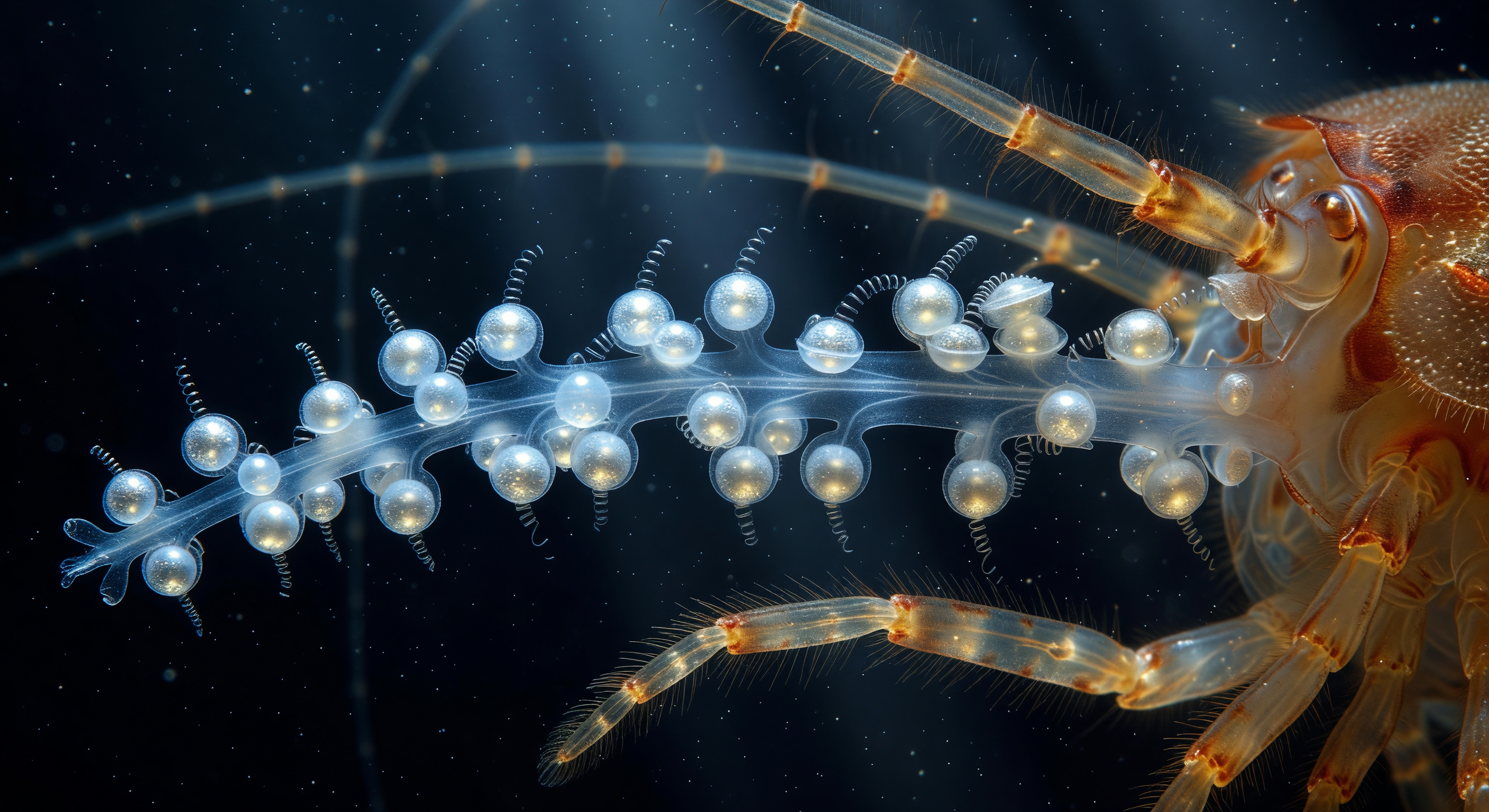
You are suspended beside a structure so fine it reads at first as a trick of the deep water's optics — a single tentillum of *Pleurobrachia*, a lateral filament no thicker than spun glass, arrayed along its length with dozens of colloblasts: adhesive cells unique to ctenophores, each one a domed hemisphere packed with refractile granules that throw back cold white-gold glints against the surrounding void of mesopelagic black-blue. This is a predatory surface unlike anything in vertebrate biology — colloblasts are not stinging cells but irreversibly adhesive ones, each dome tethered to the tentacle core by a spiral filament that functions as a coiled spring absorbing prey impact, and when a colloblast fires, its granular adhesive spreads biochemically across whatever surface it contacts, binding without venom, by pure molecular stickiness. In the upper right of your field of view, the prey has already arrived: a *Calanus* copepod's antenna segment, a beam of warm burnt-orange chitin sculpted in transverse ridges, has swept into the tentillum and several colloblast hemispheres are already crushed flat against its surface, deformed from perfect domes into adhesive discs of committed contact while spiral filaments unspooled behind them absorb the momentum of the strike. The tentillum itself curves infinitesimally under the copepod's weight, its pale ice-blue translucency beginning the muscular retraction that will haul this half-millimeter drama toward the ctenophore's mouth — a feeding event measured in seconds at organism scale, but here, at this proximity, unfolding as a slow catastrophe of cold light and irreversible chemistry.
Other languages
- Français: Tentacule Colloblaste Capture Proie
- Español: Tentáculo Colloblasto Captura Presa
- Português: Tentáculo Colloblasto Captura Presa
- Deutsch: Tentakel Colloblast Beutefang
- العربية: لاصقات مجسة تصطاد فريسة
- हिन्दी: स्पर्शक कोलोब्लास्ट शिकार प्रहार
- 日本語: 触手粘着細胞が獲物を捕捉
- 한국어: 촉수 콜로블라스트 먹이 포획
- Italiano: Tentacolo Colloblasto Cattura Preda
- Nederlands: Tentakel Colloblast Prooi Slag