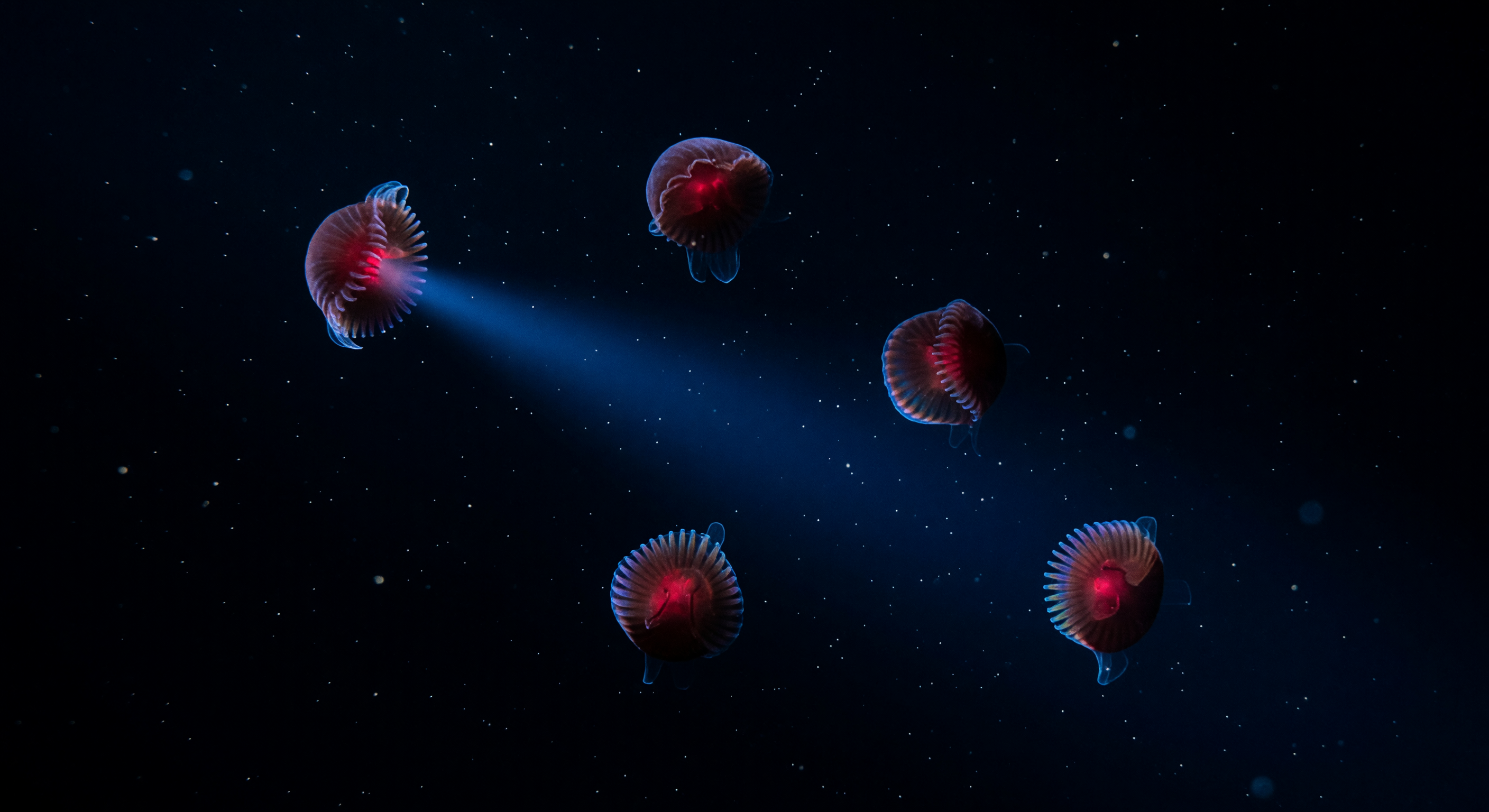
The ROV's blue LED cuts through four hundred meters of absolute darkness and the water column assembles itself in an instant: a slow constellation of marine snow drifts downward through the beam like white ash suspended in cold amber, and within it, materializing from nothing, the deep wine-red forms of *Bathocyroe fosteri* hang in loose proximity, their lobate bodies shaped like folded velvet lanterns burning crimson against a void so complete it feels less like the absence of light and more like the negation of space itself. These are lobate ctenophores — soft-bodied predators built almost entirely of mesoglea, a viscoelastic gel of collagen and water whose refractive index so closely matches seawater that the animals are optically invisible in ambient conditions, their deep pigmentation an adaptation that prevents bioluminescent flashes from silhouetting them against the faint downwelling light above. Under the 470-nanometer beam, the eight comb rows running longitudinally along each body surface act as living diffraction gratings — thousands of compound ciliary plates fragmenting the blue light into metachronal pulses of violet, teal, and amber that sweep the body in slow electric ripples, pure structural color with no chemistry involved, the physics of light encountering precisely spaced biological architecture. The marine snow filling the illuminated volume — loose aggregates of mucus, fecal pellets, and bacterial colonies, each fleck a millimeter or two across, sinking at roughly a meter per minute toward the sediment below — gives the scene its spatial depth and its strange patience, nearer particles sharp and white, distant ones dissolving into gray suggestion, everything moving with the unhurried certainty of a world accustomed to never being watched.
Other languages
- Français: Dérive Rouge Mésopélagique
- Español: Deriva Roja Mesopelágica
- Português: Deriva Vermelha Mesopelágica
- Deutsch: Rotes Mesopelagisches Treiben
- العربية: انجراف أحمر في الأعماق
- हिन्दी: गहरे समुद्र की लाल धारा
- 日本語: 深海赤き漂流体
- 한국어: 심해 붉은 부유체
- Italiano: Deriva Rossa Mesopelagica
- Nederlands: Rood Mesopelagisch Drijfsel