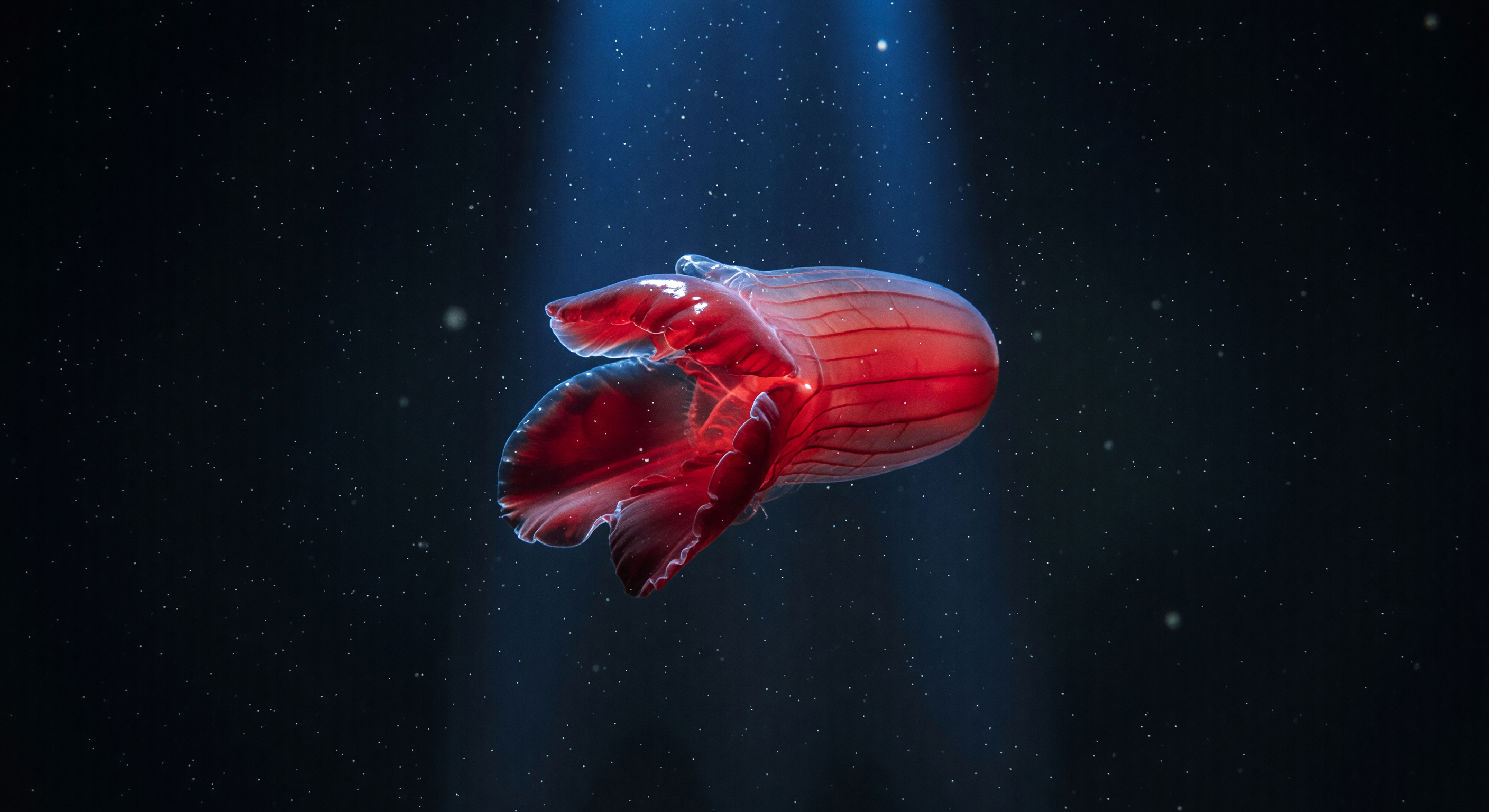
You hover in absolute darkness a kilometer beneath the Pacific surface, weightless in near-freezing water, as the ROV's blue LED beam cuts through the void and strikes something that should not exist at this depth — a ctenophore the color of fresh blood, *Lampocteis cruentiventer*, suspended motionless in the water column like a dropped jewel. The animal belongs to the lobate ctenophorans, gelatinous predators whose bodies are composed almost entirely of mesoglea, a viscoelastic collagen-glycoprotein gel that is ninety-six percent seawater by mass yet holds its architecture with surprising structural integrity, the broad oral lobes hanging open and relaxed like the draped petals of a dark tulip, their wet surfaces throwing sharp cyan highlights where the blue beam strikes the uppermost rims before the light vanishes entirely into tissue so saturated with red pigment that no wavelength below 600 nanometers survives to reflect back. Eight comb rows — the defining feature of all Ctenophora, each a longitudinal series of compound ciliary paddles fused from hundreds of thousands of individual axonemes — trace faint topographic seams across the scarlet body, their plates too small to resolve individually at this distance yet collectively imposing a ribbed texture that catches the raking illumination along the animal's flanks. Marine snow drifts continuously through the cone of light, particles of biogenic detritus on slightly diverging vectors in the ambient deep current, giving measurable depth and scale to water so dark it is otherwise indistinguishable from the inside of a closed eye, while the ctenophore blazes at the center of the beam as though generating its own red light — a body the size of a human fist, sovereign in a desert of cold pressure and absolute black.
Other languages
- Français: Abîsse Cramoisi Lampocteis 1000m
- Español: Abismo Carmesí Lampocteis 1000m
- Português: Abismo Carmesim Lampocteis 1000m
- Deutsch: Lampocteis Karmesinabgrund 1000m
- العربية: هاوية قرمزية لامبوكتيس 1000م
- हिन्दी: लैम्पोक्टिस क्रिमसन गहराई 1000मी
- 日本語: ランポクテイス深紅の深淵1000m
- 한국어: 람포크테이스 심홍 심연 1000m
- Italiano: Lampocteis Abisso Cremisi 1000m
- Nederlands: Lampocteis Karmozijnen Afgrond 1000m