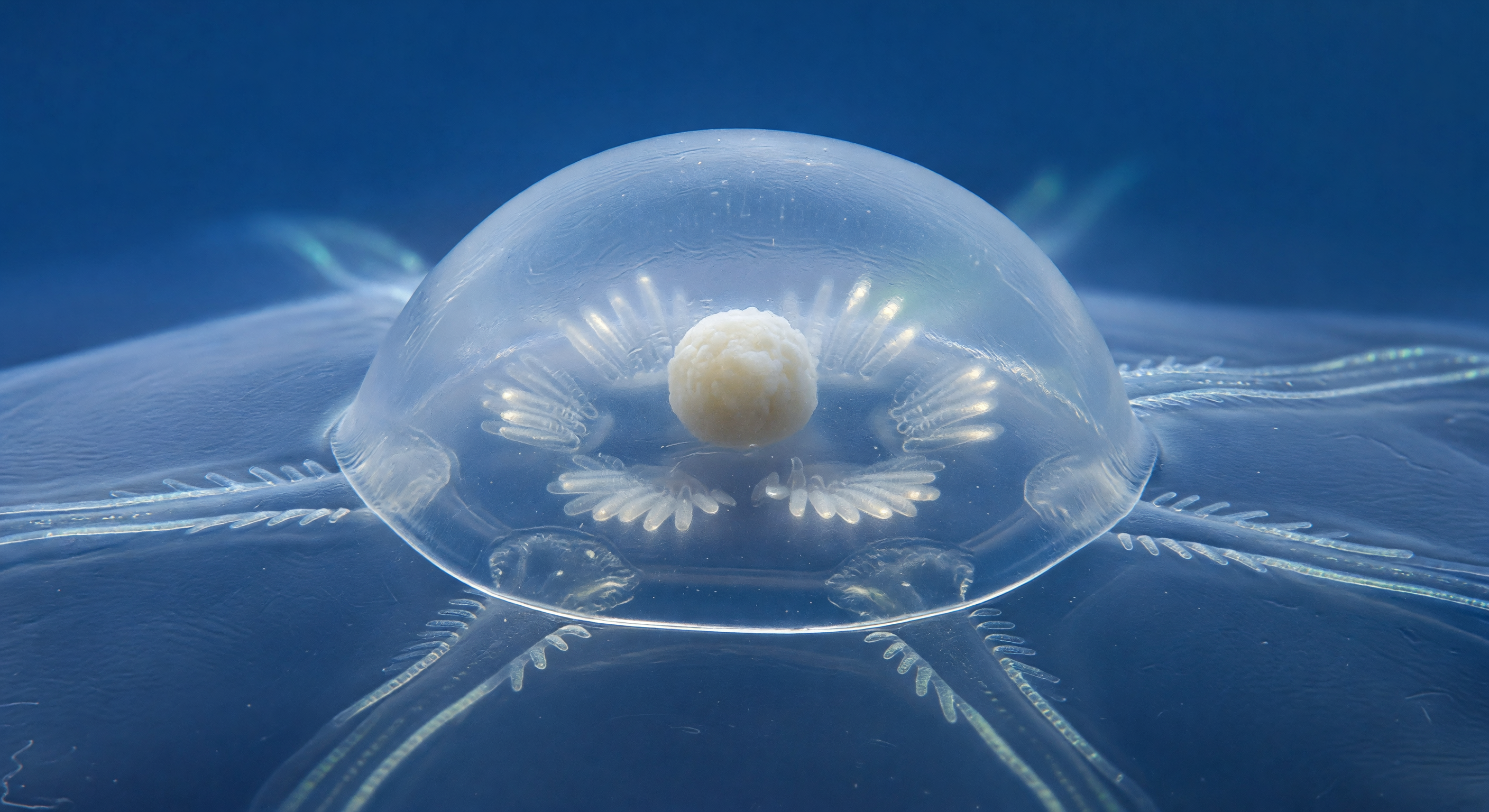
You hover motionless above the summit of a living comb jelly, looking down into a structure that seems less biological than architectural — a hemisphere of near-perfect optical clarity, two hundred microns across, rising from the animal's aboral pole like a cupola of biological glass whose presence is announced only by the finest crescent of bent light tracing its equator. Inside this dome, a creamy aggregate of calcium carbonate granules — the statolith — hangs in suspended stillness, its chalky ivory surface casting a soft diffuse shadow into the transparent tissue beneath; this is the animal's entire gravitational sense organ, a statocyst from which the whole ctenophore reads orientation and coordinates the beating of its eight comb rows accordingly. Four fans of balancer cilia surround the statolith at cardinal positions, each rendered not as discrete filaments but as a frosted vibratory aureole — beating at tens of cycles per second, scattering transmitted oceanic light into pearlescent hazes that shift and shimmer like breath on cold glass. From the dome's base, four ciliated furrows radiate outward like the seams of a compass rose, their surfaces alive with finer motile cilia that produce a barely perceptible iridescent wash of silver and green at grazing angles, extending away into the middle distance where the first luminous ribbons of the comb rows begin their arcing paths along the body — the entire scene suspended within a vast medium of transparent mesoglea, the open ocean visible beyond the animal's curved wall as a featureless luminous cobalt void, simultaneously intimate and infinite.
Other languages
- Français: Dôme Cristallin Apical Macro
- Español: Cúpula Cristal Apical Macro
- Português: Cúpula Cristalina Apical Macro
- Deutsch: Apikale Kristallkuppel Makro
- العربية: قبة بلورية قمية مكبرة
- हिन्दी: शीर्ष क्रिस्टल गुंबद मैक्रो
- 日本語: 頂端水晶ドーム接写
- 한국어: 정단 수정 돔 매크로
- Italiano: Cupola Cristallina Apicale Macro
- Nederlands: Apicale Kristalkoepel Macro