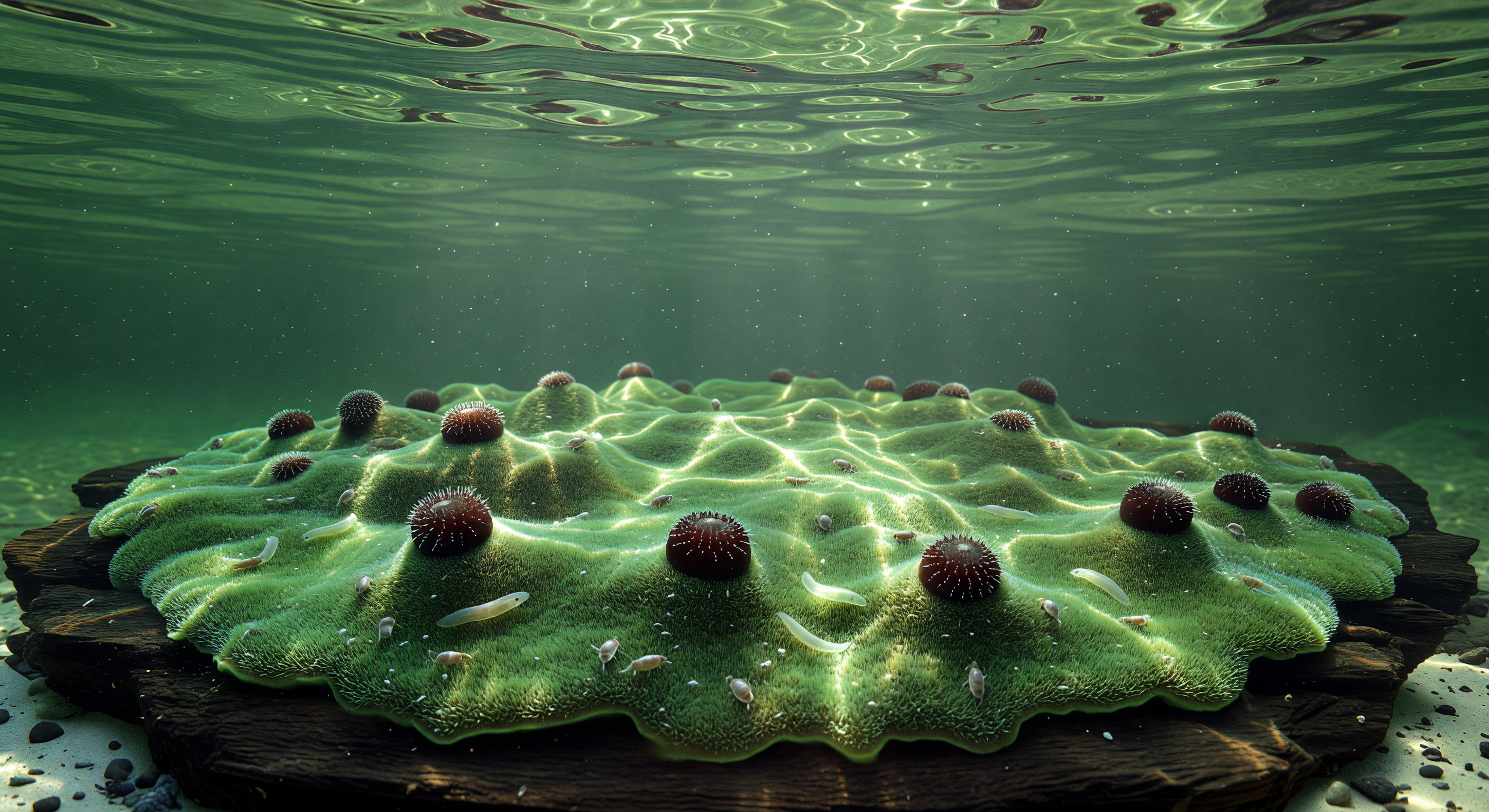
You hover centimeters above the dark, waterlogged timber, your entire field of view consumed by a vivid grass-green crust spreading across the wood's shadowed underside — Spongilla lacustris, a freshwater sponge whose color comes not from its own cells but from the dense populations of symbiotic green algae packed into its living tissue, converting every shaft of dappled stream light into photosynthetic energy that suffuses the surface with an almost interior glow. The texture is deceptive: what reads as soft velvet is in fact a living matrix of cells and silica, the sponge's skeletal spicules protruding as fine glass needles across every millimeter of surface, each silica tip catching light like a frost crystal and scattering it into a soft halo of microglints that gives the whole crust a faint luminous bristling. Embedded within this green tissue, dark mahogany spheres press upward like buried cobblestones — the gemmules, each roughly half a millimeter across and armored in their own radial spicule architecture, ancient survival capsules capable of lying dormant through winter and drought while the living tissue around them actively pumps thousands of times its own volume of stream water each day, filtering bacteria and dissolved organics through choanocyte chambers that have operated on this same fundamental plan for over six hundred million years. Tiny ostracods roll across the surface like seed pearls through velvet, pale flatworms glide in translucent arcs, and above everything the stream water rises as a cathedral of cool green clarity, its surface a shifting silver ceiling that sweeps alternating light and shadow across the sponge in slow waves, the entire scene a reminder that this unassuming green crust on dead wood represents one of the oldest surviving animal body plans on Earth.
Other languages
- Français: Croûte Verte Spongilla Symbiotique
- Español: Costra Verde Simbiótica Spongilla
- Português: Crosta Verde Simbionte Spongilla
- Deutsch: Spongilla Grüne Symbiont Kruste
- العربية: قشرة إسفنج سبونجيلا الخضراء
- हिन्दी: स्पोंजिला हरित सहजीवी परत
- 日本語: 緑色スポンジラ共生殻
- 한국어: 스폰질라 녹색 공생 외피
- Italiano: Crosta Verde Simbiotica Spongilla
- Nederlands: Spongilla Groene Symbiont Korst