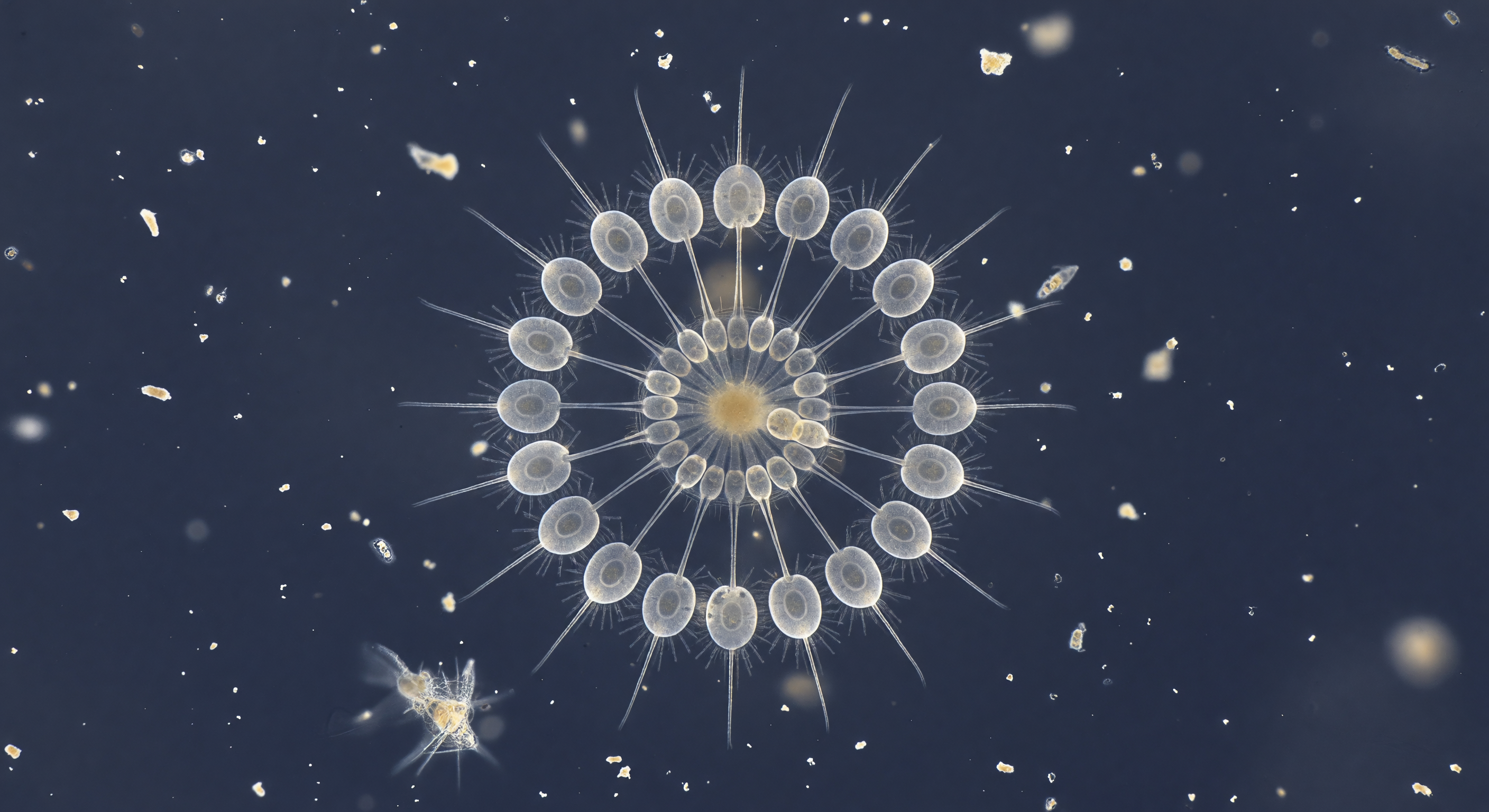
Suspended in open water at the scale of a large bacterium, you face a structure that fills your entire visual world like a slowly turning chandelier moon — a 32-cell rosette colony of *Salpingoeca rosetta*, roughly forty micrometers across, floating free in the faint blue-black depth of estuarine water. Each cell body is a plump, slightly translucent ovoid rendered in the cool achromatic silver-gray of differential interference contrast, its nucleus visible as a denser ellipsoid within, and from every distal pole a flagellum extends outward — fifteen to twenty micrometers of trembling silver filament, too fine to resolve as a solid rod but unmistakably present, thirty-two of them radiating simultaneously to give the colony the electrified silhouette of a sea urchin frozen mid-breath. The basal poles of all cells converge inward along barely visible cytoplasmic bridge threads — the intercellular connections that make this not a loose aggregate but a coordinated multicellular entity — terminating at a warm amber core of extracellular matrix that glows with faint internal translucence, the only warm tone in an otherwise cool, near-monochrome palette. At the two-o'clock position one cell is mid-division, its body pinched into a peanut form with offset nuclear shadows marking the coming separation, a live record of the clonal cell divisions that built this geometry. Around you, marine-snow flocs drift softly out of focus, their tangled polysaccharide strands and embedded bacteria establishing the particulate, populated world through which this colonial protist — the closest living relative of all animals — quietly filters its share of the sea.
Choanoflagellates & sponges