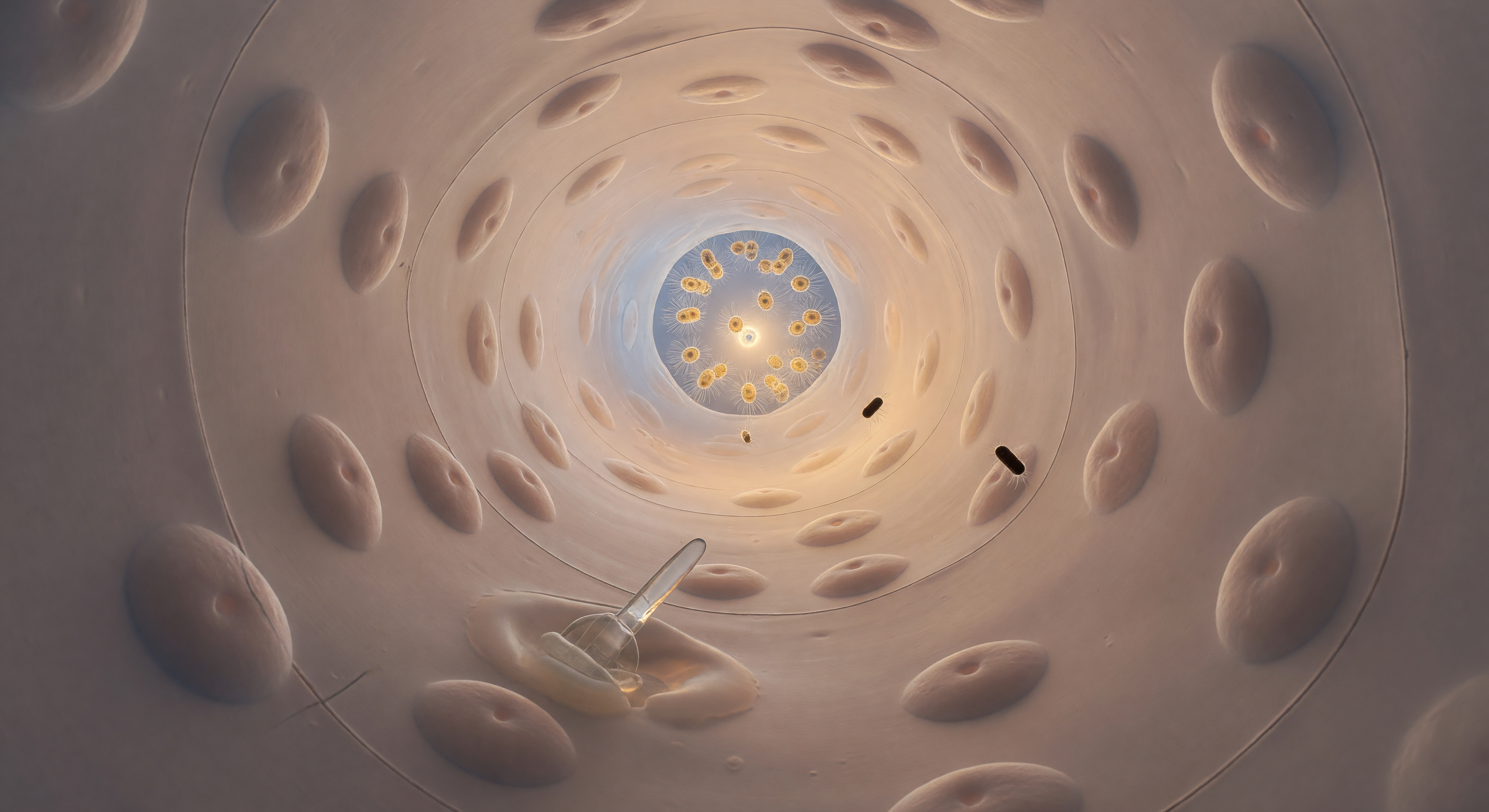
You are suspended at the entrance of a living conduit, gazing down a gently curving cylinder of flesh and fluid whose far end glows with the warm amber light of a choanocyte chamber — a small, burning aperture that anchors your perspective the way a candle anchors a dark room. The walls enclosing you are built from endopinacocytes pressed impossibly flat against the underlying mesohyl, their surfaces polished and faintly translucent, interrupted only by the soft dome of each nucleus rising like a submerged stone beneath wet silk, and by the hairline seams where cell margins meet in nearly invisible junctions. Here, water does not flow so much as it is persuaded forward: at this diameter, viscosity reigns absolutely, and the Stokes-regime current carries its passengers — rod-shaped bacteria drifting past like lacquered cylinders, one tumbling end-over-end as Brownian noise briefly claims it before the laminar flow reasserts its patience — without turbulence, without urgency, with a quality closer to procession than motion. Embedded in the lower wall, a spicule of calcium carbonate catches transmitted light along its entire length, and pressed against its base, an amoeboid archaeocyte deforms around the obstacle in slow, warm increments, cytoplasm bulging through a cell junction as it migrates through tissue that has been filtering ocean water through passages exactly like this one for the better part of six hundred million years. Behind you, cold blue-white ocean light floods through the canal mouth; ahead, through the prosopyle no wider than five microns, the choanocyte chamber blazes with the collective industry of dozens of flagellating cells whose beating, were sound possible here, would be the quietest and most ancient whisper in animal history.
Other languages
- Français: Tunnel du Canal Pinacoderme
- Español: Túnel del Canal Pinacodermo
- Português: Túnel do Canal Pinacoderme
- Deutsch: Pinacoderm-Kanal-Tunnel
- العربية: نفق قناة البيناكودرم
- हिन्दी: पिनाकोडर्म नलिका सुरंग
- 日本語: ピナコダーム管腔トンネル
- 한국어: 피나코덤 수로 터널
- Italiano: Tunnel del Canale Pinacoderma
- Nederlands: Pinacoderm Kanaal Tunnel