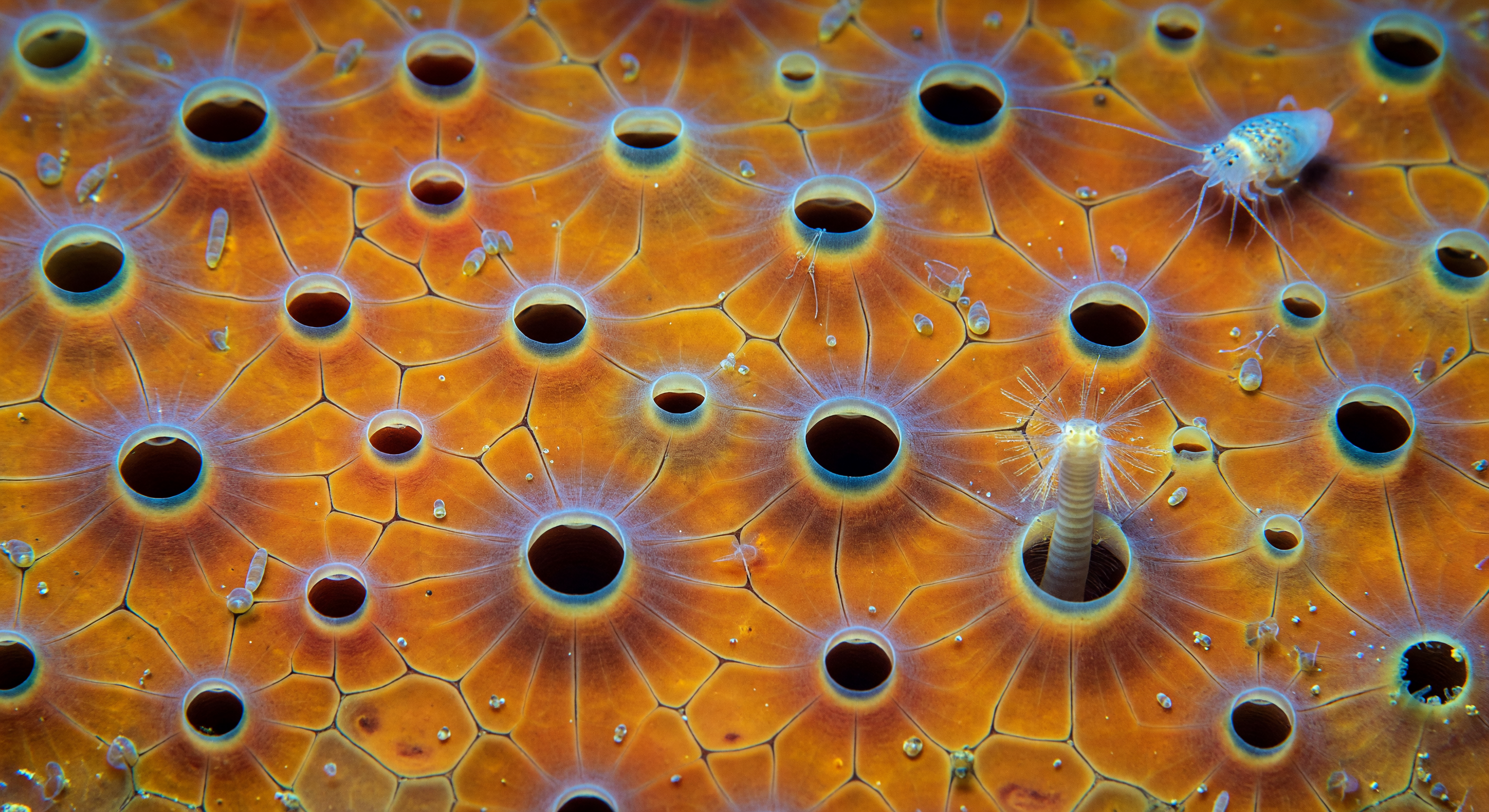
You are hovering less than a millimeter above the outer skin of a living tropical demosponge, and the world beneath you fills the horizon in every direction like an alien tidal flat seen from a low drone — except every surface breathes. The exopinacoderm spreads as an undulating mosaic of flattened polygonal tiles, each cell boundary raised into a shallow ridge saturated in deep burnt-orange and saffron carotenoid pigment, their surfaces glistening with a thin aqueous film that gives the landscape a wet, lacquered quality somewhere between freshly glazed ceramic and sun-warmed coral rubble. Scattered across this plain at irregular intervals, the ostia punctuate the surface like volcanic calderas — circular to subtly oval depressions, some fully dilated with porocyte walls retracted to reveal the absolute darkness of inhalant canals descending into the sponge's interior plumbing, others contracted to pale-rimmed slits barely admitting light, the surrounding pinacoderm tiles faintly depressed and paler at their rims as continuous negative pressure draws water downward at rates that will collectively process tens of thousands of times the sponge's own body volume each day. Between the ostia, a three-dimensional biofilm of rod bacteria, coccoid clusters, and filamentous cyanobacteria weaves through strands of mucopolysaccharide that catch the downwelling reef light as iridescent threads, while a small polychaete has surfaced from one open canal mouth with palps fanning in slow arcs through the boundary layer, and a copepod arriving at the upper edge of the scene refracts ambient blue through its transparent carapace before being deflected, invisibly but decisively, by the pressure gradient exhaled from a distant osculum.
Other languages
- Français: Paysage Biofilm Ostia Orange
- Español: Paisaje Biofilm Ostia Naranja
- Português: Paisagem Biofilme Óstia Laranja
- Deutsch: Oranges Ostia Biofilm Landschaft
- العربية: مشهد الطبقة الحيوية البرتقالية
- हिन्दी: नारंगी ओस्टिया बायोफिल्म दृश्य
- 日本語: オレンジ流孔バイオフィルム景観
- 한국어: 주황 오스티아 생물막 풍경
- Italiano: Paesaggio Biofilm Ostia Arancione
- Nederlands: Oranje Ostia Biofilm Landschap