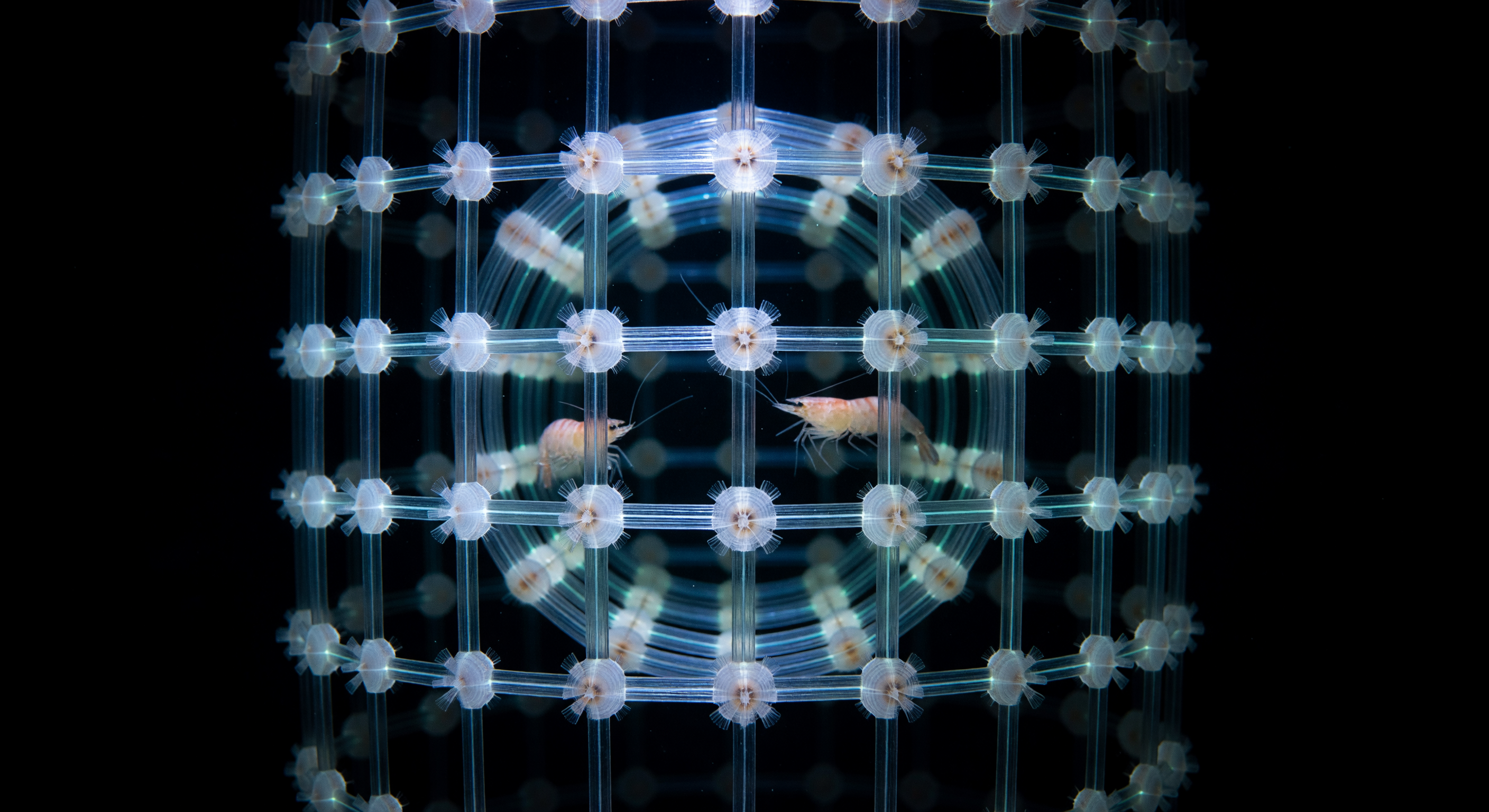
Before you, in absolute deep-sea darkness, rises a tower of living glass — the skeletal lattice of *Euplectella aspergillum*, a hexactinellid sponge whose silica spicules are fused at every intersection into a single rigid syncytial whole, the repeating chequerboard geometry so precise it reads as engineered rather than grown. The silica itself functions as true optical fiber, channeling the faint bioluminescent light of the surrounding water along the interior of each rod until the entire mesh glows cold blue-green from within, every spicule a self-luminous filament suspended in blackness, the cumulative structure a Gothic nave built from spun glass. Looking through the lattice wall, concentric shadow grids multiply inward as each cylindrical layer refracts and re-casts the luminescent geometry, while fractured spicule cross-sections at the nearest nodes reveal concentric lamination rings — pale growth bands in biosilica deposited around an organic protein template, the material transitioning from faintly amber at its dense core to glacial white at the outer sheath. Deep within the atrium, two commensal shrimp drift as warm amber-pink silhouettes rendered semi-transparent by the interior glow, living stained-glass figures sealed inside their cathedral for life, the full weight of the water column above communicated not by any sensation but by the perfect stillness of everything and the absolute darkness beyond the structure's halo.
Other languages
- Français: Lueur Cathédrale Éponge Silice
- Español: Resplandor Catedral Esponja Vítrea
- Português: Brilho Catedral Esponja Vítrea
- Deutsch: Glasschwamm Kathedrale Leuchten
- العربية: توهج كاتدرائية الإسفنج الزجاجي
- हिन्दी: काँच स्पंज गिरजाघर चमक
- 日本語: ガラス海綿大聖堂の輝き
- 한국어: 유리 해면 대성당 빛
- Italiano: Bagliore Cattedrale Spugna Vetro
- Nederlands: Glazen Spons Kathedraal Gloed