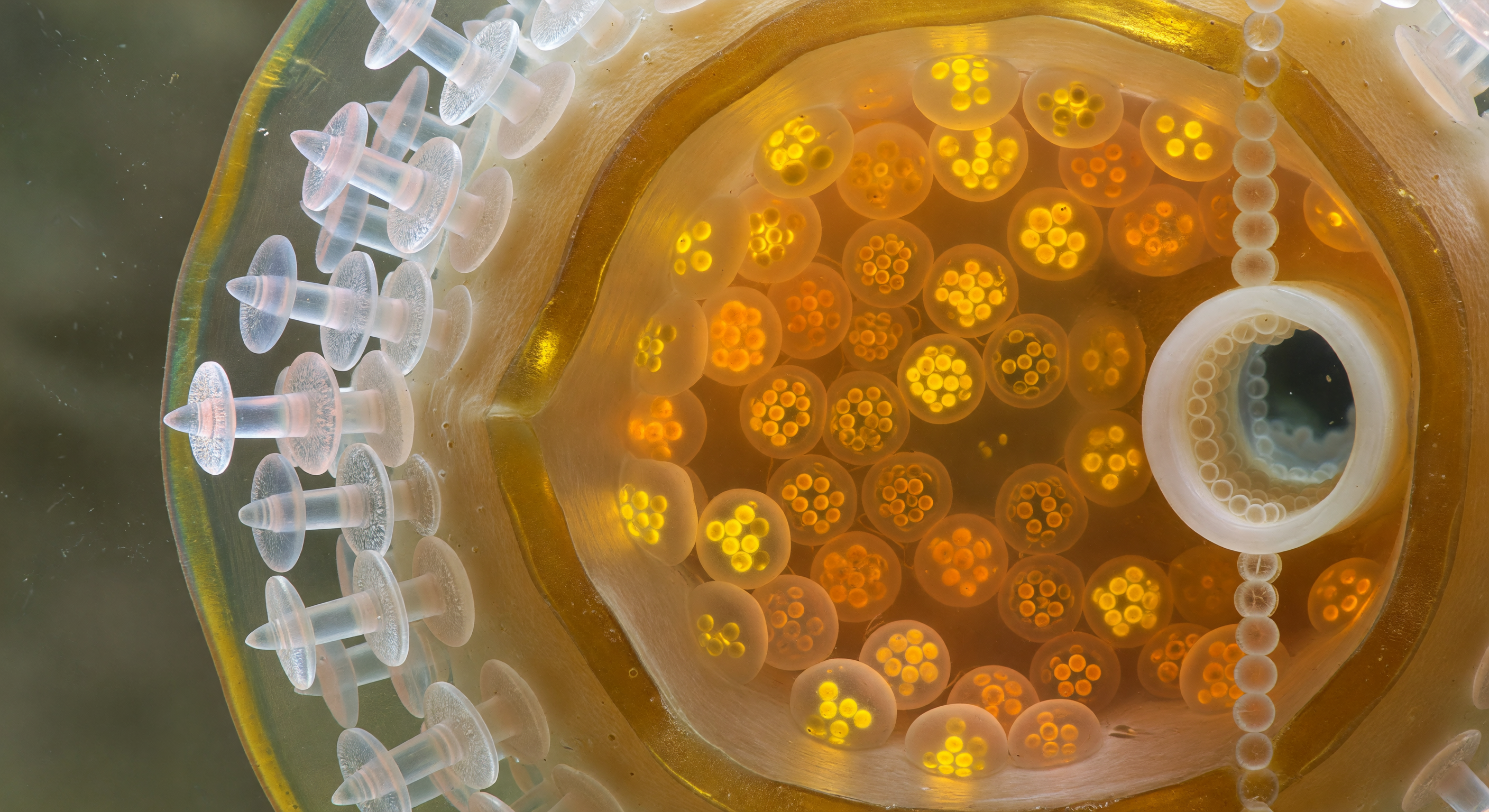
You are suspended just inside the bisected wall of a freshwater sponge's survival capsule, looking inward across a space that reads, at your scale, like the nave of a cathedral cleaved open by a geological fault. The wall to your left is a laminate fortress in three distinct zones: an outermost membrane of taut, faintly iridescent amber; behind it a palisade of amphidisc spicules standing in pale cream spongin cement, each one a dumbbell of crystalline biogenic silica whose flared rotular disc-ends interlock like ornate frosted-glass rondels, casting prismatic glints of icy white and ghost-blue as transmitted light refracts through their shafts; and finally a smooth, honey-gold inner spongin layer that curves inward to open onto the interior. Beyond that boundary, the cavity glows with saturated amber and saffron warmth — archaeocytes packed shoulder-to-shoulder, each cell a swollen globe gorged with lipid-droplet reserves that make them shine like oil-filled lanterns, the entire mass held in chemical suspended animation against winter. To the far right, a micropyle pore tube breaches the armor in cross-section, its cylindrical passage currently stoppered by a tight column of pale cells pressed membrane-to-membrane, the circular opening at its far end gazing outward into murky, cold olive-grey sediment water — the contrast between that cold exterior and the incandescent interior giving the whole scene the visual weight of a geode cracked open in deep winter, every surface radiating pressure, density, and latent biological potential.
Choanoflagellates & sponges