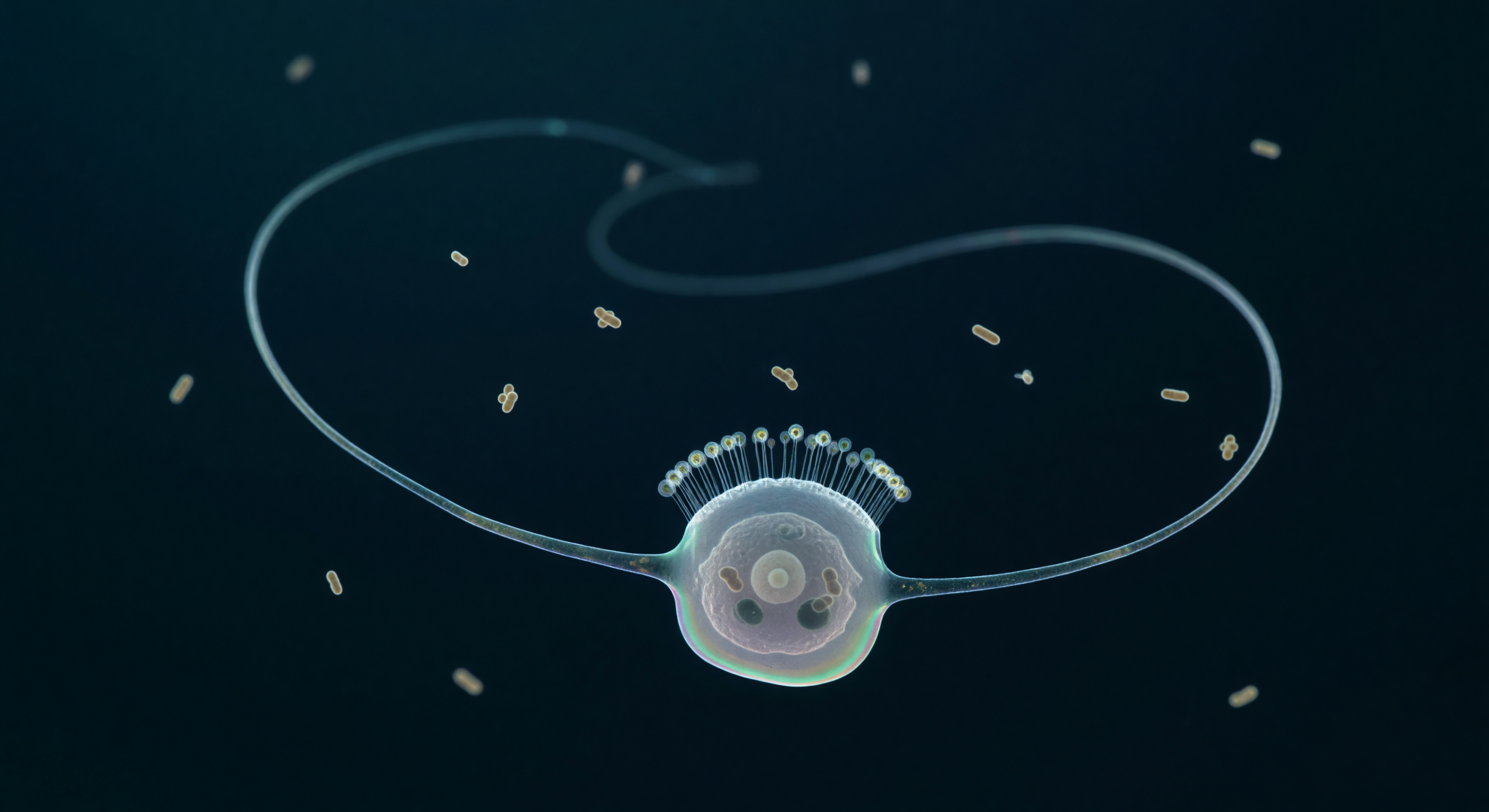
You are suspended inside a medium that behaves less like water than like a cold, faintly resistant gel — at this scale, viscosity overwhelms inertia so completely that the sinusoidal flagellum arcing across your field of view is not slicing through the void so much as sculpting it, driving a slow toroidal current that draws dissolved organics and drifting bacteria gently inward through the near-invisible cylinder of microvilli surrounding its base. This single choanoflagellate cell — its nearly colorless body no wider than a large bacterium is long — represents one of the closest living relatives to the animal ancestor, a unicellular organism whose collar-and-flagellum architecture is mirrored almost exactly in the choanocytes lining the filtration chambers of every sponge alive today, a molecular continuity preserved across perhaps six hundred million years of evolution. The collar itself, a ring of thirty-odd actin-filled microvilli thinner than a wavelength of visible light, functions as a sieve mesh, intercepting bacteria carried on the flagellum's helical wake and passing them into food vacuoles where digestion is already underway — the two dark inclusions visible inside the cytoplasm each still containing the compressed ghost of a rod bacterium mid-dissolution. Around you in the middle distance, a dozen more bacteria drift and tremble in pure Brownian agitation, neither rising nor falling, suspended in a thermal noise field that at this scale is the dominant physical reality, the closest thing this world has to weather.
Choanoflagellates & sponges