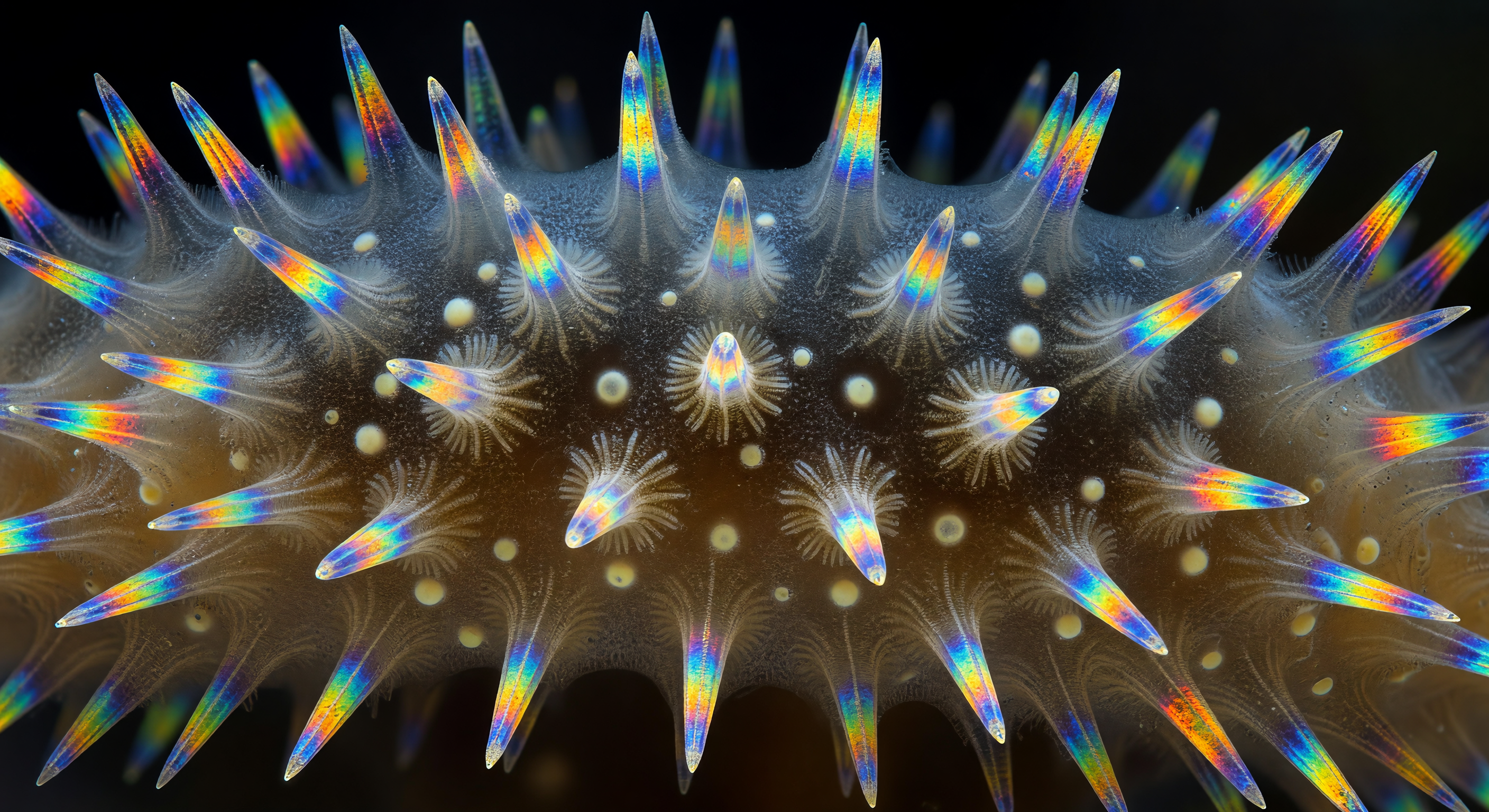
Suspended within the sectioned wall of *Sycon ciliatum*, you look out across an interior architecture that reads less like biology than like a cathedral's clerestory rendered in mineral fire: radial canals bore through the amber-gray mesohyl like nave aisles, their walls furred with choanocyte collars barely visible in the transmitted glow, while calcite triactine and tetractine spicules blaze in hallucinatory birefringent color—electric cobalt, sulfur yellow, molten orange, cold emerald—each crystal lit from within by polarized light against an absolute black void. Two rays of every triactine lie flat in the plane of the wall, throwing hard gem-sharp color gradients along their length, while the third ray punches perpendicularly outward like a needle, its tip catching a specular point of white-gold light. Where spicules cross, their interference patterns stack into iridescent aureoles—amber bleeding into violet into electric teal—the optical equivalent of medieval stained glass, except that each blazing element is a single calcite crystal secreted by a living sclerocyte cell within a matrix of fibrous extracellular gel. The scene unfolds across layered depth: foreground spicules in razor-sharp chromatic definition, mid-ground canal walls dissolving into warm translucency, the far background fading to pure blackness where polarized light cannot penetrate—and the vertiginous realization settles that this entire luminous architecture, part mineral, part living organism, part pure optics, fits within a structure no larger than a human fingernail.
Other languages
- Français: Section Sycon Biréfringente
- Español: Sección Sycon Birrefringente
- Português: Seção Sycon Birrefringente
- Deutsch: Doppelbrechender Sycon Schnitt
- العربية: مقطع سيكون ثنائي الانكسار
- हिन्दी: द्विअपवर्ती साइकन काटछेद
- 日本語: 複屈折サイコン断面
- 한국어: 복굴절 시콘 단면
- Italiano: Sezione Sycon Birifrangente
- Nederlands: Dubbelbrekende Sycon Doorsnede