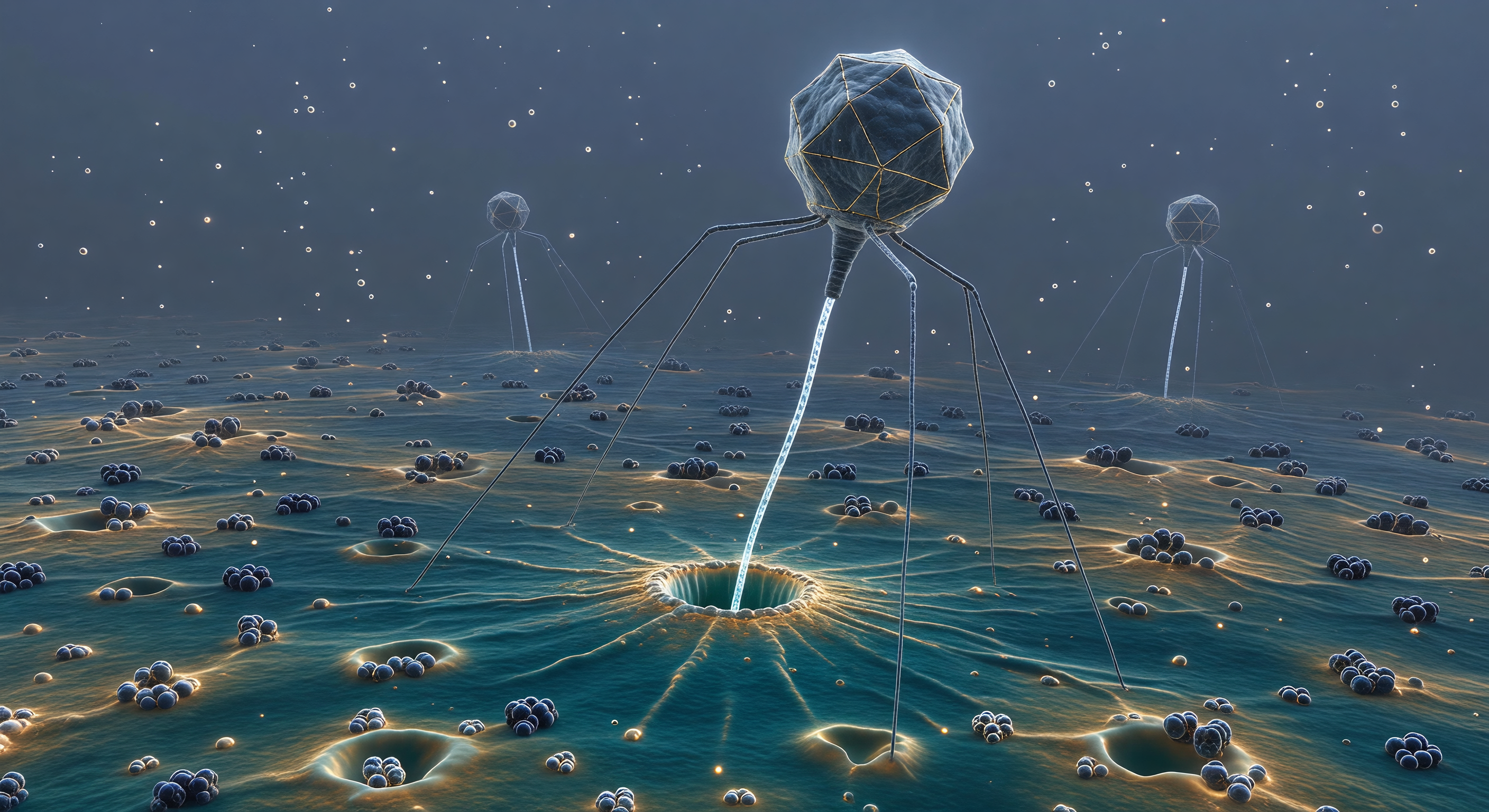
Standing at eighty nanometers above the outer membrane of *E. coli*, you look up into the slow, silent descent of a T4 bacteriophage — its icosahedral capsid, roughly one hundred nanometers across, looms like a faceted asteroid eclipsing the upper field of view, its dark-gray polyhedral faces traced by faint gold seams where capsomere proteins lock together with crystallographic precision, the entire structure carrying the gravitational authority of a body that has crossed this threshold ten thousand times before. Below it, six jointed tail fibers splay radially across the teal-gold LPS terrain like the legs of some ancient, patient predator, their receptor-binding tips pressing into the lipopolysaccharide surface and creating shallow molecular dimples where glycan chains reorganize under localized mechanical stress. At the composition's center, the tail tube has already breached the membrane — a pore perhaps three nanometers across, its lipid rim slightly disordered, the bilayer's material character shifting from uniform teal to a warmer amber at the wound site — and through that needle-thin channel a luminous filament of single-stranded DNA streams downward into the periplasm, pale blue-white and opalescent, driven by the osmotic pressure differential between capsid interior and host cytoplasm. In the aqueous middle distance, two further phage particles hover in the diffuse blue-gray medium with tail sheaths still extended and gleaming cold silver, their approach as inevitable as gravity at any other scale — the surrounding fluid not a passive backdrop but a thermally restless, chemically saturated medium in which every surface attracts, repels, and negotiates across distances measured in bond lengths.
Other languages
- Français: Attaque d'Injection du Phage T4
- Español: Ataque de Inyección del Fago T4
- Português: Ataque de Injeção do Fago T4
- Deutsch: T4-Phagen-Injektionsangriff
- العربية: هجوم حقن العاثي T4
- हिन्दी: T4 फेज इंजेक्शन हमला
- 日本語: T4ファージ注入攻撃
- 한국어: T4 파지 주입 공격
- Italiano: Attacco di Iniezione del Fago T4
- Nederlands: T4 Faag Injectie Aanval