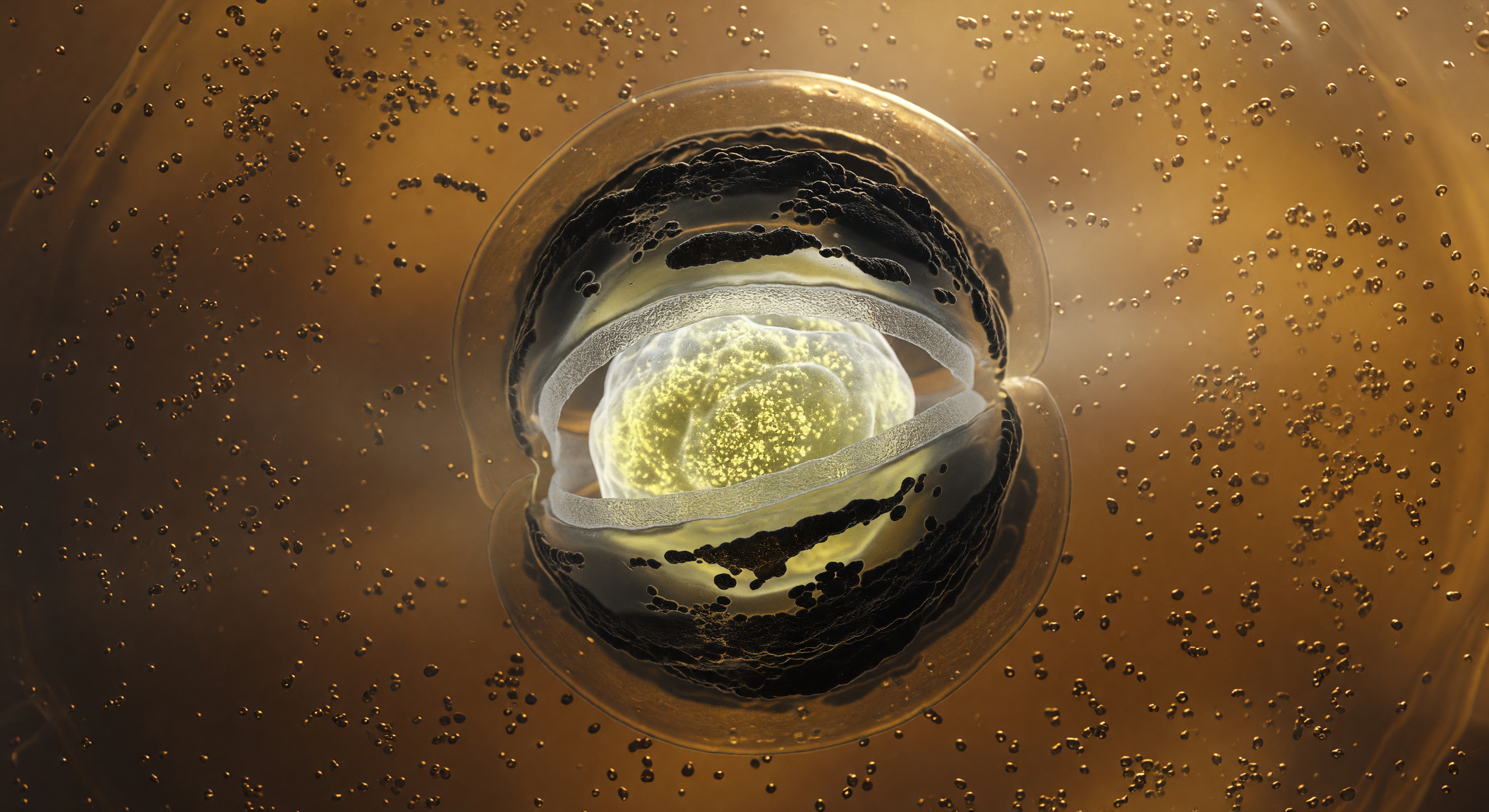
You are standing inside a living cell that is consuming itself to build an ark — the amber-gold cytoplasm surrounding you is so densely crowded with ribosomes and drifting protein granules that the medium itself feels more like warm gel than aqueous solution, every particle suspended in a low-Reynolds-number world where inertia means nothing and molecular friction governs all motion. At the center of this viscous cavern, the forespore hangs like a luminous moon: an ovoid compartment lit from within by the cold mineral glow of calcium-dipicolinic acid deposits and hyper-condensed DNA wrapped tight by small acid-soluble proteins, its interior reaching densities no normal cell ever achieves, the accumulated mass of a dormancy strategy refined across billions of years. Encircling that inner light, a pale gray peptidoglycan cortex scatters the glow diffusely outward like frosted glass, while beyond it, concentric sheets of SpoIVA and CotC coat proteins polymerize into dark, matte-black arcs that absorb light rather than reflect it — the structural armor of a spore that will outlast drought, radiation, and geological time. Most arresting is the engulfing membrane itself, two glistening lipid bilayers curving inward from the mother cell's own inner membrane in a tight phagocytic embrace, bent to their geometric limit around the forespore's equator, the periplasmic gap between them barely visible as a sliver of dark contrast against the warm amber glow — a molecular zipper closing, irreversibly, around a future.
Other languages
- Français: Engloutissement de la préspore
- Español: Engullimiento de la Preespora
- Português: Engolfamento do Pré-esporo
- Deutsch: Vorspore wird Verschlungen
- العربية: ابتلاع البوغ الأولي
- हिन्दी: फोरस्पोर का अंतर्ग्रहण
- 日本語: 前胞子の取り込み
- 한국어: 전포자 흡수 과정
- Italiano: Inghiottimento della Prespora
- Nederlands: Voorspore Omhulling Begint