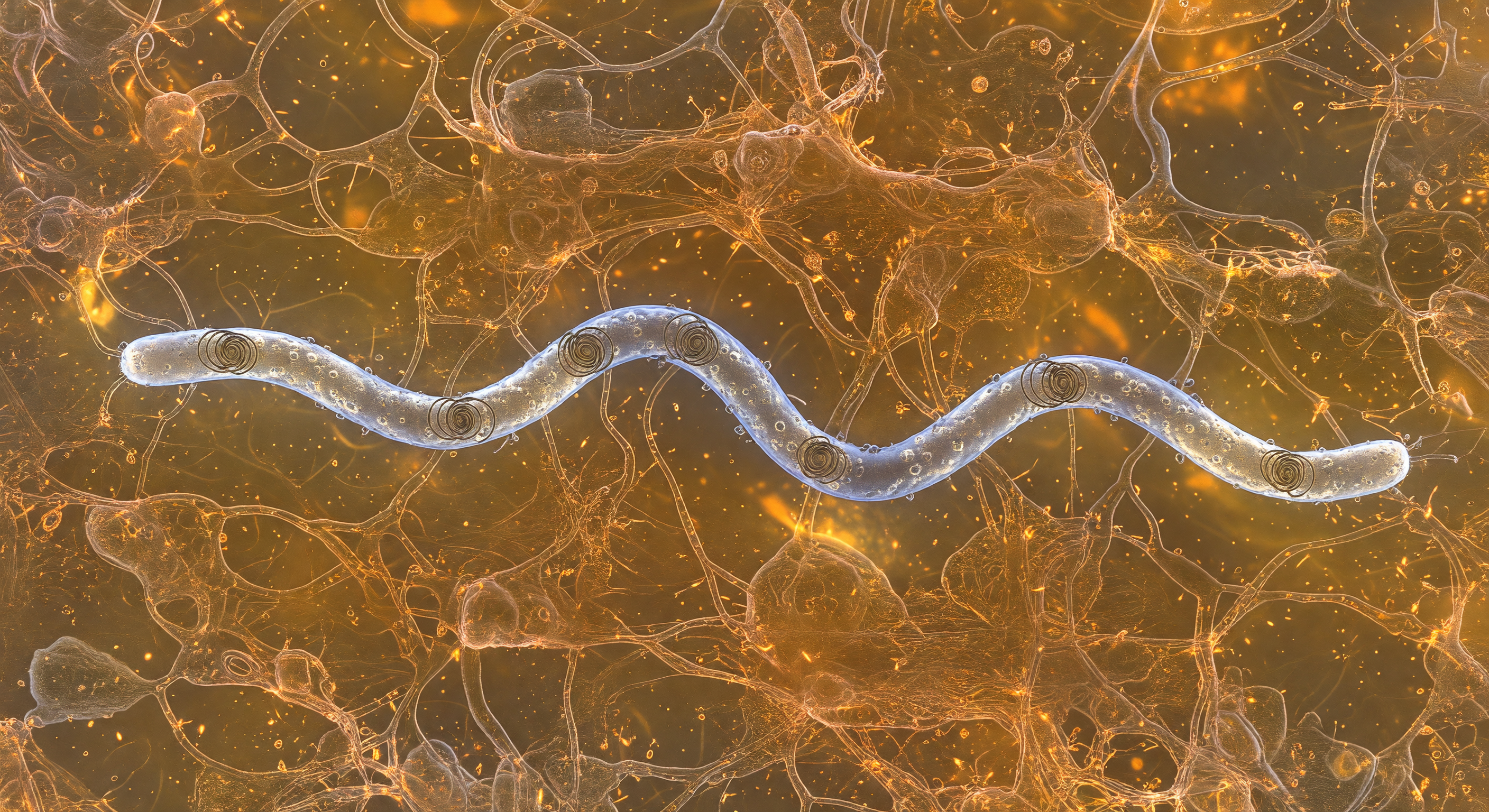
You find yourself suspended in a viscous amber world, immersed in the mucin gel lining a biological passage — a three-dimensional lacework of glycoprotein strands glowing with diffuse, sourceless warmth, pressing close on all sides like copper rigging in slow suspension. Five micrometers to your left, a *Borrelia burgdorferi* spirochete slices through this matrix with mechanical precision: its eighteen-micrometer helical body gleams with a cold silver-blue iridescence, outer-membrane proteins dimpling the surface like hammered platinum foil, while periplasmic flagella — entirely enclosed within the cell's outer sheath — are just visible as shadow-dark internal cables, their coordinated rotation bending the whole cell into a traveling flat wave that drives it forward without a single exposed appendage contacting the surrounding gel. This is a profoundly low Reynolds number world, where inertia means nothing and viscosity is absolute — the moment that internal flagellar machinery would cease its rotation, motion would stop instantaneously, the amber medium clamping down like cooling syrup. Where the spirochete's tapered ends push through the polymer network, glycoprotein strands bow outward in a slow V-wake before reforming behind the cell, individual filaments catching new angles of the omnidirectional bioluminescent glow and flashing brief copper-gold highlights as the pathogen navigates, molecule by molecule, through the dense biological architecture of its host.
Other languages
- Français: Spirochète Traversant le Mucus
- Español: Espiroqueta Perforando la Matriz Mucosa
- Português: Espiroqueta Atravessando o Muco
- Deutsch: Spirochäte Durchbohrt Schleimmatrix
- العربية: لولبية تخترق مصفوفة المخاط
- हिन्दी: स्पाइरोकीट बलगम जाल में
- 日本語: スピロヘータ粘液を貫く
- 한국어: 나선균 점액 통과
- Italiano: Spirocheta Trafora il Muco
- Nederlands: Spirocheet Doorkruist Slijmmatrix