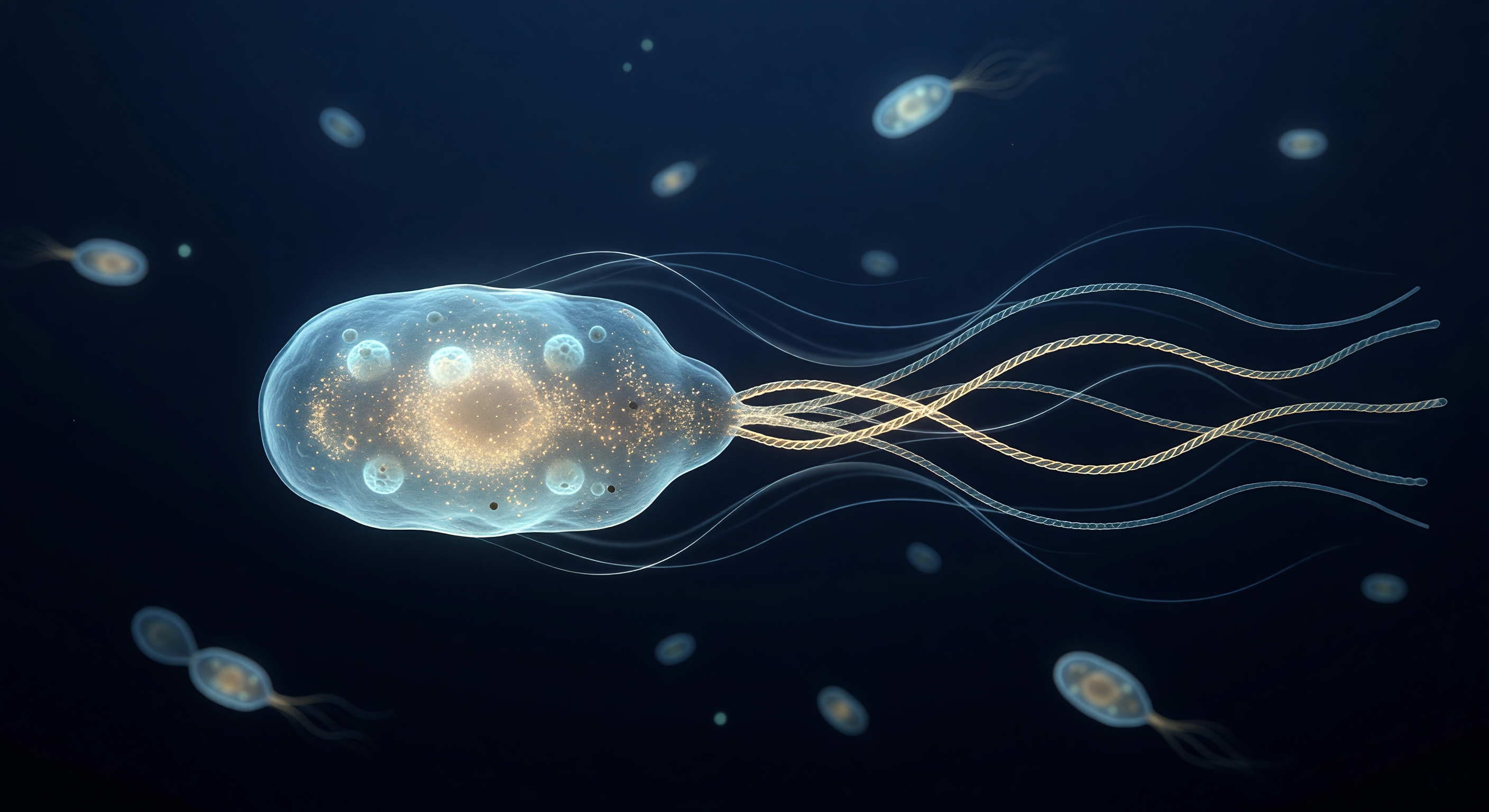
You are suspended just behind the stern of a living *E. coli* cell as it drives itself forward through a world where viscosity rules absolutely and inertia is a concept without meaning. The pale-cyan translucent body fills your field of view like the hull of a slow vessel, its outer membrane shimmering with the faint corrugation of porin rosettes and edged in a thin silver-blue caustic, while the dense amber interior resolves at the poles into the granular scatter of tens of thousands of ribosomes packed into a cytoplasm closer to gel than to water. Behind the cell, four pale-gold helical flagellar filaments have braided into a single superhelical bundle rotating at hundreds of revolutions per second, yet the surrounding medium betrays none of the turbulence that speed would imply at any larger scale — instead, delicate silver-blue Stokes-flow streamlines curve forward in perfectly symmetric arcs, silk-smooth and unhurried, the visual signature of a Reynolds number so vanishingly small that every stroke must be non-reciprocal to produce motion at all. The deep navy water is not empty: a dozen out-of-focus bacterial silhouettes drift in the distance like faintly glowing embers, each already dissolved into soft cyan bokeh, compressing depth until the space feels simultaneously intimate and oceanic — a thermally jittering, charge-saturated immensity in which the only light is the cold phosphorescent self-glow of molecular machinery that has been perfecting this particular solution to locomotion for nearly four billion years.
Other languages
- Français: Sillage du Faisceau Flagellaire
- Español: Estela del Haz Flagelar
- Português: Esteira do Feixe Flagelar
- Deutsch: Wirbelndes Geißelbündel Kielwasser
- العربية: أثر حزمة السوط الدوارة
- हिन्दी: घूर्णित फ्लैजेलर बंडल धारा
- 日本語: 回転鞭毛束の航跡
- 한국어: 회전 편모 다발 항적
- Italiano: Scia del Fascio Flagellare
- Nederlands: Roterende Flagellenbundel Kielzog