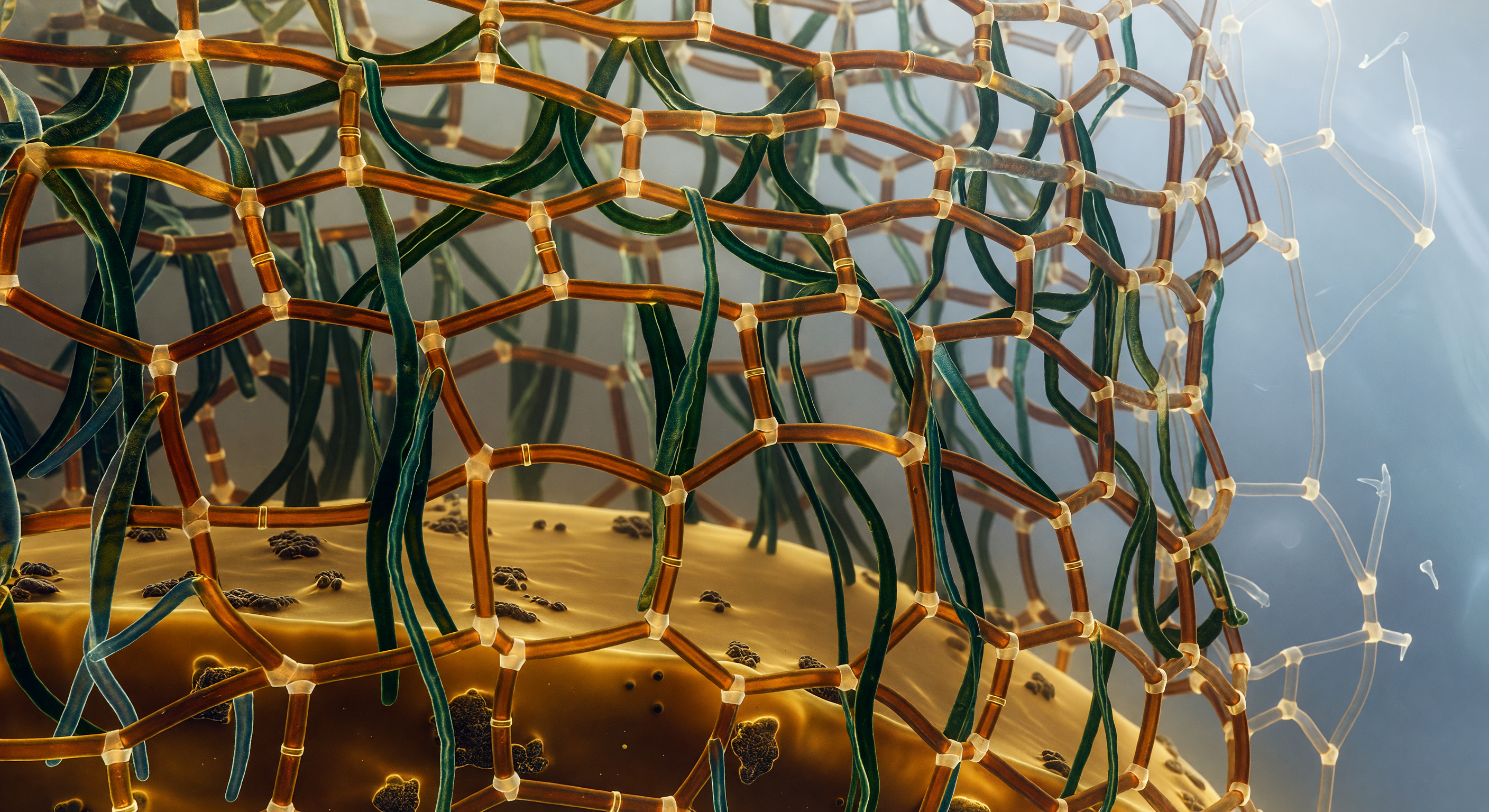
You are standing inside the wall of a living bacterium, looking outward through one of the densest biological architectures that life has ever built. What surrounds you in every direction is the peptidoglycan layer of *Bacillus subtilis* — a Gram-positive species that constructs its wall not as a single membrane but as a compressed, multi-layered fortress twenty to eighty nanometers thick, a structure whose depth, at this scale, feels like the interior of a cathedral made from interlocking organic masonry. The glycan strands stretch as long, warm amber rods cross-linked at irregular intervals by shorter peptide bridges, each junction a covalent bond holding compressive turgor pressure that could rupture the cell in milliseconds if the architecture failed — inside *B. subtilis*, internal osmotic pressure reaches several atmospheres, and this amber lattice is the only thing resisting it. Threading between the glycan rungs, the teichoic acid chains hang as dark sinuous polymers, their dense anionic charge shaping the wall's electrostatic environment, regulating divalent cation binding and controlling access by antimicrobial peptides that approach from the pale-blue extracellular world dissolving above. Deep below, the phospholipid inner membrane shimmers in amber warmth, studded with protein complexes that remain invisible from this vantage — and beyond the ragged outer frontier of the wall, where the last glycan threads fray into nothing, the cool aqueous medium opens into a diffuse, luminous void where the bacterium meets its world.
Other languages
- Français: Intérieur Forteresse Peptidoglycane
- Español: Interior Fortaleza Peptidoglicana
- Português: Interior da Fortaleza Peptidoglicana
- Deutsch: Peptidoglykan Festung Innen
- العربية: داخل حصن الببتيدوغليكان
- हिन्दी: पेप्टिडोग्लाइकन किले का भीतर
- 日本語: ペプチドグリカン要塞の内部
- 한국어: 펩티도글리칸 요새 내부
- Italiano: Interno Fortezza Peptidoglicano
- Nederlands: Peptidoglycaan Vesting Interieur