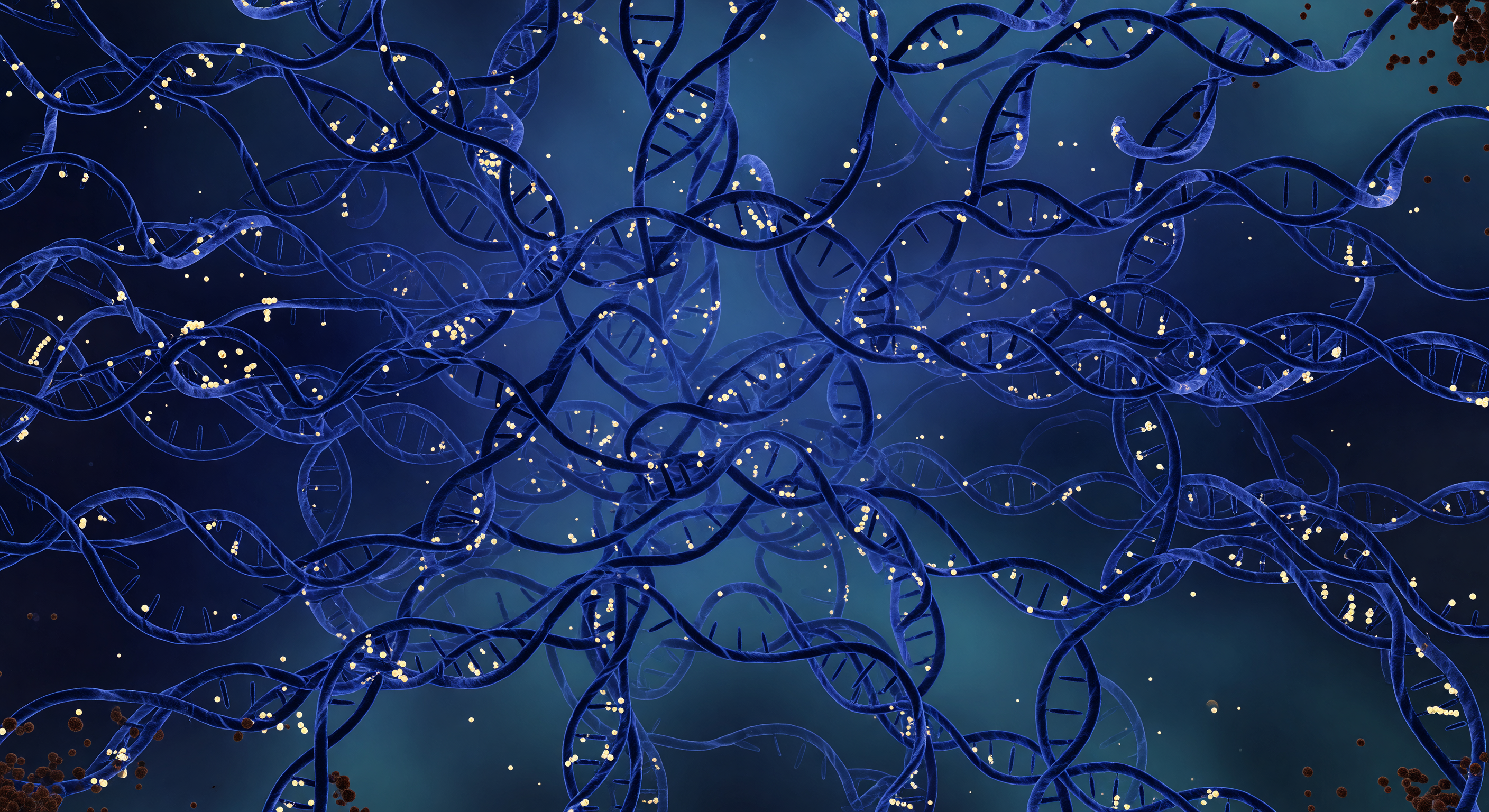
Floating at the geometric center of a living *E. coli* cell, you are engulfed by a fractal storm of plectonemically supercoiled DNA that loops and re-loops in every direction, filling the entire visual sphere with dense navy-blue braided ropes no wider than a few nanometers yet collectively occupying a compressed cubic micron of space — the bacterium's nucleoid, holding roughly 4.6 million base pairs of chromosome folded into a volume smaller than the wavelength of visible light. The fibers radiate a sourceless cobalt luminance outward, bathing the environment in cold indigo gradients that deepen toward violet in the most entangled depths, while warm yellow-white beads of nucleoid-associated proteins — HU and Fis — clasp every sharp plectonemic bend, kinking the DNA into organized pleats and returning the blue glow as amber-gold constellations distributed through the cloud like embedded stars in nebular gas. The intervening medium is no empty solvent but a crowded, gel-like cytoplasm at roughly 300 mg/mL protein concentration, where molecular crowding and Brownian forces utterly replace gravity as the dominant physics, and the aquamarine haze between adjacent supercoil loops — separated by mere tens of nanometers — carries the refractive quality of smoky glass. Only at the nucleoid's outermost margin, where the DNA thins and cytoplasm reasserts itself near the inner membrane, do the dark cinder-brown spheres of ribosomes appear, soft and slightly out of focus, hovering in the transitional zone between organized genetic architecture and the wider cellular machinery beyond.
Other languages
- Français: Plongée Nuage ADN Nucléoïde
- Español: Inmersión Nube ADN Nucleoide
- Português: Mergulho Nuvem DNA Nucleoide
- Deutsch: Nukleoid DNA Wolken Tauchgang
- العربية: غوص سحابة نووي DNA
- हिन्दी: न्यूक्लियॉइड DNA बादल गोता
- 日本語: ヌクレオイドDNA雲潜航
- 한국어: 뉴클레오이드 DNA 구름 탐험
- Italiano: Tuffo Nube DNA Nucleoide
- Nederlands: Nucleoïd DNA Wolk Duik