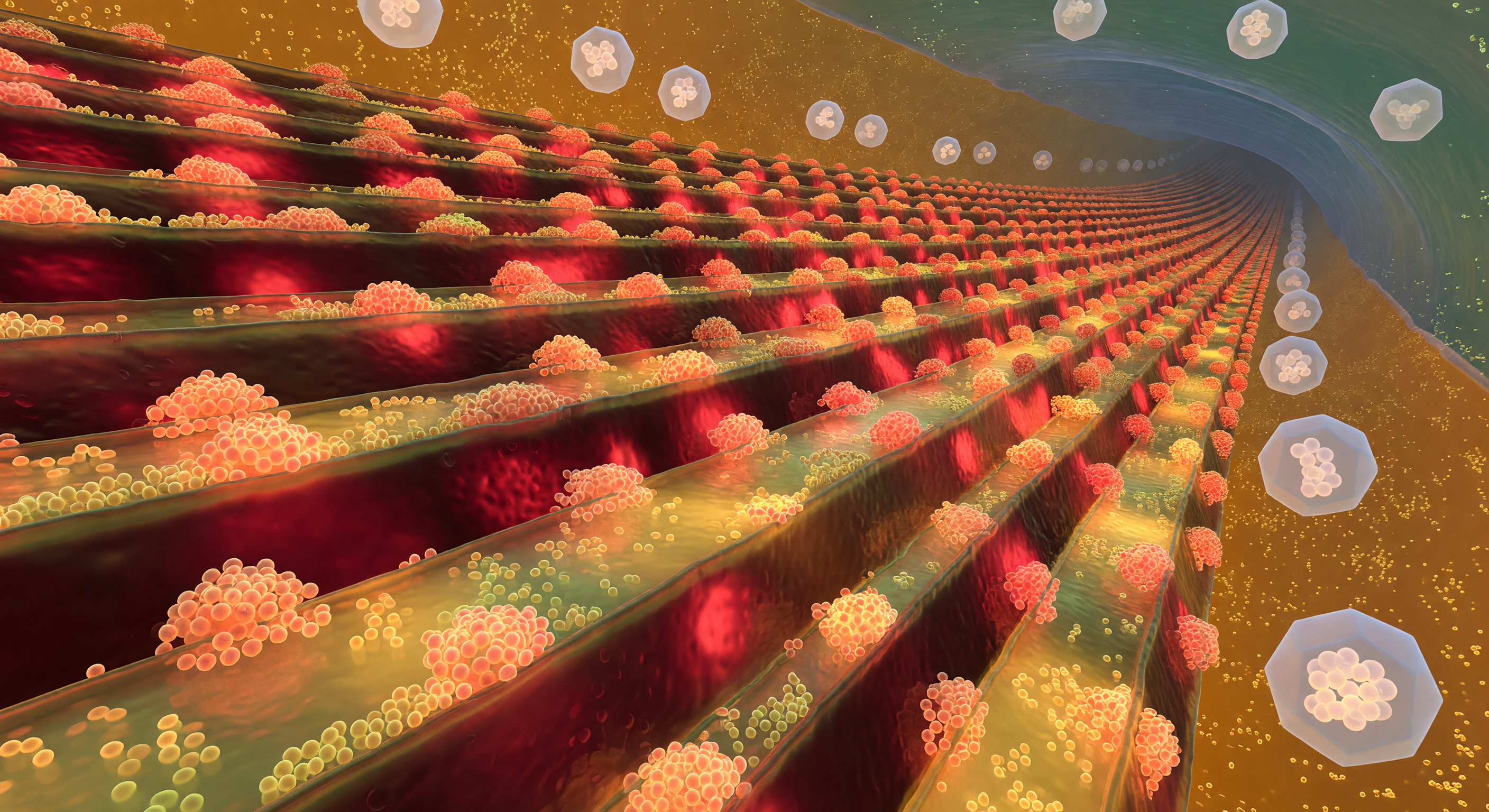
You are standing inside a living cell, suspended within a cathedral of stacked membrane sheets that curve away in every direction, their surfaces burning with a deep wine-red luminescence born of chlorophyll molecules embedded in the bilayer itself. Each membrane is encrusted with hemispheric phycobilisome antenna complexes — coral-orange and saffron domes crowding together like baroque ornaments — that harvest light energy and funnel it into the photosynthetic machinery below, while the narrow lumenal corridors between membrane sheets glow amber-gold with electrochemical gradients driving ATP synthesis. Drifting in the surrounding cytoplasm, icosahedral carboxysome shells hover like frosted lanterns, their pale faceted walls enclosing dense clusters of RuBisCO enzymes that fix carbon dioxide into organic matter, a chemistry that oxygenated Earth's atmosphere over two billion years ago and made complex life possible. The cytoplasm itself is not a clear fluid but a crowded amber gel — ribosomes, proteins, and nucleic acids packed so densely that molecules diffuse as if through warm resin, every cubic nanometer contested. At the cell's far boundary, a faint teal luminescence bleeds through the plasma membrane from the aquatic world outside, the entire scene self-lit from within, a photosynthetic engine no more than a few micrometers across that converts sunlight into the biochemical currency sustaining nearly every food web on the planet.
Other languages
- Français: Rayonnement Thylakoïde Cyanobactérien
- Español: Resplandor Tilacoide Cianobacteriano
- Português: Radiância Tilacoide Cianobacteriana
- Deutsch: Thylakoid-Leuchten der Cyanobakterie
- العربية: إشعاع الثايلاكويد الزرقاء
- हिन्दी: सायनोबैक्टीरियम थायलाकॉइड प्रभा
- 日本語: シアノバクテリア チラコイド輝き
- 한국어: 시아노박테리아 틸라코이드 광채
- Italiano: Radiosità Tilacoide Cianobatterica
- Nederlands: Cyanobacterie Thylakoïd Glinstering