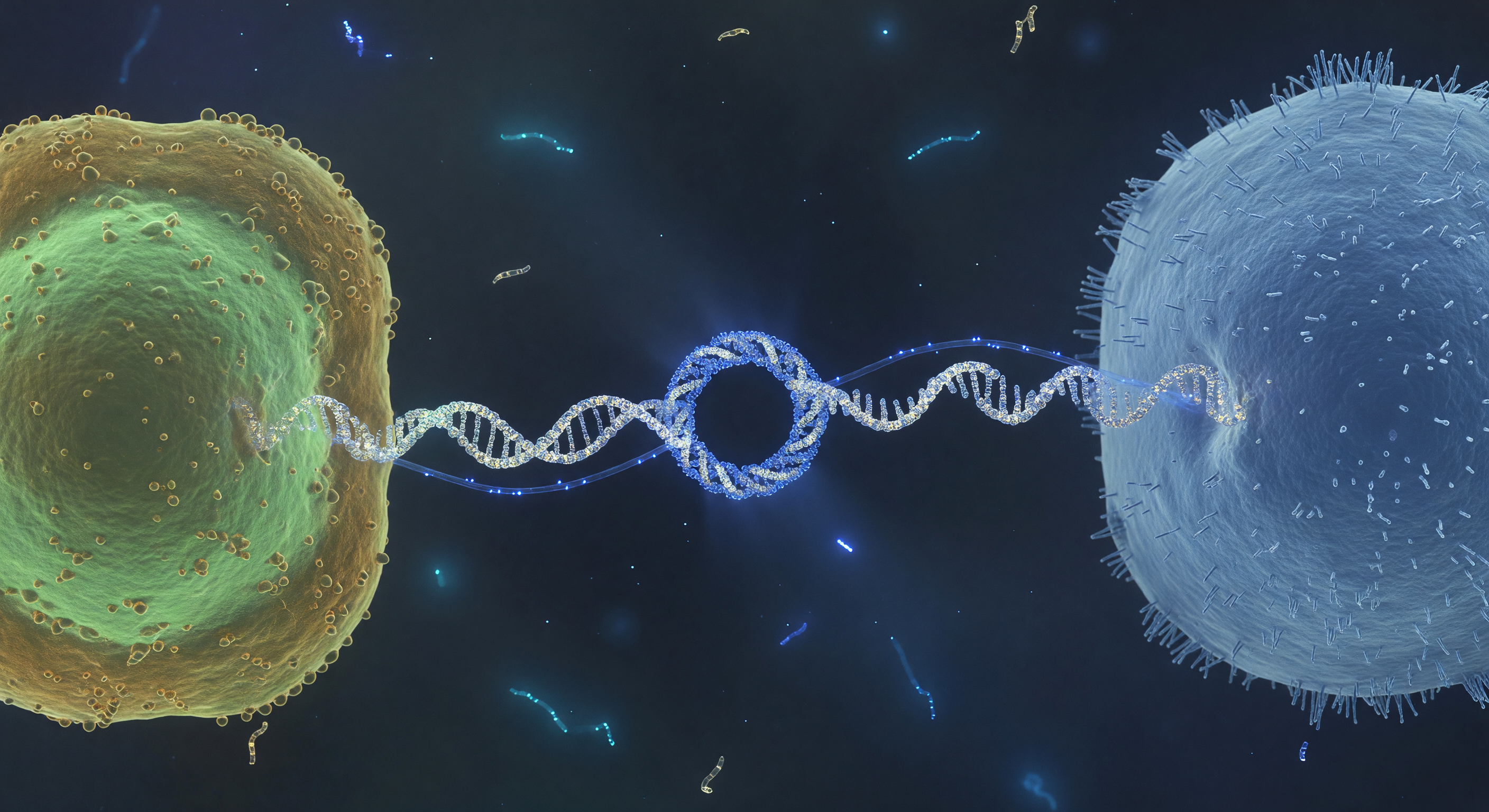
You hover at the midpoint of something that should not exist at this scale — a taut, luminous cable no wider than eight protein subunits, stretched across the gulf between two living worlds. The pilus is a conjugative type IV structure, a helical polymer of pilin subunits assembled and extended through the donor's inner and outer membranes, capable of retraction as well as extension, its architecture evolved not for locomotion but for molecular intimacy: it draws recipient and donor into direct membrane contact, collapsing the distance until the conjugative pore — a 20-nanometer docking annulus of multiprotein relaxosome and mating-pair stabilization complexes — aligns across both envelopes and opens a channel through which a single-stranded DNA copy of the plasmid threads, nicked at its origin of transfer and piloted by a relaxase enzyme covalently bound to its leading end. What moves through that channel now is not passive diffusion but a directed, ATP-powered translocation event — the electric-blue filament pulsing from donor to recipient is a strand of mobilizable DNA crossing a biological border in real time, carrying cargo that may include antibiotic resistance genes, virulence factors, or metabolic innovations, a horizontal transfer event of the kind that has reshuffled bacterial genomes across geological time. In the surrounding fluid, the low Reynolds number regime makes the aqueous medium feel viscous and absolute, thermal fluctuations registering as a ceaseless molecular tremor at every surface, while the ghostly cyan wisps drifting in the far background — free plasmid fragments or degraded nucleic acids tumbling under Brownian bombardment — remind us that this intimate handshake unfolds inside a molecular ocean where information and material are always in motion, always available to be captured.
Other languages
- Français: Pont de Conjugaison Bactérienne
- Español: Puente de Conjugación Genética
- Português: Ponte de Conjugação Genética
- Deutsch: Konjugationsbrücke Gentransfer
- العربية: جسر الاقتران النووي
- हिन्दी: संयुग्मन सेतु जीन स्थानांतरण
- 日本語: 接合橋遺伝子移送
- 한국어: 접합 다리 유전자 전달
- Italiano: Ponte di Coniugazione Genetica
- Nederlands: Conjugatiebrug Genoverdracht