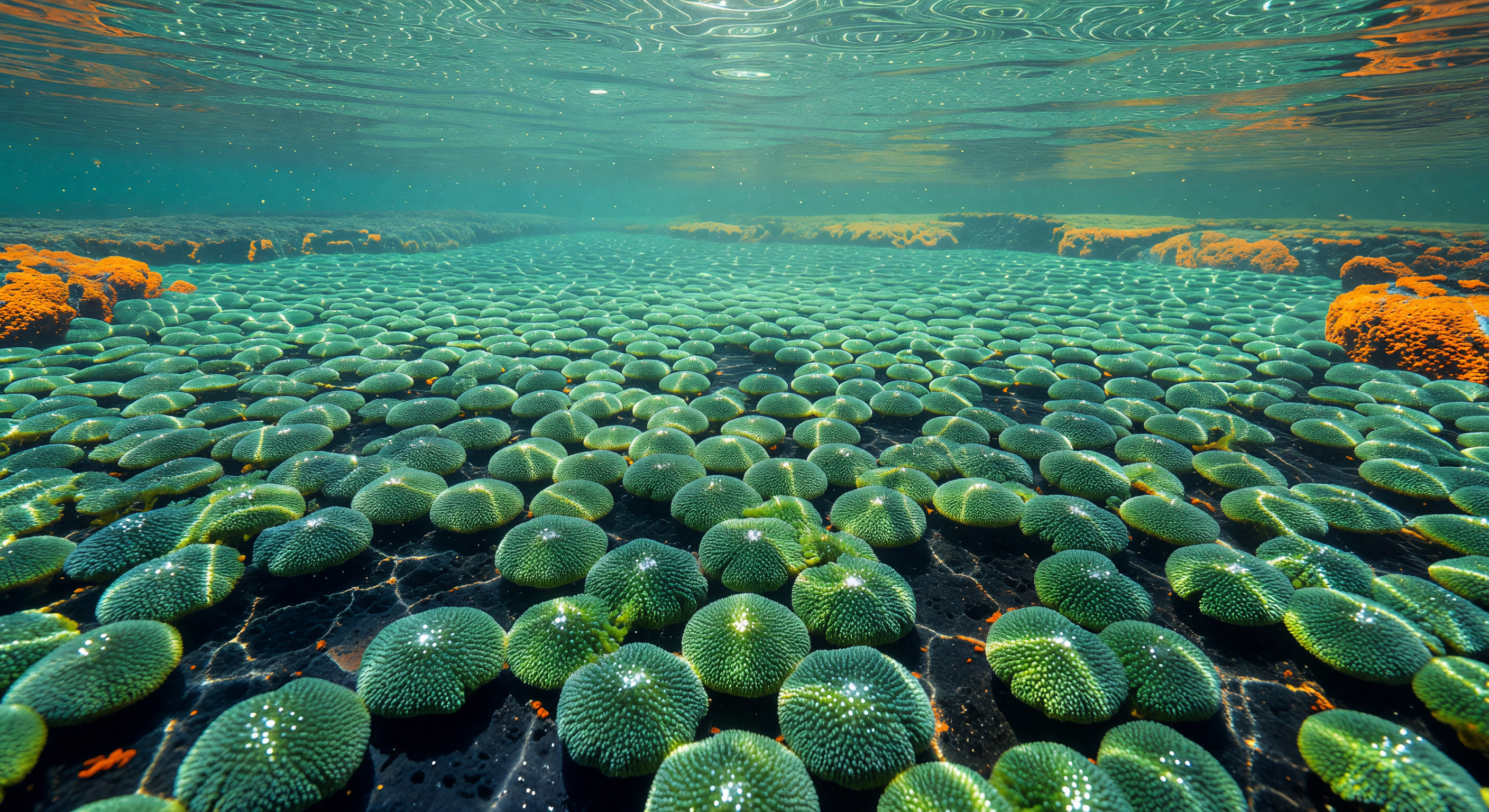
You are gazing down through four centimeters of mirror-still tidepool water at a living landscape that belongs, impossibly, to a single cell — or rather, to thousands of them, each one the size of a small seed yet here reading as boulders in a cobblestone terrain that stretches across coal-black basalt toward an amber fringe of encrusting sponge. The carpet below is *Caulerpa racemosa*, a siphonous green alga whose entire sprawling thallus — holdfast, stolon, and every one of these tightly packed spherical ramuli — exists as one continuous coenocytic cytoplasm enclosed by a single plasma membrane, no internal walls dividing the flowing greenness within. Noon caustics shiver and lock and dissolve across the glaucous blue-green surface, threads of refracted light tracing the microstructure of the water's skin before dissolving into the ambient teal luminescence of the pool, while each sphere catches its own hard white specular point so that the whole colony glitters like a field of frosted glass beads. What the eye receives as topography — hills and shadow crevices, the matte powder of the bloom against the wet gleam of the inner curve, the deep cobalt shadows where ramuli press against one another — is cytoplasm and chloroplast and turgor pressure made architectural, a single organism wearing the convincing costume of a landscape.
Other languages
- English: Racemosa Grapes in Sunlit Rockpool
- Français: Raisins de mer en vasque ensoleillée
- Español: Uvas de mar en charco soleado
- Português: Uvas marinhas em poça iluminada
- Deutsch: Meeresraupen im sonnigen Felsbecken
- العربية: عنب البحر في بركة مشمسة
- 日本語: 陽光の潮だまりの海ぶどう
- 한국어: 햇살 조수웅덩이의 바다포도
- Italiano: Uva di mare in vasca soleggiata
- Nederlands: Zeedruiven in zonnige rotspool